In Part 1, we mapped every layer of Tamil Nadu’s government — from the Chief Minister at Fort St George to the ward member in your neighbourhood. Structure. Names. Escalation paths. Complaint templates. The full floor plan.
But knowing the floor plan doesn’t fix a leaking roof.
The system we mapped has a fundamental problem: it works on paper but breaks in practice. Citizens don’t file complaints because the process is opaque. Officers don’t act on complaints because they’re buried in noise. Both sides are failing — not out of malice, but out of friction.
This is where AI enters. Not to replace the structure, but to make it actually function. To turn a citizen’s frustration into a properly-routed, properly-formatted complaint that lands on the right desk — and to give the officer on that desk the tools to see what’s broken, what’s urgent, and what’s been ignored.
The two-sided AI pattern
Every civic transaction has two parties with different bottlenecks. AI doesn’t replace either side — it removes friction for the citizen and adds signal for the officer.
The citizen’s bottleneck: Friction
Trouble describing the problem clearly. Trouble routing it to the right office. Trouble filing in the right format. Trouble following up across departments. The citizen experience is: “I don’t know who to call, and when I do call, nothing happens.”
The officer’s bottleneck: Signal-to-noise
Trouble receiving complaints at volume. Trouble triaging what’s urgent vs. routine. Trouble verifying claims without field visits. Trouble prioritizing across hundreds of open tickets. The officer experience is: “Everything is urgent and nothing has enough detail.”
Done well, the citizen experiences “this just worked” and the officer experiences “the system now actually shows me what’s broken.”
Interactive: AI Integration Across All 10 Escalation Paths
Explore how AI removes friction on the citizen side and adds signal on the officer side — for each of the ten real-world escalation scenarios.
One citizen agent, not ten apps
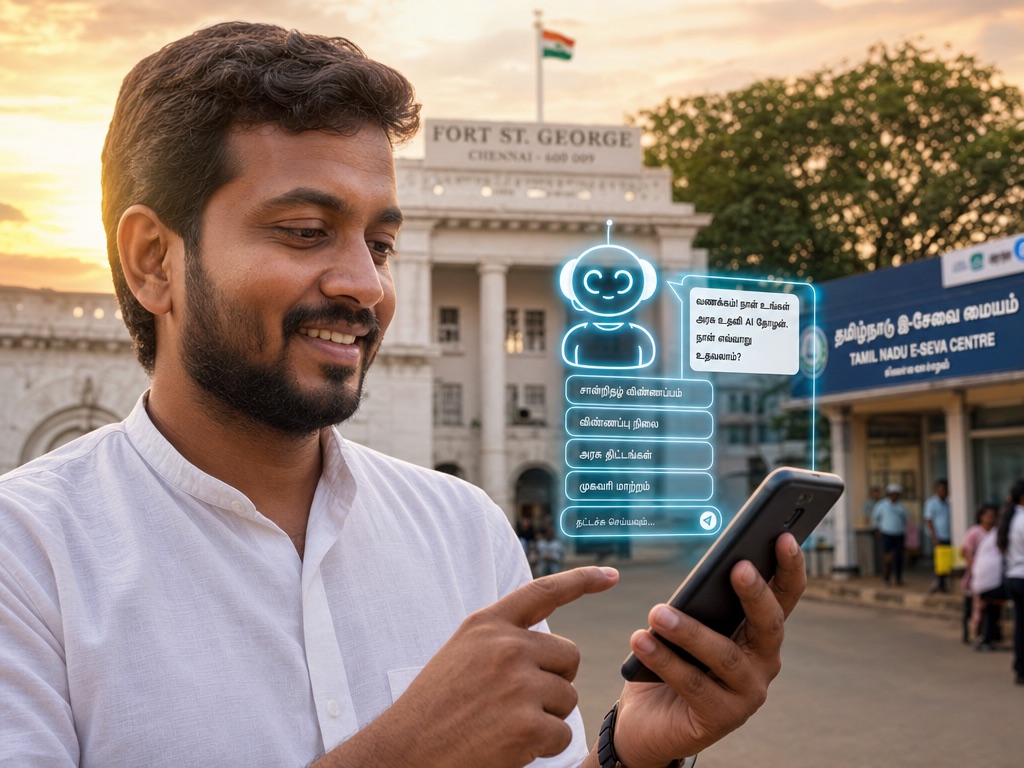
Look at all ten escalation paths from Part 1 and one thing becomes obvious: every citizen is doing the same five things, just in different domains. Triage. Draft. File. Track. Escalate. So the highest-leverage AI play isn’t ten separate apps — it’s one citizen agent, channel-agnostic, that handles every kind of issue.
| Capability | What It Means |
|---|---|
| Triage | “My power is out and there’s a fallen wire” → the agent distinguishes between a TANGEDCO outage and a police emergency; routes to 1912 and 100 simultaneously. |
| Draft | Tamil voice → properly-formatted complaint with all required fields, location, prior reference number, photo evidence attached. |
| File | Submits via the right channel — CM Helpline portal, e-Sevai, departmental API, WhatsApp, or opens the relevant phone call. |
| Track | Listens to status across all open tickets. Normalizes statuses across departments. Sends proactive nudges to the citizen. |
| Escalate | When SLA is breached, auto-drafts the next-level complaint with the prior ticket attached. Asks the citizen to confirm before sending. |
This is technically modest — voice ASR (Tamil), an LLM router, departmental API connectors, a state store per citizen. Multi-agent in the back, single conversation in the front. WhatsApp + voice covers approximately 90% of Tamil Nadu.
Citizens stop maintaining the mental map of which office handles what. The agent does. That alone reduces the load on the CM Helpline by an order of magnitude — because most 1100 calls today are routing questions with known answers.
Interactive: Citizen AI Dashboard Mockup
See what a real citizen experience looks like — Priya Selvam’s active complaints, SLA tracking, AI-suggested next steps, and one-tap escalation.
Government AI by layer — each tier needs different tools
Generic AI dashboards fail because they assume one persona. A BDO in a block office and a Secretary at Fort St George have completely different bottlenecks. The right approach builds for each layer.
Village & Block (Panchayat President, BDO, VAO)
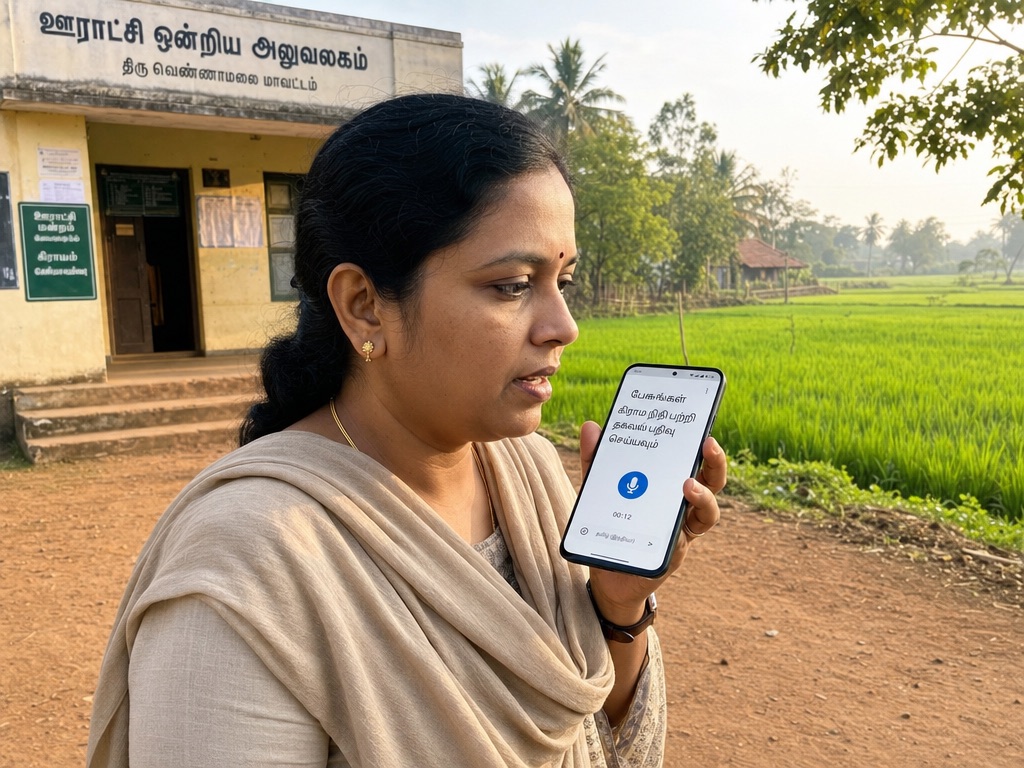
The field. Need: voice-first tools that work on low-bandwidth phones. Photo-based work verification. Lightweight ticketing that doesn’t require typing in English.
The BDO’s day is currently spent on paperwork, supervisory rounds, and reactive complaint-firefighting. Good AI here transcribes their voice notes, geo-stamps their field visits, and auto-generates the weekly report — giving them back 30–40% of their week.
District (Collector, SP, Line Department Heads)
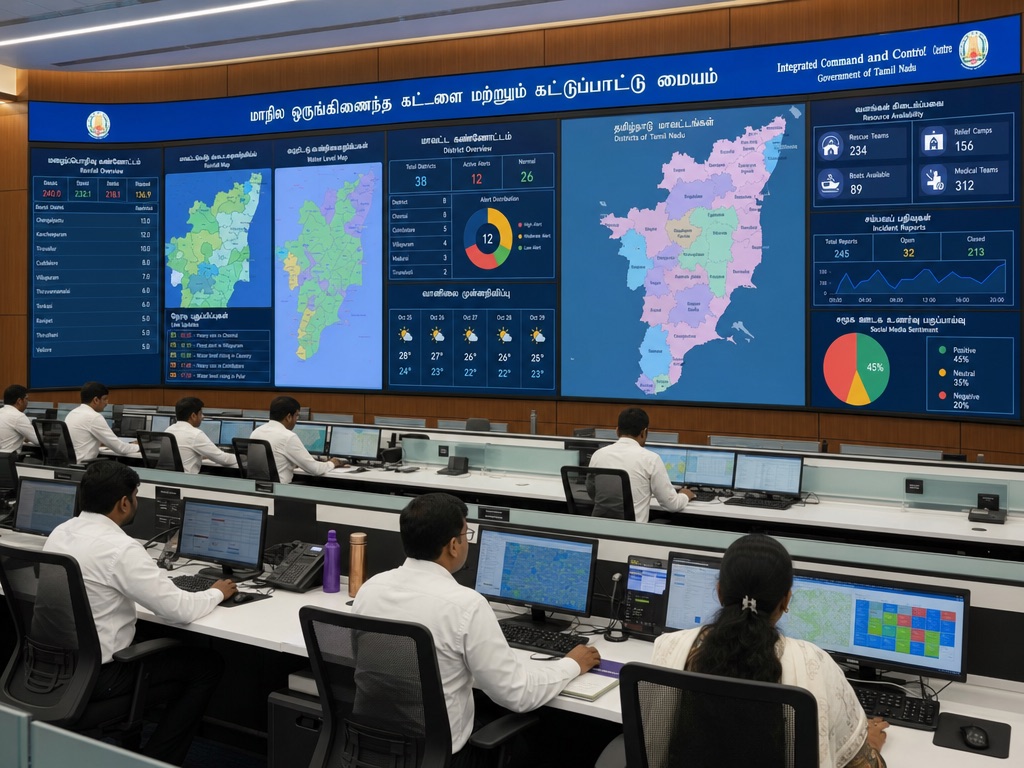
The orchestrator. Need: cross-department aggregation, anomaly surfacing, capacity heat-mapping. The Collector’s job is coordination, and right now they get information through phone calls and weekly meetings.
The right dashboard answers “where is my district failing right now?” by department, with drill-downs. Bonus: monsoon/heatwave/outbreak early-warning fusing IMD + PHC + school attendance data.
State (Department Secretaries, Chief Secretary, Ministers)
The policy and resource allocator. Need: sentiment + theme analytics on the 1100 complaint corpus (millions of texts in Tamil), pattern detection across districts, budget-vs-outcome dashboards by scheme, and cabinet-grade briefings auto-generated from data.
Today this happens through manual report compilation. AI can give the CMO a Monday-morning state-of-the-state in under a minute.
Chief Minister’s Office
Sees everything, cannot act on everything. Need: signal compression. AI that surfaces the 0.1% of complaints that genuinely need CM attention vs. the 99.9% that have correct lower-layer owners. Today this is done by junior staff; AI does it faster, more consistently, and with audit trails.
Interactive: Officer AI Dashboard Mockup
See the officer’s view — Commissioner Sundararajan’s district stats, AI hotspot alerts, complaint-type analysis, zone SLA tracking, and anomaly flags.
AI plays by department
Department-specific opportunities — these are the buckets where pilots are easiest to scope and measure.
| Department | High-Leverage AI Pilots |
|---|---|
| Revenue (CRA) | Document OCR for VAO/Tahsildar, fraud-pattern detection on patta requests, e-Sevai chatbot in Tamil, queue prediction, anomaly scoring on approval rates per officer |
| Police (Home) | Tamil FIR drafting, evidence locker, CCTV natural-language search, beat optimization with bias audits, case-priority scoring, victim support chatbot |
| Health & Family Welfare | Triage chatbot, PHC visit-pattern outbreak detection, drug stockout prediction, diagnostic decision-support for rural medical officers, telemedicine routing |
| School Education | Dropout prediction, AI tutor for free-period use, teacher-vacancy heat-mapping, mid-day-meal supply tracking, parent communication assistant |
| MAWS (Urban Civic) | Photo-classification of civic issues, predictive maintenance for streetlights & pumps, cluster detection for emerging problems, SLA dashboards per ward |
| Rural Development (TNRD) | MGNREGA geo-tagged verification, ghost-worker detection, fund-utilization tracking per panchayat, demand prediction for worksites |
| TANGEDCO | Predictive maintenance, theft detection from meter data, billing-anomaly resolution bot, outage-aware customer communications |
| Civil Supplies (PDS) | Beneficiary fraud detection, supply chain optimization, ration-shop performance scoring, family-card change automation |
| Disaster Management (TNSDMA) | Cyclone & flood early-warning fusion, evacuation routing, post-disaster needs assessment from drone + citizen photo |
| Transport (RTO) | Driving-license + permit chatbot, vehicle-tax anomaly detection, traffic-camera analytics for congestion forecasting |
| Forest & Environment | Encroachment detection from satellite, human-wildlife conflict mapping, pollution-complaint clustering near industrial zones |
The pattern: AI as a force-multiplier on the field officer and a signal-extractor for the supervisor — not a replacement for either.
A reference architecture
Think of it as three planes. Tamil Nadu already has many of the parts — TNeGA (e-Governance Agency), e-Sevai, CM Helpline, departmental portals, Aadhaar + Family Card identity. What’s missing is the bus and the citizen agent on top.
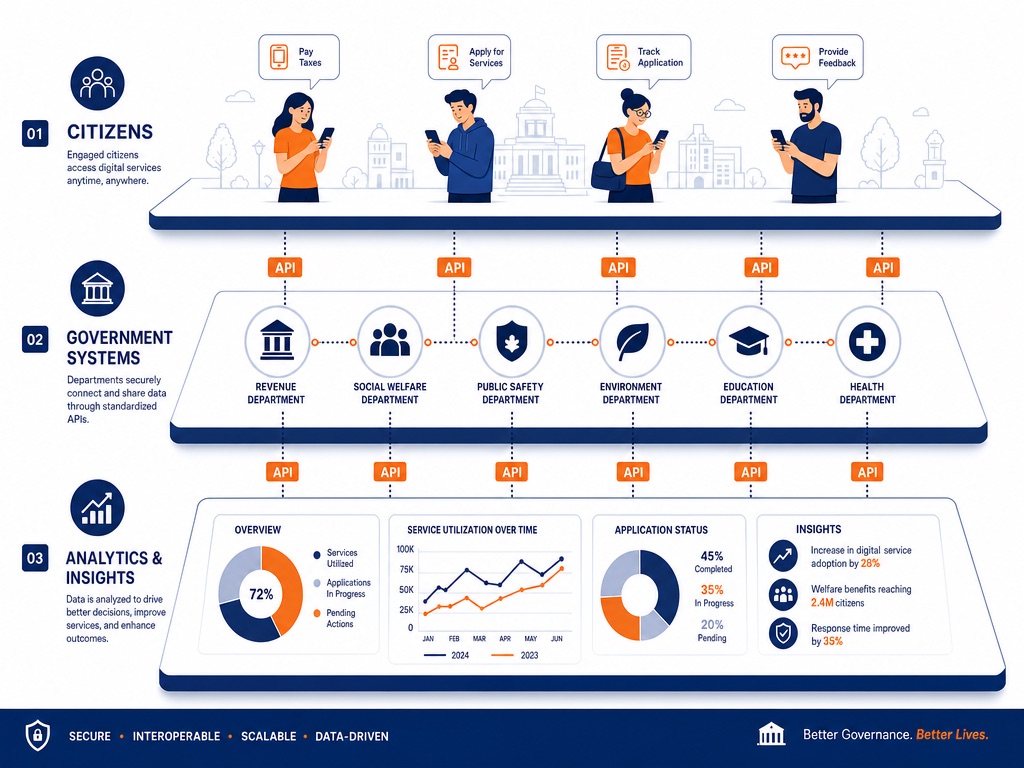
WhatsApp, IVR (Tamil voice), CM Helpline app, departmental apps
All routed through one Citizen Agent that maintains a single conversation per citizen. The citizen never needs to know which department handles what — the agent does the routing.
A common API layer that every department exposes
File complaint, get status, escalate, close, attach evidence. Today each department is its own silo (e-Sevai, TANGEDCO, GCC, TNRD) — the bus normalizes them. This is the missing piece.
Per-department analytics + cross-department correlation + CMO dashboard
Reads from the bus, writes back insights and alerts. Anomaly detection, theme trending, capacity heat-mapping, outbreak early-warning. The state-of-the-state in real time.
Two engineering teams could deliver a working pilot in 6–9 months across 2 districts.
Five pilots that could start tomorrow
If someone wanted to actually make this real, here are the five highest-leverage, easiest-to-scope pilots — each one delivers visible citizen value in a single quarter.
WhatsApp Tamil Civic Agent for one corporation
Start with Coimbatore or Madurai. Photo-based civic complaint filing with auto-routing to ward + 1913-equivalent. Citizen sends a photo of a broken streetlight in Tamil voice → complaint filed, tracked, escalated automatically.
Measure: complaints filed, resolution time, citizen NPS. Pitch lead: MAWS Secretary or Corporation Commissioner.
MGNREGA geo-tagged verification in one block
Field photos + GPS + time → ML model verifies work completion. Cuts ghost-worker fraud, speeds wage release. Works on any smartphone the BDO already carries.
Measure: payment lag, complaint rate. Pitch lead: BDO + DRDA Project Officer.
PHC outbreak early-warning for one district
Aggregate PHC visit reasons + school attendance + medical-shop sales (where data exists). Detect dengue/chikungunya clusters 7–10 days earlier than current passive surveillance.
Measure: early detection rate, response time. Pitch lead: District Health Officer + Director of Public Health.
e-Sevai certificate fraud + queue dashboard for one taluk
OCR cross-check + anomaly scoring on rejection/approval patterns + realistic timeline predictor for citizens. Catches suspicious patterns and gives citizens honest wait-time estimates.
Measure: fraud detection rate, citizen wait time. Pitch lead: Tahsildar + RDO.
1100 Helpline analytics layer
Don’t change the helpline. Just add a Tamil-language analytics layer on top of the existing complaint corpus. Surface trending themes weekly by district, by department. Give the new government a live state-of-the-state without disrupting any existing system.
The most strategic pilot. Pitch lead: TNeGA + CMO.
Where the line stays bright
Two cautions worth stating clearly so the work doesn’t go sideways.
The citizen agent must never be the only channel
Mandatory digital channels exclude the elderly, the poorly literate, the offline poor. Voice + WhatsApp + IVR + human helpline must coexist. AI lowers the floor — it does not raise it. The 1100 phone line, the Collector’s petition day, the e-Sevai centre — all of these stay. AI is a faster lane, not the only lane.
Officer-side AI must be advisory for high-stakes decisions
Predictive policing, dropout flagging, fraud scoring — these are triage tools for human officers, not decision systems. Every consequential action stays in human hands, with logged AI input as one signal among many.
Build the audit trail from day one. Bias audits quarterly. The moment any model is allowed to auto-deny a citizen something, you’ve broken the social contract the government runs on.
AI that works for citizens must be built with the same accountability we demand from the officers it augments.
The connection
Part 1 gave you the map. This Part 2 gives you the engine. The map tells you that a broken streetlight in your ward should go to your councillor, then the zonal officer, then the corporation commissioner. The engine makes that journey take 30 seconds on WhatsApp instead of three weeks of phone calls.
Tamil Nadu has every ingredient. A tech-forward e-governance agency in TNeGA. A functioning CM Helpline. Digital identity through Aadhaar and Family Card. Over 3,500 e-Sevai centres. A new government with the political will to be seen as modern.
What’s missing is the connective tissue — the bus that links departments, and the agent that sits between citizens and the bus. Two engineering teams. Six months. Two pilot districts. That’s all it takes to prove the model.
The question isn’t whether AI can make Tamil Nadu’s government work better. It obviously can. The question is whether the political will exists to build it openly, accountably, and for everyone — not just the digitally fluent.
The floor plan is drawn. The engine is designed. Someone just needs to turn the key.
— VJ
A note on how I write
I am not a writer. I am a person with strong opinions and scattered notes. Every essay on this site started as a messy brain-dump — half-formed arguments, bullet points, and “you know what I mean” — that I hand to an LLM. Another LLM handles the background research needed to find the facts that support an argument. And then it all gets translated into writing far too good for me to pretend is mine. The ideas are mine. The craft is not. They say blogs are dead — but I am falling in love with this. It gives me an outlet for expression that would otherwise have stayed buried in my head. I believe you deserve to know all of that.