Freshness notice
This guide was composed on 12 May 2026 and is not dynamically updated. Office-holder names, local-body counts, and contact details change — always verify at tn.gov.in before formal correspondence. The structure, escalation logic, and complaint process described here remain stable across governments.
Ask the average Tamil Nadu resident who their District Collector is, or which minister handles their water supply problem, and you’ll likely get a blank stare. It’s not that people don’t care. It’s that nobody ever laid out the full picture in a way that’s actually useful.
This blog is that picture. A complete map of who runs Tamil Nadu — from the Chief Minister at Fort St George all the way down to the ward member in your neighbourhood. Not a textbook chapter. A practical guide. Names. Titles. Who to call. Who to escalate to when the first person doesn’t act.
Bookmark this. Share it with your family WhatsApp group. Because the single most powerful tool a citizen has is knowing exactly who is responsible.
Interactive: Explore the Full Government Tree
Search, filter, and expand every layer of Tamil Nadu’s government — state, district, urban, and rural — with roles, contacts, and escalation paths.
Layer 1: The State Government
Everything in Tamil Nadu’s governance flows from Fort St George in Chennai. This is where policy is made, budgets are allocated, and the direction of the state is set. The 2026 state election brought a new government to power, and here are the people at the top.
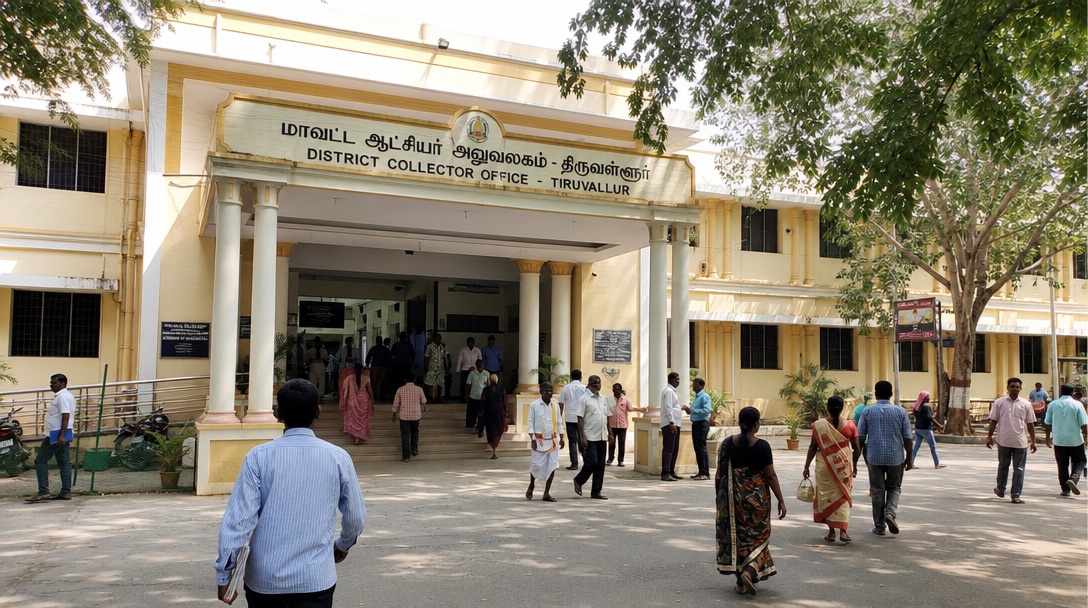
The Executive
Governor of Tamil Nadu
Role: Constitutional head. Appoints the Chief Minister, summons and prorogues the Assembly, gives assent to bills. Largely a ceremonial role, but can return bills and invite parties to form government after elections.
Raj Bhavan: Guindy, Chennai · Web: tnrajbhavan.gov.in
Chief Minister of Tamil Nadu
Role: Leads the Council of Ministers, chairs the Cabinet, sets policy priorities, and controls departmental allocations. The CM’s office drives the direction of the state — from welfare scheme design to infrastructure funding.
Secretariat: Fort St George, Chennai – 600009 · CM Helpline: 1100 (toll-free, 7 am–10 pm, all days) · Portal: cmhelpline.tnega.org
Deputy Chief Minister
Role: When appointed, the Deputy CM assists the CM, handles assigned portfolios, and acts as CM in the Chief Minister’s absence. Typically holds important ministries like Finance or Home. Not every government fills this position; check the latest official gazette notification.
The Legislature
Speaker of the Tamil Nadu Legislative Assembly
Role: Presides over proceedings, applies Assembly rules, maintains order, and decides procedural questions. The Speaker controls the flow of legislative business and ensures debates follow established procedure.
Assembly: 234 MLAs representing constituencies across the state.
Your MLA is your political representative for state-level or unresolved constituency issues. They can raise questions in the Assembly, demand answers from departments, and allocate local development funds.
The Bureaucracy
Elected leaders make policy. Bureaucrats execute it. The permanent civil service — IAS, IPS, and state service officers — is the engine that actually delivers governance on the ground.
| Role | Cadre | What They Do |
|---|---|---|
| Chief Secretary | Senior IAS officer | Top bureaucrat in the state. Coordinates all departments, chairs secretary-level meetings, advises the CM on policy implementation. Holders change with each government — verify current name on tn.gov.in. |
| DGP (Director General of Police) | Senior IPS officer | Heads the entire Tamil Nadu Police force. Responsible for law and order, crime investigation, and police administration statewide. |
| Home Secretary | Senior IAS officer | Handles internal security, police policy, prison administration, and disaster management. |
| Finance Secretary | Senior IAS officer | Controls the state budget, treasury operations, and financial approvals for all departments. |
Note: Senior bureaucratic postings (Chief Secretary, DGP, and department secretaries) change frequently. For the latest names, check tn.gov.in or the official gazette. The roles and reporting structures, however, remain constant.
Layer 2: The Council of Ministers
The Chief Minister doesn’t run every department personally. Ministers are assigned portfolios, and each minister is responsible for the policy and performance of their department. When you have a specific issue — education, healthcare, roads, water — knowing which minister owns it is half the battle.
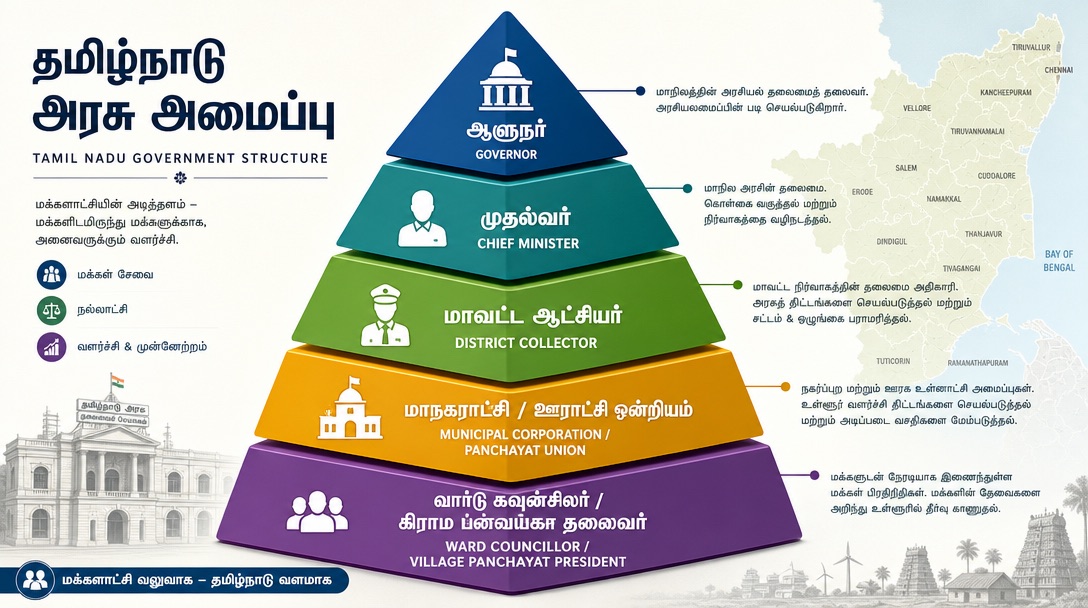
| Portfolio | What Falls Under It | Common Citizen Issues |
|---|---|---|
| Revenue & Disaster Management | Land records, patta transfers, encroachment, natural disaster relief | Land disputes, patta issues, flood/cyclone relief |
| Municipal Admin & Water Supply | City corporations, town panchayats, water supply, drainage | Water shortage, sewage, road maintenance in cities |
| Rural Development & Panchayati Raj | Village panchayats, block development, MGNREGA | Rural roads, village infrastructure, employment guarantee |
| Education | Government schools, teacher appointments, curriculum, mid-day meals | School admissions, teacher vacancies, infrastructure quality |
| Health & Family Welfare | Government hospitals, PHCs, disease control, health insurance | Hospital quality, medicine availability, CM insurance scheme |
| Home (Police) | Law and order, FIR registration, police conduct | Filing complaints, police inaction, seeking protection |
| Highways & Minor Ports | State highway construction, maintenance, toll roads | Road quality, accident-prone stretches, highway expansion |
| Electricity | TANGEDCO, power generation, distribution, tariff | Power cuts, new connections, billing disputes |
The right ministry + the right complaint channel = results. The wrong door = endless runaround.
Layer 3: The District — Where Governance Gets Real
Tamil Nadu has 38 districts, and the District Collector is the most important government official most citizens will ever interact with. The Collector is an IAS officer posted by the state government, and they are essentially the CEO of the district.
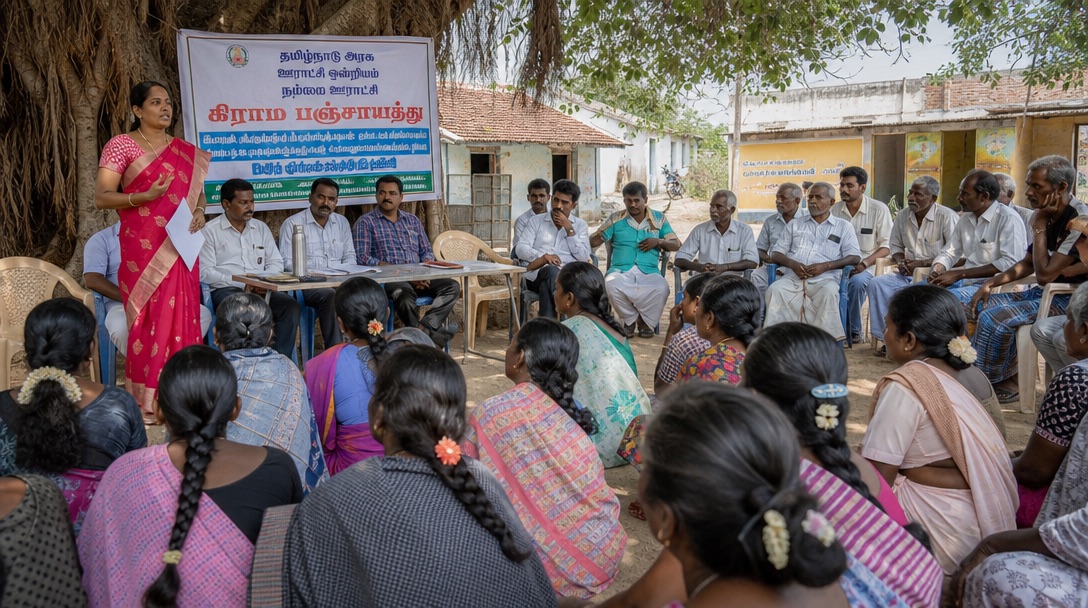
District Collector / District Magistrate
Role: The single most powerful administrator at the district level. Oversees revenue administration, law and order coordination, election management, disaster response, welfare scheme implementation, and development planning. The Collector’s office is the nerve centre of district governance.
Key power: Conducts weekly public grievance hearings (Collector’s petition day) where any citizen can walk in and submit a complaint directly.
Other District-Level Officers
| Officer | Handles | When to Contact |
|---|---|---|
| Superintendent of Police (SP) | All police operations in the district | Police inaction on FIRs, serious crimes, requesting protection |
| District Revenue Officer (DRO) | Land records, patta, chitta, adangal | Land ownership disputes, revenue records correction |
| District Education Officer (DEO) | Government schools in the district | School quality, teacher issues, mid-day meal complaints |
| Joint Director of Health | PHCs, government hospitals, health programs | Hospital complaints, medicine shortage, sanitation |
| District Supply Officer | PDS (ration shops), smart ration cards | Ration card issues, quality of PDS supplies |
| District Social Welfare Officer | Welfare schemes for SC/ST, women, disabled | Scholarship applications, pension issues, scheme enrolment |
Every district has a Collector’s petition day
This is your most direct channel to the highest authority in your district. Usually held weekly (often Monday), you can submit a written petition about any issue. The Collector is obligated to review and route it to the appropriate department for resolution.
- Bring a written petition with your name, address, and issue clearly described
- Keep a copy of the petition and note the diary number assigned
- Follow up after 15 days if you haven’t heard back
- If unresolved, escalate to the Revenue Divisional Officer or the state-level CM Cell
Layer 4: Your City — Corporations, Municipalities, and Town Panchayats
Urban governance in Tamil Nadu operates through three tiers based on population. This is the layer that directly handles your daily quality of life — roads, water, garbage, streetlights, building permits, and property tax.
| Type | Population Threshold | Approximate Count | Head |
|---|---|---|---|
| Municipal Corporation | Above 5 lakh (large cities) | ~25 corporations | Mayor (elected) + Commissioner (IAS officer) |
| Municipality | 50,000 – 5 lakh | Hundreds of municipalities | Chairperson (indirectly elected by councillors) + Commissioner (appointed) |
| Town Panchayat | Below 50,000 (small towns) | Hundreds of town panchayats | Chairperson (indirectly elected by councillors) + Executive Officer |
Counts change as towns are upgraded from town panchayat to municipality or municipality to corporation. Check the Directorate of Town Panchayats and Commissionerate of Municipal Administration for current numbers.
Greater Chennai Corporation (GCC)
Mayor: Indirectly elected by the ward councillors (not directly by voters, in current TN practice). Presides over council meetings and represents the city officially.
Commissioner: IAS officer. The real administrative head. Manages the corporation’s budget, staff, and all civic services.
Ward Councillor: Your most local elected representative in the city. Each of the 200 wards has one councillor who can escalate civic complaints on your behalf.
GCC Helpline: 1913 · App: Namma Chennai · Web: chennaicorporation.gov.in
What your city/municipal body handles
- Water supply and drainage — piped water connections, sewage, stormwater drains
- Roads and streetlights — local road maintenance, new road construction, street lighting
- Solid waste management — garbage collection, waste processing, cleanliness
- Building permissions — plan approval, occupancy certificates, building violations
- Property tax — assessment, collection, grievances
- Birth and death certificates — registration and issuance
- Public health — sanitation, vector control, food safety inspections
Your ward councillor is your local voice. Don’t skip them. They can file complaints, attend standing committee meetings, and push for your area’s needs in the council budget.
Chennai is different
No District Panchayat. Chennai district is fully urban — the rural three-tier panchayat system does not apply within Corporation limits.
The Corporation is huge. Greater Chennai Corporation covers 200+ wards organized into 15 zones, each with a Zonal Officer reporting to the Commissioner. For most issues: Councillor → Zonal Office → Commissioner.
Police is a Commissionerate, not SP-led. Greater Chennai Police is headed by a Commissioner of Police (senior IPS), with the city split into zones each headed by a DCP. Adjacent metro areas (Avadi, Tambaram) also have their own Police Commissionerates.
Interactive: Chennai Government Tree
Explore Chennai’s Corporation, District administration, and Police Commissionerate — expandable nodes with roles and contact paths.
Layer 5: Rural Tamil Nadu — The Three-Tier Panchayati Raj
More than half of Tamil Nadu’s population lives in rural areas. Their governance is structured in three tiers, each with elected representatives and appointed officials. This is the layer closest to the ground — and often the most neglected in civic education.
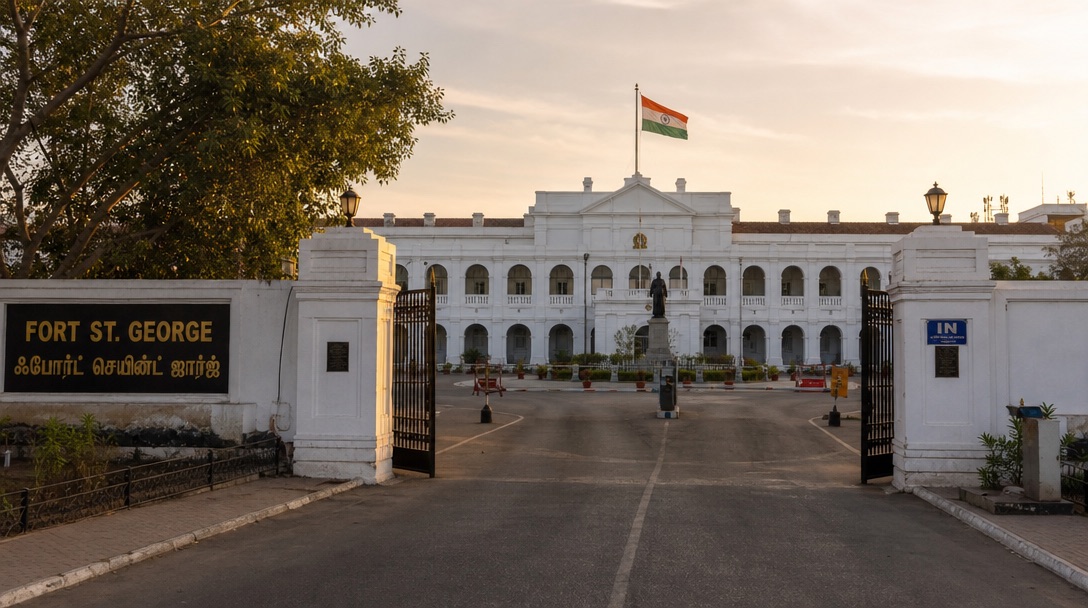
Village Panchayat (Gram Panchayat)
Panchayat President: Directly elected by village voters. Leads the panchayat, chairs meetings, and is the first point of contact for all village-level issues.
Ward Members: Elected representatives for each ward within the village panchayat.
Village Administrative Officer (VAO): Government-appointed official who maintains land records, supports field verification for certificates (income, community, nativity — apply through e-Sevai; the Tahsildar/revenue authority issues them), and assists in revenue matters.
Gram Sabha (கிராமசபை): The assembly of all registered voters in the village panchayat. Meets at least four times a year. Approves budgets, selects scheme beneficiaries, and reviews panchayat accounts. This is direct democracy at its most local — attend these meetings.
Handles: Village roads, drinking water, sanitation, streetlights, burial grounds, public distribution, MGNREGA implementation at village level.
Panchayat Union (Block Panchayat)
Panchayat Union Chairman: Elected indirectly from among panchayat union ward members.
Block Development Officer (BDO): The key bureaucrat at the block level. Coordinates rural development schemes, monitors village panchayats, and acts as the link between villages and the district administration.
Handles: Block-level roads, primary health centres, rural water supply schemes, coordination of MGNREGA, Anganwadi centres, and rural housing.
District Panchayat (Zilla Panchayat)
District Panchayat Chairman: Elected. Presides over district panchayat meetings.
Role: Approves development plans for the district’s rural areas, reviews panchayat union budgets, and advises on inter-panchayat issues. Works in coordination with the District Collector for scheme implementation.
First: Identify the type of problem
Before you call anyone or write a petition, spend 30 seconds classifying your issue. The single biggest reason complaints go unanswered is that they land on the wrong desk. Here’s a quick triage.
Emergency
Call 112 (unified) · 100 police · 108 ambulance · 101 fire · 1091 women · 1098 child.
Civic Issue
Road, streetlight, garbage, drainage, water supply. Go to your ward councillor or corporation helpline.
Revenue / Land Issue
Patta, chitta, adangal, land records, survey, certificates. Start with the VAO or e-Sevai centre.
Welfare Issue
Pension, ration card, scholarship, housing scheme. District Social Welfare Officer or Block Development Officer.
Corruption
Bribery, misuse of power, disproportionate assets. Contact DVAC (see toolkit below).
Information Delay
Government not responding? File an RTI application. Forces a response within 30 days.
Policy / Legislative Issue
Disagree with a policy or need a law changed? Contact your MLA or the relevant minister’s office.
Not Sure? Start Here
Call the CM Helpline 1100 or visit your nearest e-Sevai centre. They’ll route you to the right department.
State vs Central: Don’t knock the wrong door
A common mistake is complaining to the state government about something only the central government handles — or vice versa. Here’s a quick guide.
| State Government Handles | Central Government Handles |
|---|---|
| Police, law and order, local courts | Passports, visa services |
| Land records, patta, registration | Railways (Indian Railways) |
| State highways, local roads | National highways (NHAI) |
| Government schools, state universities | Central universities, IITs, IIMs |
| State hospitals, PHCs | AIIMS, CGHS, ESI hospitals |
| TANGEDCO (electricity) | Income tax, customs, central GST (note: GST notices may come from either central or state tax authorities) |
| PDS, ration cards | Banks (RBI-regulated), telecom (TRAI) |
| Property tax, water tax | Post offices, Aadhaar (UIDAI) |
Rule of thumb: if it involves land, police, local roads, ration, electricity, or local schools — it’s state. If it involves passports, railways, banks, telecom, national highways, or income tax — it’s central.
When things don’t move: Escalation paths that work
Knowing the structure is one thing. Knowing how to push when the system isn’t responding is what separates an informed citizen from a frustrated one. Here are the escalation paths for the most common categories of complaints.
Interactive: 10 Step-by-Step Escalation Paths
Click through each scenario — land disputes, police complaints, civic issues, and more — with step-by-step escalation guidance and action prompts.
Land & Revenue Issues
Step 1: Village Administrative Officer (VAO)
Start here for patta, chitta, adangal, land measurement, and certificate requests.
Step 2: Tahsildar
If the VAO doesn’t resolve it, escalate to the Tahsildar of your taluk. They have authority over land records and can order surveys.
Step 3: Revenue Divisional Officer (RDO)
If the Tahsildar is unhelpful, the RDO oversees multiple taluks and can intervene.
Step 4: District Collector
The Collector’s petition day is your channel. Submit a written complaint referencing your earlier attempts.
Step 5: CM Cell / State Revenue Secretary
If the district fails, file a complaint on the CM’s Special Cell portal or write to the Revenue Secretary at the Secretariat.
Police Complaints
Step 1: Local Police Station (SHO)
File an FIR or complaint with the Station House Officer. If they refuse to register your FIR, that itself is a violation.
Step 2: DSP / Assistant Commissioner
Sub-divisional police head. Can order the SHO to act.
Step 3: Superintendent of Police (SP)
District police head. Can transfer cases, order investigations, take action against erring officers.
Step 4: DGP Office / State Police Complaints Authority
For systemic issues or serious police misconduct.
Step 5: State Human Rights Commission / Court
Last resort for rights violations and serious injustice.
Civic Issues (Water, Roads, Garbage)
Step 1: Ward Councillor / Panchayat President
Your elected local representative. Start here.
Step 2: Corporation/Municipality Helpline
GCC: 1913, other corporations have zone-wise complaint numbers.
Step 3: Corporation Commissioner / Municipal Chairman
Written complaint with photos and previous complaint references.
Step 4: District Collector
Collector’s petition day. The Collector can direct municipal bodies to act.
Step 5: Minister for Municipal Administration
Write to the ministry directly if the district cannot resolve it.
The full escalation matrix — at a glance
One table. Every common issue. First stop, second stop, final escalation.
| Issue | First Stop | Second Stop | Final Escalation |
|---|---|---|---|
| Streetlight / garbage / water (city) | Ward Councillor · 1913 (Chennai) | Zonal Officer | Corporation Commissioner |
| Streetlight / water (village) | Village Panchayat President | BDO | District Collector |
| Patta / land records / certificates | VAO (verification) | Tahsildar (issues) | RDO → Collector |
| Ration card / PDS issue | Taluk Supply Officer | District Supply Officer | Civil Supplies Commissioner |
| Police / FIR / law & order | Police Station (SHO) | DSP / ACP | SP · Comm. of Police · DGP |
| Electricity (TANGEDCO) | Section Office | Assistant Engineer | 1912 · tnebltd.gov.in |
| Government hospital | Block Medical Officer | District Health Officer | Director of Public Health |
| Government school | Headmaster | Block Education Officer | Chief Educational Officer |
| MGNREGA / job card / wages | Village Panchayat | BDO | DRDA Project Officer → Collector |
| Corruption (govt staff) | DVAC for state public servants | Lokayukta for eligible public functionaries | CBI only for central matters or court/state-authorized cases |
| Major issue / no progress | All applicable steps first | District Collector | CM Helpline 1100 |
| Rights violation | SHRC / NHRC for rights complaints | District Legal Services Authority for free legal aid | High Court for writ remedy (with counsel) |
What not to do
- Do not start at the CM for a ward-level issue. A pothole on your street is not a Chief Minister problem. Start at the bottom of the ladder — the Councillor or Village Panchayat President.
- Do not send vague complaints. Always include date, location, photos, and prior complaint numbers. The system cannot act on “the road near my house is bad.”
- Do not confuse political representatives with administrative officers. Your MLA, MP, and Mayor are political reps with influence but not direct executive authority. The Collector, BDO, Commissioner, and Tahsildar are administrative officers with statutory power. Both matter — they work differently.
- Do not assume every issue is a state issue. Railways, passports, income tax, banks, telecom, and national highways are Central Government matters. The CM cannot fix them.
- Do not give up after one closed complaint. Escalation only works if you have evidence of the previous attempt — keep complaint numbers, screenshots, and acknowledgment emails.
Your toolkit: Helplines, portals, and how to file
The Tamil Nadu government has built significant digital infrastructure for citizen complaints. The problem is that most people don’t know these exist. Here are the channels every citizen should have bookmarked.
Your complaint template
Whether you’re submitting a petition at the Collector’s office, writing to the CM Cell, or emailing a department — use this format. A well-structured complaint gets routed faster and taken more seriously.
Standard Complaint Format
Helplines, portals, and contacts
CM Helpline
File complaints routed to the Chief Minister’s office. Get a tracking number for follow-up.
Phone: 1100 (toll-free, 7 am–10 pm)
Web: cmhelpline.tnega.org
e-Sevai Centres
One-stop shops for government certificates, applications, and bill payments. Over 3,500 centres statewide.
Services: Income/community/nativity certificates, pension applications, ration card updates
Emergency Numbers
All available 24/7 across the state.
Unified: 112 · Police: 100 · Ambulance: 108
Fire: 101 · Women: 1091 · Child: 1098
Disaster: 1077 · Cyber crime: cybercrime.gov.in
TANGEDCO (Electricity)
Power outage reporting, new connections, billing disputes, and meter complaints.
Helpline: 1912
Web: tangedco.gov.in
TWAD Board (Rural Water)
Drinking water supply issues in rural areas. Also handles water quality testing.
Web: twadboard.tn.gov.in
Right to Information (RTI)
Any citizen can file an RTI application to demand information from any government department. ₹10 fee.
Web: rti.tn.gov.in
DVAC (Anti-Corruption)
Directorate of Vigilance and Anti-Corruption. Report bribery, misuse of power, disproportionate assets by government officials. Escalates to the Vigilance Commissioner and Lokayukta.
Phone: 044-2232 1090 / 2232 1085 / 2231 0989 / 2234 2142
Email: dvac@nic.in · Web: dvac.tn.gov.in
Pro tips for getting things done
- Always get a receipt number. Whether it’s a police complaint, a corporation grievance, or a CM Cell petition — get a written acknowledgment with a number you can reference.
- Document everything. Take photos, save screenshots, keep copies. When you escalate, attach your previous complaint references.
- Use the right channel. A land patta issue shouldn’t go to the police. A sewage problem shouldn’t go to the Tahsildar. Matching the issue to the right department saves weeks.
- Follow up in 15 days. Most government departments have a 15-day resolution norm. If you don’t hear back, escalate to the next level with your original complaint number.
- RTI is your superpower. If a department is stalling, file an RTI asking for the status of your complaint. It forces them to respond within 30 days by law.
The big picture: Why this matters
Democracy doesn’t fail because of bad leaders alone. It fails when citizens don’t know how to hold leaders accountable. And accountability starts with knowing who is responsible for what.
Most people in Tamil Nadu interact with the government only when they need something — a certificate, a ration card, a road repair. And most of those interactions are frustrating because people don’t know the right door to knock on, the right person to escalate to, or the right channel to file through.
This guide exists to change that. Knowing the structure isn’t about memorizing org charts. It’s about understanding that every level of government has a person with a name, a role, and a phone number — and that person is answerable to you.
An informed citizen isn’t a nuisance. An informed citizen is exactly what democracy was designed for.
Share this with your family. Send it to your neighbourhood group. Print it and pin it on a notice board if you have to. Because the next time your street floods, or your patta is stuck, or the police won’t file your FIR — you’ll know exactly who to call, who comes next, and how to make the system work for you.
Sources & Official Links
tn.gov.in — Tamil Nadu Government portal (officeholders, departments)
cmhelpline.tnega.org — CM Helpline 1100 (complaints & tracking)
tnrajbhavan.gov.in — Raj Bhavan / Lok Bhavan (Governor’s office)
assembly.tn.gov.in — Tamil Nadu Legislative Assembly
tnrd.tn.gov.in — Rural Development & Panchayat Raj
tnesevai.tn.gov.in — e-Sevai (online citizen services)
eservices.tn.gov.in — Land records (patta, chitta)
tnsec.tn.gov.in — Tamil Nadu State Election Commission (local body elections)
chennaicorporation.gov.in — Greater Chennai Corporation
dvac.tn.gov.in — Directorate of Vigilance & Anti-Corruption
rti.tn.gov.in — Right to Information (Tamil Nadu)
tnebltd.gov.in — TANGEDCO (electricity)
Democracy is not a spectator sport. Know the players. Know the rules. Play your part.
— VJ
A note on how I write
I am not a writer. I am a person with strong opinions and scattered notes. Every essay on this site started as a messy brain-dump — half-formed arguments, bullet points, and “you know what I mean” — that I hand to an LLM. Another LLM handles the background research needed to find the facts that support an argument. And then it all gets translated into writing far too good for me to pretend is mine. The ideas are mine. The craft is not. They say blogs are dead — but I am falling in love with this. It gives me an outlet for expression that would otherwise have stayed buried in my head. I believe you deserve to know all of that.