
How to read this essay: This is written as a futuristic 2029 essay. Baseline numbers use currently available Tamil Nadu fiscal and economic data (FY 2025–26). All 2029 outcomes are synthetic projections for storytelling and policy imagination — not predictions. Sources for baseline figures are listed at the end.
In 2026, Tamil Nadu was already one of India’s great economic machines.
Its 2025–26 GSDP was projected at ₹35.68 lakh crore. Its annual expenditure, excluding debt repayment, stood at ₹4.39 lakh crore. Its fiscal deficit was targeted at ₹1.07 lakh crore, or 3% of GSDP. Its debt was projected at roughly ₹9.30 lakh crore, about 26.07% of GSDP.
The state was strong, but stretched.
It had world-class manufacturing, deep welfare systems, ports, textiles, electronics, automobiles, colleges, hospitals, MSMEs, and a globally connected workforce. But it also had friction: delayed approvals, unresolved complaints, repeated inspections, department silos, welfare leakage, infrastructure bottlenecks, and citizens forced to chase files across offices.
Then Tamil Nadu made a decision that changed its trajectory.
It did not treat AI as a chatbot.
It treated AI as state infrastructure.
By 2029, Tamil Nadu had become India’s first true AI-governed productivity state.
Not because machines replaced people. But because government, industry, citizens, and officers finally began to move on the same live map.
The 2026 Starting Line
Tamil Nadu did not begin from weakness. It began from scale.
In 2024, the Global Investors Meet brought investment commitments of ₹6.64 lakh crore, with potential for 26.9 lakh jobs. Electronics exports hit $14.65 billion in FY25, giving Tamil Nadu more than 41% of India’s electronics exports. Textile exports touched nearly $8 billion, making the state India’s leading textile exporter.
But there was one question hanging over all of it:
Could Tamil Nadu convert promise into execution?
AI became the answer.
The 2029 Scoreboard
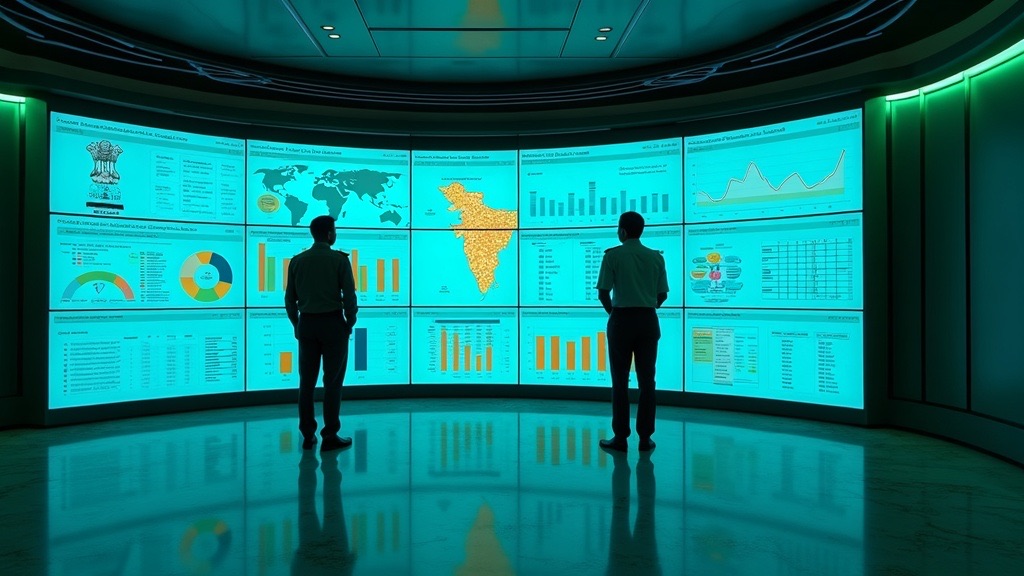
By 2029, synthetic projections show what the AI productivity effect looked like:
| Metric | 2025–26 Baseline | 2028–29 Synthetic |
|---|---|---|
| Nominal GSDP | ₹35.68 lakh crore | ₹59.8 lakh crore |
| Annual budget size | ₹4.39 lakh crore | ₹6.85 lakh crore |
| Own tax revenue | ~₹2.21 lakh crore | ₹4.05 lakh crore |
| Fiscal deficit | 3.0% of GSDP | 2.35% of GSDP |
| Debt-to-GSDP | 26.07% | 22.8% |
| Capital expenditure | ₹65,333 crore | ₹1.48 lakh crore |
| New formal jobs enabled | Baseline | 38 lakh+ |
| Realized investment pipeline | GIM MoUs + new FDI | ₹9.7 lakh crore |
| Citizen service time saved | Baseline | 48 crore hours/year |
This was not growth by announcement. It was growth by removal of friction.
Tamil Nadu became the state where things moved.
Citizen AI: The End of the Office Chase
Before Citizen AI, a person with a problem had to know the system.
After Citizen AI, the system understood the person.
A farmer could speak into WhatsApp in Tamil: “My crop compensation has not come.” A mother could say: “The PHC has no doctor.” A small business owner could ask: “Why is my license delayed?” A pensioner could ask: “Why did my payment stop?”
Citizen AI classified the issue, checked eligibility, filed the complaint, found the department, gave a tracking number, explained the escalation path, and reminded the citizen before the deadline.
By 2029, the synthetic numbers were staggering:
This was Tamil Nadu’s first productivity dividend.
Every hour not spent standing in a government corridor became an hour returned to farming, work, business, education, or family.
Officer AI: From Files to Foresight
Citizen AI helped people speak.
Officer AI helped government hear.
Earlier, 500 complaints meant 500 files. By 2029, Officer AI could say:
These 500 complaints are actually 42 problem clusters. Four are urgent. Seven are duplicate campaigns. One is likely fraud. Three indicate contractor failure. Two may become law-and-order issues if ignored.
For a Corporation Commissioner, Officer AI showed streetlight clusters, water-pressure drops, garbage route failures, drainage choke points, property-tax anomalies, and building-permit delays.
For a District Collector, it showed ration-shop patterns, school infrastructure gaps, PHC medicine stockouts, welfare delays, and taluk-level bottlenecks.
This was not merely administrative reform. It was economic reform.
A faster state is a richer state.
Business AI: The License Raj Meets Its Replacement
The biggest GDP jump came from a simple insight: the same AI logic that routed citizen complaints could route business approvals. Remember the escalation paths from Part 1? Every citizen was doing five things — triage, draft, file, track, escalate. So was every MSME owner, every factory compliance officer, every exporter. The citizen agent from Part 2 had already proven the pattern. Business AI was the same architecture aimed at a different bottleneck.
The state built Business AI, a single intelligent layer for MSMEs, factories, exporters, and investors. It explained permissions, generated compliance checklists, tracked applications, predicted missing documents, integrated land-bank data, and flagged approval delays.
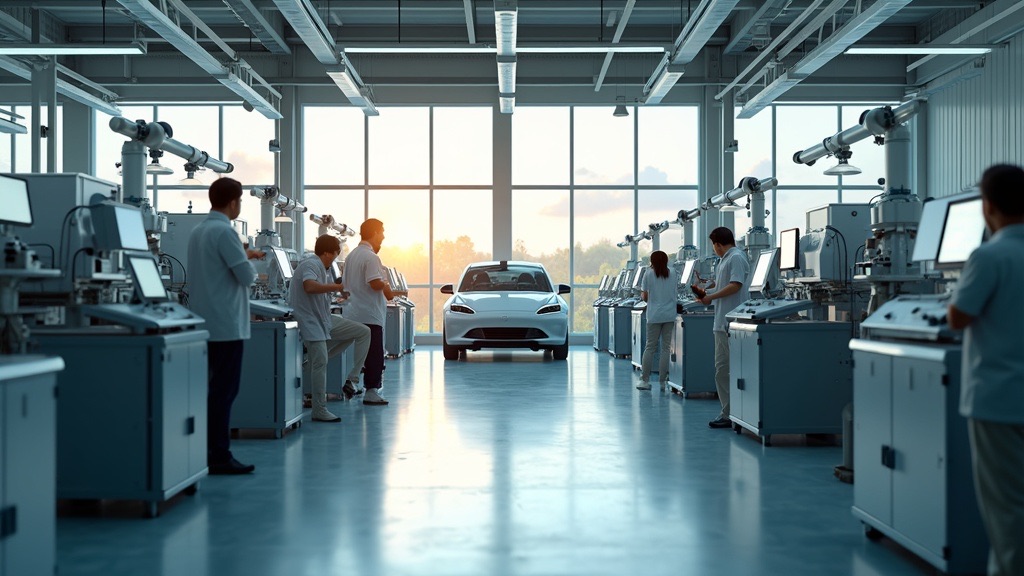
A German EV supplier could ask: “Where can I set up within 40 km of a port with 50 MW power access and 2,000 trained workers?”
A Tiruppur exporter could ask: “Which subsidy applies if I install AI-based quality inspection?”
A Coimbatore MSME could ask: “What filings are due this month?”
This is where Tamil Nadu began to separate from other states.
Other states promised ease of doing business. Tamil Nadu made ease of doing business measurable.
Foreign Investment: Why MNCs Came
By 2029, global companies did not come to Tamil Nadu only for cheap land or labor. They came because execution risk was lower.
The state could show investors live dashboards: power availability, land status, approval timelines, port connectivity, skill availability, water stress, ESG compliance, local vendor ecosystems, and dispute-resolution time.
MNCs like certainty. AI gave Tamil Nadu a certainty advantage.
| Sector | 2029 Synthetic Outcome |
|---|---|
| Electronics & smartphones | $32 billion exports |
| EVs & batteries | ₹1.85 lakh crore realized investment |
| Semiconductors & advanced electronics | 2.4 lakh skilled jobs created |
| Global Capability Centres | 1,200+ GCCs across Chennai, Coimbatore, Madurai, Trichy |
| Green energy | 38 GW AI-managed renewable capacity |
| Textiles & technical fabrics | $13.5 billion exports |
| Aerospace & defence | ₹72,000 crore investment pipeline |
| AI startups & civic tech | 8,500 startups, 42 unicorn/soonicorn firms |
Tamil Nadu stopped being seen as only a manufacturing state. It became a manufacturing-intelligence state.
The Budget Changed Shape
In 2026, Tamil Nadu’s fiscal challenge was clear: a large welfare state, high debt stock, rising interest payments, and the need for more capital expenditure.
AI did not remove debt. It improved the state’s ability to grow faster than debt.
| Fiscal Indicator | 2025–26 | 2028–29 Synthetic |
|---|---|---|
| Budget expenditure | ₹4.39 lakh crore | ₹6.85 lakh crore |
| Capital expenditure | ₹65,333 crore | ₹1.48 lakh crore |
| Interest payments | ₹46,968 crore | ₹58,500 crore |
| Own tax revenue | ~₹2.21 lakh crore | ₹4.05 lakh crore |
| Revenue deficit | ₹41,635 crore | ₹12,800 crore |
| Fiscal deficit | ₹1.07 lakh crore | ₹1.40 lakh crore |
| Fiscal deficit as % GSDP | 3.0% | 2.35% |
Notice the trick.
The fiscal deficit in rupees still existed. But the economy grew faster. Tax collection became smarter. Leakages reduced. Approvals created activity. Activity created revenue. Revenue created capital space.
The state did not become fiscally strong by cutting its soul. It became fiscally stronger by making its machine productive.
Sector Explosions
Electronics
Tamil Nadu’s electronics exports were already $14.65 billion in FY25. By 2029, AI-driven supply-chain mapping, port scheduling, quality inspection, and vendor discovery pushed synthetic exports to $32 billion.
Smartphones were no longer the whole story. Components, PCBs, sensors, industrial electronics, EV controllers, and semiconductor-linked testing became new pillars.
Textiles
AI revived an old strength. Tiruppur, Erode, Karur, Salem, and Coimbatore moved into predictive demand, automated quality inspection, water-use optimization, and technical textiles.
Textile exports rose synthetically from about $8 billion to $13.5 billion. The state that once stitched garments now engineered fabrics.
Automobiles & EVs
Tamil Nadu’s auto belt became an EV intelligence corridor. AI-managed vendor networks reduced downtime. Battery plants used predictive maintenance. Logistics AI connected Hosur, Chennai, Ennore, Tuticorin, and Coimbatore.
- 38% of India’s EV two-wheeler components
- 31% of electric commercial vehicle parts
- 44% of exported auto electronics
- 2.8 lakh new EV-sector jobs

Agriculture
Agriculture did not grow explosively, but farmer risk fell. AI advisories combined weather, soil, crop disease, water, procurement, insurance, and price signals.
- Crop-loss claim time down from 74 days to 18 days
- Irrigation efficiency up 17% in pilot delta blocks
- Pest outbreak detection 9 days earlier
- Farmer income in AI advisory clusters up 12–16%
The farmer did not become dependent on AI. The farmer became less dependent on rumor.
Healthcare
The public health grid became one of Tamil Nadu’s quiet miracles. AI predicted drug stockouts, flagged disease clusters, optimized ambulance dispatch, tracked high-risk pregnancies, and reduced hospital queues.
- Essential drug stockouts down 58%
- Outpatient wait time in pilot hospitals down 52%
- High-risk pregnancy missed follow-ups down 70%
- Outbreak detection moved from weeks to days
This improved productivity in a way economists often miss: fewer sick days, fewer emergency expenses, fewer family members pulled out of work to navigate hospitals.
Education & Skills
Tamil Nadu’s AI skills exchange became the bridge between education and industry. A Class 10 student in Tirunelveli could see local job pathways. A polytechnic student in Salem could be matched to an EV supplier. A government college student in Madurai could get AI-guided training for a GCC role.
- 31 lakh students received AI-personalized learning support
- 18 lakh youth matched to apprenticeships or skill tracks
- Dropout-risk alerts reduced secondary dropout in pilot districts by 34%
- 2.4 lakh semiconductor and advanced electronics workers trained or certified
Talent stopped leaking blindly. It started flowing toward opportunity.
What didn’t work — and what almost failed
This essay would be dishonest without this section. The 2029 numbers above are the outcome of compounding. But the path to compounding was not smooth. Several things broke along the way.
The Revenue Department resisted the longest
Land records are politically sensitive in Tamil Nadu. Patta transfers, survey data, and revenue officer discretion touch patronage networks that predate independence. The Revenue Department was the last to integrate with Business AI and the citizen agent. It took a direct CM intervention in 2027 — after two embarrassing Collector petition-day scandals went viral on social media — to force the digitization of the remaining manual patta workflows. Even then, adoption in southern districts lagged northern ones by 8 months.
Tamil NLP was not ready at launch
The Citizen AI pilot in Coimbatore launched in late 2026 with a Tamil voice model that misclassified roughly 23% of complaints — confusing “drainage” with “drinking water,” routing temple-land disputes to the Forest Department, misreading Kongu dialect terms. The first three months were an embarrassment. Public trust dipped. The fix came from an unexpected source: a consortium of Tamil Wikipedia editors, Anna University NLP researchers, and citizen volunteers who built a correction corpus of 1.8 lakh verified Tamil civic terms. By mid-2027, accuracy crossed 91%. But the early stumble cost six months of credibility.
Officers gamed the dashboards
Within four months of Officer AI deployment, a pattern emerged: some zonal officers were closing complaints by marking them “resolved” without actually fixing the issue — driving their dashboard metrics up while citizen satisfaction stayed flat. It took an adversarial audit layer (AI cross-checking closure claims against citizen follow-up surveys and re-opened complaints) to catch and correct this. Three officers were publicly reprimanded. The lesson: dashboards without verification create performance theater, not performance.
Data-entry staff feared displacement
Government employee unions in Chennai staged a three-day work-to-rule in early 2027, opposing what they called “stealth retrenchment by algorithm.” The resolution came through retraining: 14,000 data-entry and clerical staff were reskilled as AI supervisors, quality auditors, and citizen-support agents. By 2028, most of them reported higher job satisfaction — the repetitive filing work had been the worst part of their jobs. But the political cost of the transition was real, and the government nearly lost a by-election over it.
Rural connectivity remained the hard ceiling
In 2027, 18% of village panchayats still lacked reliable mobile data. Citizen AI could not reach these areas. The government’s BharatNet connectivity drive closed much of this gap by late 2028, but the gap meant that the earliest AI productivity benefits accrued disproportionately to urban and semi-urban citizens. The rural catch-up happened — but it was 12–18 months behind, and the inequality of access during that window was a fair criticism.
None of these failures were fatal. But they were real. The 2029 scoreboard exists despite these frictions, not because the path was clean. Any state attempting to replicate Tamil Nadu’s model should budget for at least two years of political resistance, technical embarrassment, and institutional inertia before compounding kicks in.
Why Tamil Nadu Became a Powerhouse
The powerhouse tag did not come from one sector. It came from compounding.
The Compounding Loop
AI was the multiplier. Not the engine by itself. The multiplier.
Tamil Nadu’s edge was that it applied AI across the whole state, not just one department.
Citizen AI made public services easier. Officer AI made administration sharper. Business AI made investment faster. Health AI made the workforce healthier. Education AI made talent more employable. Logistics AI made exports smoother. Welfare AI made benefits more accurate. Tax AI improved collections without harassment.
By 2029, Tamil Nadu was not light years ahead because it had more apps.
It was ahead because every app was connected to accountability.
The New Definition of Growth
In 2029, Tamil Nadu taught India a new economic lesson:
GDP is not only built in factories. It is also built in time saved. In files not delayed. In trucks not waiting. In students not dropping out. In patients treated earlier. In farmers warned sooner. In entrepreneurs approved faster. In officers seeing the whole picture.
AI made these invisible gains visible.
That visibility became productivity. That productivity became growth. That growth became power.
The Question for India
Tamil Nadu’s rise was not inevitable. It happened because the state asked a better question.
Not: “How do we use AI?”
But:
Where is time being wasted, who is paying the price, and how do we make the system answer faster?
That question changed governance. Then it changed industry. Then it changed the economy.
And by 2029, the rest of India was left facing a harder question:
If Tamil Nadu can turn every complaint, every approval, every scheme, every factory, every classroom, and every hospital into a live system of productivity, how long can any other state afford to govern in the dark?
Sources & Notes
Baseline figures: PRS Tamil Nadu Budget Analysis 2025–26, Tamil Nadu Budget 2025–26 reporting, GIM 2024 investment data, NIRYAT/export reporting, and FY25 electronics/textile export reports.
2028–29 figures: All numbers labeled “synthetic” in this essay are scenario projections for narrative and policy imagination. They are not forecasts, predictions, or endorsed targets. They illustrate what could happen if AI-driven governance productivity compounds over three years across citizen services, business approvals, and economic activity.
Part 1: Who Runs Tamil Nadu? ·
Part 2: Now Make It Work
The map was drawn. The engine was designed. The state compounded. Someone turned the key.
— VJ
A note on how I write
I am not a writer. I am a person with strong opinions and scattered notes. Every essay on this site started as a messy brain-dump — half-formed arguments, bullet points, and “you know what I mean” — that I hand to an LLM. Another LLM handles the background research needed to find the facts that support an argument. And then it all gets translated into writing far too good for me to pretend is mine. The ideas are mine. The craft is not. They say blogs are dead — but I am falling in love with this. It gives me an outlet for expression that would otherwise have stayed buried in my head. I believe you deserve to know all of that.