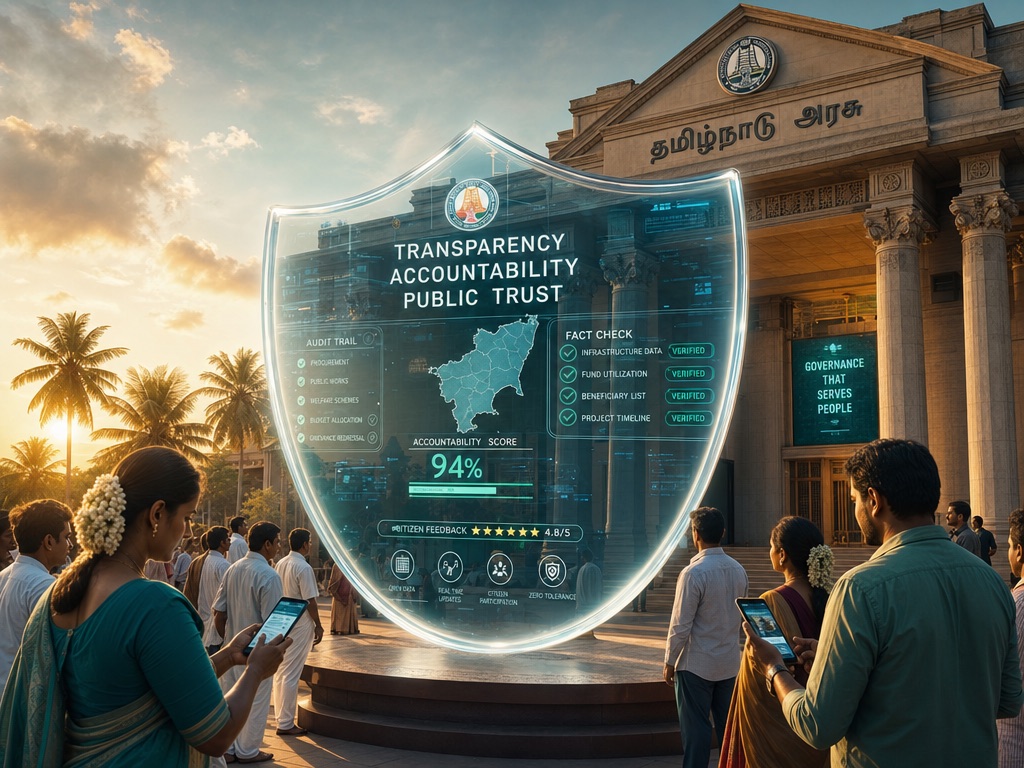
What this series is — and is not. This is a citizen's proposal, not a government project. The author has no affiliation with any political party, government agency, or technology vendor. Makkal Kanakku does not exist yet. The architecture and policy mechanisms described here are informed estimates based on publicly available data, not insider knowledge. Where specific figures are cited, sources are linked. Where numbers are estimated, that is noted. This series is meant to start a conversation, not end one.
Part 2 described the architecture: urban AI sensing and rural human networks feeding a unified problem graph. That architecture is powerful. Power is the problem.
A system that can hear every citizen, rank every grievance, and score every officer is also a system that — in the wrong hands — can silence dissent, bury inconvenient complaints, and turn accountability into a weapon against political opponents. The history of technology in Indian governance is littered with tools that started as reform and ended as control.
This essay is about designing the system so that cannot happen. Not by trusting the government. Not by trusting the opposition. Not by trusting the bureaucracy. By making verification so easy, and evidence so permanent, that trust becomes optional.
Layer 1: The public audit trail
Every action in Makkal Kanakku is logged, timestamped, and immutable. Every single one.
When a complaint is filed, the filing is logged. When it is assigned to an officer, the assignment is logged. When the officer changes the status from "open" to "in progress," the change is logged. When a deadline passes, the missed deadline is logged. When the case is escalated, the escalation is logged. When the case is closed, the closure is logged — along with the citizen's verification of whether the problem was actually solved.
None of these records can be edited or deleted. Not by the officer. Not by the district collector. Not by the Chief Minister's office. The audit trail is append-only, cryptographically hashed, and replicated to an independent data store that the government does not control.
Why this matters: In the current system, a complaint can be quietly closed without resolution. An officer can mark a case as "resolved" while the pothole is still there. A department can delete an embarrassing backlog before the CM's review. Makkal Kanakku makes all of that visible. You can still do it — but everyone will see that you did.
The design principle here is not prevention. It is cost inflation. The system does not stop bad behavior. It makes bad behavior expensive — because the evidence is permanent, public, and undeniable.
Layer 2: Public scorecards
Every department and every district carries a public scorecard. The scorecard is generated automatically from the audit trail. No human curates it. No PR department edits it.
A district scorecard shows:
- Total open cases by category
- Average resolution time vs. deadline
- Percentage of cases resolved within SLA
- Escalation rate (how often deadlines are missed)
- Citizen satisfaction rating (post-resolution survey)
- Comparison to state average and to the same district's previous quarter
A department scorecard shows the same metrics, aggregated across all districts. The Health Department's scorecard reveals whether PHC staffing gaps are being filled. The Highways Department's scorecard reveals whether road repair complaints are being resolved or quietly closed.
Here is the critical detail: department and district scorecards are public by default. Any citizen can view them. Any journalist can download the raw data. Any opposition MLA can cite district-level performance in the Assembly. The government does not get to choose which metrics to publish. The system publishes all of them, because the system does not know which ones the government would prefer to hide.
Individual officer performance is a different matter. Named officer scorecards are visible to their reporting chain, the District Collector, and the Makkal Kanakku Commission — but not to the general public. Officers are identified by role and designation on the public dashboard, not by name. This prevents targeted harassment of frontline workers while preserving institutional accountability. If a pattern of poor performance persists, the commission and the chain of command can see exactly where it originates. The public sees the department fail; the department sees the officer fail.
Layer 3: Automatic escalation
Deadlines in Makkal Kanakku are not aspirational. They are triggers.
When a case is assigned, it gets a deadline based on its severity and category. A critical water contamination event might get 24 hours. A routine road repair might get 30 days. These deadlines are set by policy, not by the officer handling the case. The officer cannot extend their own deadline.
When the deadline expires without resolution:
- The case status changes to "escalated" — automatically, without any human intervention.
- The case is reassigned to the next level in the chain: from taluk officer to district officer, from district to department head, from department to Secretary.
- The escalation is visible on the public status page. The original officer's scorecard records the missed deadline.
- If the escalated deadline is also missed, the case reaches the Chief Secretary's dashboard with a flag.
Pause states. Automatic escalation must account for legitimate delays. An officer can request a deadline extension — but the request must include a reason, and both the original deadline and the extension are logged on the public status page. The citizen sees: "Deadline extended from 15 days to 30 days — reason: pending land survey report from Revenue Department." The officer's scorecard records the extension separately from a missed deadline. This prevents the system from punishing officers for delays caused by other departments, while making the real bottleneck visible.
The point of automatic escalation is not to punish individual officers. It is to make institutional bottlenecks visible. If the Highways Department in Villupuram consistently misses deadlines, the pattern shows up in the data before any politician raises it. If Revenue Department land surveys are the bottleneck behind half of those delays, the pause-state data reveals that too. The CM's office does not need a review meeting to discover the problem — the problem graph has already surfaced it.
Layer 4: Fact-checking and anti-disinformation
A system that listens to everyone will also hear from liars, trolls, and political operators. This is the most frequently cited objection to any open civic platform, and it is legitimate.
The defense is layered:
Deduplication and source weighting
As described in Part 2, complaints corroborated by multiple independent sources carry higher weight. A single anonymous Twitter account claiming a hospital has closed carries less weight than the same claim corroborated by an ASHA worker's field report and a patient's CM Helpline call. Sensor data corroboration — flood sensor readings, power grid telemetry — pushes confidence even higher. The system does not treat all inputs as equally reliable.
Bot and coordination detection
Social media inputs pass through bot-detection filters. Coordinated campaigns — fifty identical complaints filed from accounts created on the same day — are flagged and quarantined. They are not deleted. They are marked as "under review" and their weight in the problem graph is reduced until a human moderator clears them. The flagging logic itself is published. If an opposition party believes its legitimate complaints are being suppressed, they can audit the flagging criteria.
Moderation transparency
This is the single most important trust mechanism. Every moderation action — every complaint that is downweighted, flagged, quarantined, or removed — is logged with the reason. A quarterly moderation report is published. If the system is systematically suppressing complaints about a particular minister's department, the pattern will be visible in the moderation report long before anyone accuses the system of bias.
Redaction protections: The moderation log is public in aggregate — categories of action, volumes, outcomes — but specific detection techniques are redacted. Publishing exactly how a coordinated bot campaign was identified teaches the next campaign how to evade detection. The commission and approved security auditors see the full technical detail. The public sees: "247 complaints flagged as coordinated inauthentic behavior in Q3; 189 confirmed, 41 reinstated after review, 17 pending." The pattern is visible. The attack surface is not.
The hard truth: No AI system can perfectly distinguish a legitimate grievance from a politically motivated fabrication. The system will make mistakes. The defense is not perfection — it is transparency about the mistakes. A system that openly publishes its errors is trusted more than one that claims to have none.
Layer 5: Opposition access
This is the layer that separates Makkal Kanakku from every "digital governance" initiative that came before it.
In the current model, opposition parties get their information from RTI requests, Assembly questions, field visits, and media reports. Each of these channels has friction — RTI takes 30 days, Assembly questions can be deflected, field visits are anecdotal, and media coverage is selective. The government controls the information asymmetry, and every government — regardless of party — exploits it.
Makkal Kanakku eliminates that asymmetry by design.
Full read access to anonymized data. Every opposition MLA, MP, and recognized party's research team gets the same dashboards, the same aggregate data, and the same scorecard access as the ruling party. They can see every open case in their constituency — case number, category, location, deadline, status, assigned department. They can download district-level performance data. They can compare their district to the state average. They do not need to file an RTI. The data is already there.
Role-based access tiers. Not all data is equal. Case metadata (category, location, status, timeline) is fully public. Citizen identity is never exposed — opposition members see the same anonymized records as any other user. Detailed case narratives that might identify individuals are accessible to the assigned department and the commission, not to external parties. This is not a limitation on opposition oversight — it is a protection for citizens who file complaints about powerful people in their community.
Query access. Opposition members can run structured queries against the problem graph: "Show all health-staffing cases in Ramanathapuram district open for more than 60 days." "Show all road-repair cases in Chennai that were closed without citizen verification." "Show the average escalation rate for the Revenue Department in Q3 2027 compared to Q3 2026." These queries run against real-time data. The government cannot prepare for them, because it does not know which questions will be asked.
Alert subscriptions. Opposition members can subscribe to alerts: notify me whenever a case in my constituency is escalated, whenever a department scorecard drops below a threshold, whenever a citizen complaint about water quality is filed in my district. These are the same alerts available to the ruling party's officers. The information is symmetric.
A system the opposition cannot read is not an accountability tool. It is a press release with a database.
Layer 6: Capture resistance
The most dangerous scenario for Makkal Kanakku is not external attack. It is internal capture — the gradual process by which the ruling party turns the system into an instrument of political control.
Capture looks like this: the Chief Minister's office gains the ability to suppress complaints about friendly departments. The classification engine is quietly re-tuned to lower the severity of politically sensitive issues. The moderation layer is used to silence critics. The scorecard weightings are adjusted to make the ruling party's districts look better.
Preventing capture requires structural independence, not good intentions.
Statutory body, not government department
Makkal Kanakku must be governed by an independent statutory commission — similar to the State Election Commission or the CAG — with members appointed through a process that requires bipartisan consent. The chairperson should be a retired High Court judge or a person of equivalent public standing. Members cannot be removed by the government of the day without legislative supermajority. The commission controls the system's algorithms, moderation policies, and data access rules.
Open-source code — with practical limits
The classification engine, the severity scoring algorithm, the escalation logic, and the core moderation rules must be open source. Publicly available on a code repository. Any computer science department in any university can inspect the logic. Any journalist with technical skills can verify that the algorithm matches the published specification. This is the difference between "trust us, the AI is fair" and "here is the code — verify it yourself."
The practical limit: security-sensitive components — bot detection signatures, rate-limiting configurations, infrastructure access controls — are auditable but not publicly published. The commission and approved third-party security auditors (selected through a transparent process) can inspect these components. Publishing bot detection heuristics in full would be the equivalent of publishing a bank's fraud detection rules — it would help the attackers more than the public. The principle is: logic is open, defenses are auditable.
Data sovereignty
The problem graph data — anonymized — must be treated as a public asset, not government property. When the government changes, the data stays. The incoming government cannot purge the outgoing government's performance records. The audit trail from 2026 is as accessible in 2036 as it is today. This is not a technical constraint — it is a legal one, and the enabling legislation must be drafted in the first 100 days.
Adversarial red team
The Makkal Kanakku Commission should maintain a standing red team — a small group of security researchers, ethicists, and civic technologists whose job is to try to break the system. They attempt to game the severity scores, inject fake complaints, manipulate the scorecards, and identify vulnerabilities before bad actors do. Their findings are published quarterly. A system that is continuously attacked from within is harder to attack from without.
Layer 7: Privacy within transparency
Transparency is about government actions. Privacy is about citizen identity. These are not in conflict — they are complementary, but only if the architecture treats them as separate concerns.
What is always public: the problem node (location, category, severity), the assigned officer, the deadline, the status, the escalation history, the audit trail of all government actions on the case.
What is always private: the identity of the citizen who filed the complaint (unless they choose to be identified), personal details in the complaint (phone numbers, Aadhaar numbers, medical records), and any data that could identify a specific individual in the affected population.
What is anonymized: citizen satisfaction surveys are aggregated. Social media inputs are processed for content, not identity — the system cares about what was said, not who said it. ASHA worker reports identify facilities and locations, not individual patients.
The system must comply with the Digital Personal Data Protection Act, 2023. But compliance with DPDPA is the floor, not the ceiling. Makkal Kanakku should exceed DPDPA's requirements, because the political cost of a privacy breach in a government accountability system would be catastrophic to public trust.
Layer 8: Citizen appeal rights
Every layer described above protects the system from the government. This layer protects the citizen from the system.
Makkal Kanakku will make mistakes. A legitimate complaint will be flagged as spam. A case will be marked "resolved" while the problem persists. A severity score will underweight a real emergency. When this happens, the citizen must have recourse — and that recourse cannot go back to the same department that made the decision.
What can be appealed
Moderation appeals. If a complaint is downweighted, quarantined, or flagged as inauthentic, the citizen can appeal to the commission. The appeal is logged. The commission reviews the moderation decision and publishes the outcome — upheld, reversed, or modified — in the quarterly moderation report.
Closure disputes. If an officer marks a case as "resolved" but the citizen disagrees, the citizen can dispute the closure. The case reopens with a flag: "closure disputed by complainant." The dispute is visible on the public status page. A disputed closure counts against the officer's scorecard until the dispute is resolved.
Severity re-evaluation. If a citizen believes their case was scored too low — a flooding complaint classified as routine maintenance, for example — they can request a severity review. The review is handled by the commission's assessment team, not by the department responsible for the case.
The appeal mechanism serves a second purpose: it generates data about the system's failure modes. If 30% of closure disputes in Kancheepuram district are upheld in the citizen's favor, the system has a pattern — officers in that district are closing cases prematurely. The appeal data feeds back into the scorecard and the problem graph, making the system self-correcting.
The trust equation
Each of the eight layers addresses a specific trust failure:
- Audit trail → prevents silent deletion of inconvenient records
- Public scorecards → prevents selective reporting of favorable metrics
- Automatic escalation → prevents deliberate delay as a strategy
- Fact-checking → prevents noise from drowning out signal
- Opposition access → prevents information asymmetry as political advantage
- Capture resistance → prevents the system from becoming a political tool
- Privacy → prevents the system from becoming a surveillance tool
- Citizen appeals → prevents the system from becoming unaccountable to the people it serves
Remove any one layer and the system fails in a specific, predictable way. Remove the audit trail, and officers can silently close cases. Remove opposition access, and the government controls the narrative. Remove capture resistance, and the next election turns Makkal Kanakku into a partisan weapon. Remove citizen appeals, and the system is accountable to everyone except the person who filed the complaint.
Together, the eight layers create a system where trust is not required — because verification is always available. The citizen does not need to trust the officer. The opposition does not need to trust the government. The government does not need to trust the media. And the citizen does not need to trust the system itself. Everyone can check.
Trust in government should not be an act of faith. It should be an act of arithmetic. Makkal Kanakku makes the arithmetic public.
The architecture is defined. The trust model is designed. What remains is the hardest part: actually building it. Part 4 lays out the execution plan — 100 days, one year, five years — with budget, owners, pilots, and a risk register that does not pretend everything will go smoothly.
Sources & references
- CM Helpline (1100) — Tamil Nadu CM Special Cell, operational since 2017, handles ~1.5 lakh calls/month across all districts.
- e-Sevai — Tamil Nadu e-Governance Agency (TNeGA), provides 200+ government services through Common Service Centres.
- Digital Personal Data Protection Act, 2023 — Full text (MeitY), India's comprehensive data protection legislation.
- Tamil Nadu Information Commission — TNIC, the state body adjudicating RTI appeals and transparency compliance.
- State Election Commission model — For the statutory independence framework referenced in Layer 6; see TN SEC.
— A citizen and a builder
A note on how I write
I am not a writer. I am a person with strong opinions and scattered notes. Every essay on this site started as a messy brain-dump — half-formed arguments, bullet points, and “you know what I mean” — that I hand to an LLM. Another LLM handles the background research needed to find the facts that support an argument. And then it all gets translated into writing far too good for me to pretend is mine. The ideas are mine. The craft is not. They say blogs are dead — but I am falling in love with this. It gives me an outlet for expression that would otherwise have stayed buried in my head. I believe you deserve to know all of that.