What this series is — and is not. This is a citizen's proposal, not a government project. The author has no affiliation with any political party, government agency, or technology vendor. Makkal Kanakku does not exist yet. The budget, timeline, and technical architecture described here are informed estimates based on publicly available data, not insider knowledge. Where specific figures are cited, sources are linked. Where numbers are estimated, that is noted. This series is meant to start a conversation, not end one.
Three essays have now laid the groundwork. Part 1 proposed Makkal Kanakku — a live public accountability system. Part 2 described the architecture — how urban AI sensing and rural human networks feed a unified problem graph. Part 3 designed the trust stack — audit trails, public scorecards, opposition access, and capture resistance.
This final essay answers the questions that separate proposals from governance: Who builds it? What does it cost? Where do you start? What goes wrong? And how do you wire it into the infrastructure Tamil Nadu already has — without rebuilding what already works?
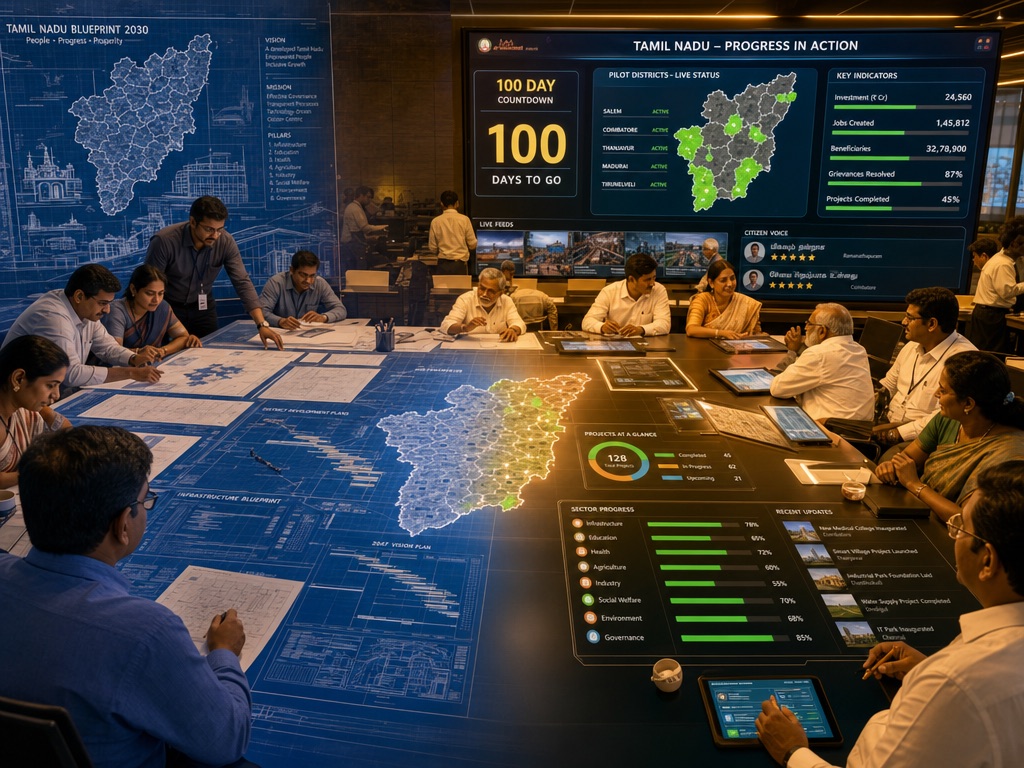
Phase 1: The first 100 days
The honeymoon is finite. Public attention is high, bureaucratic resistance is low, and the political cost of a bold move is at its cheapest. These 100 days set the foundation. Everything built later depends on getting this phase right.
Days 1–15: Legal and institutional foundation
Establish a temporary Makkal Kanakku Mission Cell by government order (G.O.), housed under the CM's office and staffed by TNeGA. A statutory commission requires legislation, which takes months. The Mission Cell gets work started immediately. It operates with a clear sunset clause: it dissolves when the Makkal Kanakku Commission is formally constituted under the enabling Act.
The owner stack — who is responsible at each level:
CM's Office → political sponsorship, unblocking inter-departmental resistance
TNeGA → technology execution, platform build, integration with e-Sevai
CM Helpline (1100) → primary intake channel, first-mile complaint capture
District Collector → pilot district execution, field-worker coordination, escalation resolution
Future Makkal Kanakku Commission → independent governance, algorithm oversight, opposition access, citizen appeals (once constituted by Act)
Draft the enabling legislation. Begin drafting the Makkal Kanakku Act for introduction in the next Assembly session. The Act should codify the commission's independence, data retention obligations, opposition access rights, and open-source requirements described in Part 3. Legislation takes time — starting on Day 1 means it might pass by Month 8.
Appoint a Chief Technology Officer for the project. This person must have built production systems at scale — not a consultant who writes reports. Ideally recruited from the Tamil Nadu technology diaspora. Compensation must be competitive with the private sector, which means departing from IAS pay scales. This is worth fighting for early.
Days 16–45: Audit, integration, and pilot selection
Audit the existing stack. The CM Helpline, e-Sevai, Open Data Portal, and district-level complaint systems already generate data. Before building anything new, map exactly what exists: data formats, volumes, update frequency, API availability, access controls. The audit will reveal that 60% of the integration work is cleaning and normalizing data that already exists but lives in incompatible formats.
Select three pilot districts. One urban (Chennai — high digital signal volume, flood-prone, politically visible). One semi-urban (Coimbatore — mix of tech-savvy population and rural hinterland). One rural (Dharmapuri — low connectivity, high dependency on human networks, historically underserved). The three districts represent the full spectrum of Tamil Nadu's two-speed reality.
Begin CM Helpline integration. The CM Helpline is the single most valuable existing intake channel. Every complaint already has a category, location, and timestamp. Wiring the Helpline into the problem graph requires an API bridge, not a rebuild. This is the fastest path to a working prototype: existing complaints, flowing into a new graph, visible on a new dashboard.
Days 46–100: Pilot launch
Launch the problem graph in three pilot districts. Starting narrow: CM Helpline complaints only. No social media yet, no IoT sensors. Just the structured complaint data that already flows into the system, now displayed on a public dashboard with case numbers, assigned officers, deadlines, and status. This is the minimum viable Makkal Kanakku — unglamorous, but real.
Train VAOs and ASHA workers in pilot districts. In Dharmapuri, begin the rural sensing layer. Train 200 VAOs and 500 ASHA workers on the structured reporting tool — a simple mobile form or IVR system. These workers already file reports. Makkal Kanakku gives them a faster channel and the knowledge that their reports will be publicly visible and tracked.
Publish the first public scorecards. At Day 100, publish the first district-level scorecards for the three pilot districts. This is the moment the system becomes real. Officers see their response times published. Citizens see their complaints tracked. The opposition sees the data. The press writes the story.
The Day 100 milestone: Three districts. CM Helpline complaints tracked on a public dashboard. Rural field reports from VAOs and ASHA workers flowing in from Dharmapuri. First scorecards published. The system is small, imperfect, and visible. That visibility is the point.
Phase 2: Year one — scaling and deepening
Months 4–6: Expand intake channels
Social media integration. Deploy Tamil NLP classifiers on public social media — Twitter/X, Facebook, and public forum posts — for the three pilot districts. For WhatsApp, the intake channel is opt-in: citizens can message a dedicated Makkal Kanakku WhatsApp number to file complaints, but the system does not monitor private groups. The classifier will be imperfect — expect 70–75% accuracy at launch. Publish the accuracy metrics alongside the results. Improving the model is a continuous process, not a gating event.
e-Sevai integration. Connect e-Sevai service delivery tracking to the problem graph. Every certificate request, licence application, and service delivery now has a public status page. The twenty-one-day certificate guarantee from the TVK manifesto becomes a tracked SLA with automatic escalation.
IoT pilot in Chennai. Integrate existing flood sensors, air quality monitors, and power grid telemetry in Chennai. Sensor-corroborated complaints get automatic severity boosts in the problem graph.
Months 7–9: Roll out to all 38 districts
Statewide CM Helpline integration. Extend the problem graph to accept CM Helpline complaints from all 38 districts. This is the highest-impact, lowest-risk expansion — the data already exists and the dashboard is proven in the pilots.
Rural sensing in 10 additional districts. Train VAOs and ASHA workers in ten more rural and semi-urban districts. Priority: districts with the lowest digital penetration and highest complaint backlogs in the CM Helpline data.
Opposition access portal. Launch the structured query and dashboard access system for opposition MLAs. This is politically costly for the ruling party and therefore the strongest signal that Makkal Kanakku is genuine. If the government hesitates here, the system's credibility collapses.
Months 10–12: Accountability milestones
First annual Makkal Kanakku report. The commission publishes a comprehensive report: total cases filed, resolved, escalated, and pending. District-by-district comparison. Department-by-department comparison. Moderation log summary. System uptime. NLP accuracy. Rural reporting rates. This report is the system's own accountability — the public account of the public account.
Manifesto tracker launch. Every TVK manifesto promise becomes a tracked project in the problem graph: budget allocated, budget spent, milestones hit, milestones missed. The ₹2,500 women's assistance scheme. The five lakh government jobs. The Annan Seer Thittam. Each promise has a public status page. No more five-year guessing games.
Phase 3: Year five — the mature system
The steady state
Full-state coverage. All 38 districts on the problem graph. All intake channels active: CM Helpline, e-Sevai, social media, IoT sensors, rural human networks, IVR.
Predictive capabilities. Three years of data enables pattern recognition. The system can predict which roads will flood before the monsoon, which PHCs will face staffing gaps based on retirement schedules, which districts are approaching electricity demand thresholds. Government shifts from reactive to anticipatory.
Cross-department coordination. The problem graph reveals connections that departmental silos hide. A cluster of school dropout complaints in Villupuram correlates with a cluster of malnutrition cases and a PHC staffing gap. The system surfaces the connection. The response is coordinated across education, health, and ICDS.
National model. If Makkal Kanakku works in Tamil Nadu, other states will adopt it. The open-source codebase, the published architecture, and the operational data make replication straightforward. Tamil Nadu becomes the standard, not by lobbying, but by building.
The budget
Government technology projects are notorious for budget overruns. This plan errs on the side of realism. The numbers below include infrastructure, staffing, training, and operations — not just the software.
| Line item | Year 1 | Year 2–5 (annual) |
|---|---|---|
| Makkal Kanakku Commission (5 members + staff) | ₹8 crore | ₹10 crore |
| Technology platform (cloud, AI/ML, dashboards) | ₹45 crore | ₹25 crore |
| CM Helpline / e-Sevai integration | ₹12 crore | ₹4 crore |
| IoT sensor integration (Chennai pilot) | ₹6 crore | ₹8 crore |
| Tamil NLP development and training | ₹15 crore | ₹8 crore |
| Rural sensing (VAO/ASHA training, IVR, devices) | ₹18 crore | ₹12 crore |
| Red team and security audit | ₹4 crore | ₹4 crore |
| Public communications and citizen onboarding | ₹10 crore | ₹6 crore |
| Total | ₹118 crore | ₹77 crore |
For context: state governments across India routinely spend hundreds of crores annually on information and publicity — press ads, TV spots, and social media campaigns about government schemes.[1] Tamil Nadu's allocation is in this range. Makkal Kanakku's Year 1 cost is a fraction of a typical state's publicity budget. The question is not whether Tamil Nadu can afford Makkal Kanakku. It is whether it can afford not to build it — and continue spending on telling people what the government did, instead of showing them.
Procurement guardrails
Government technology projects fail as often from bad procurement as from bad technology. Makkal Kanakku must be built differently from the typical NIC or large-vendor IT project.
- No single-vendor lock-in. The platform must use open standards and modular architecture. No proprietary cloud that cannot be migrated. No vendor-specific API that creates dependency. The enabling Act should mandate that all core components have at least two viable implementation paths.
- Phased contracting. Do not sign a five-year contract on Day 1. Contract the pilot phase (100 days) separately. Evaluate. Then contract the scale-up phase based on what actually worked. The vendor that builds the best pilot prototype may not be the vendor that runs the best statewide platform.
- TNeGA as technical owner, not pass-through. TNeGA must retain in-house technical capability to evaluate vendor work, not merely sign off on deliverables. At least 30% of core platform development should be in-house or through open-source contributors, to prevent the knowledge from living entirely inside a vendor.
- Public procurement transparency. All contracts above ₹1 crore are published — scope, vendor, amount, deliverables, and evaluation criteria. The commission's red team (described in Part 3) audits the procurement process itself, not just the technology.
The risk register
Political reversal
High probabilityRisk: The next government dismantles Makkal Kanakku to avoid accountability.
Mitigation: Pass the enabling Act within Year 1. Statutory bodies are harder to dismantle than government programs. Make the data public and replicated — once citizens have seen their complaints tracked in real time, removing the system is politically expensive. The opposition access portal ensures the opposition becomes a stakeholder in the system's survival.
Bureaucratic resistance
High probabilityRisk: IAS officers and department heads resist public scorecards and automatic escalation. Senior bureaucrats view the system as a threat to their discretion.
Mitigation: Frame the system as a tool that protects good officers — the ones who resolve cases on time now get public credit instead of being invisible. Start with the three pilot districts and identify early-adopter District Collectors who become champions. The CM must personally back the system in the first six months.
Technology failure
Medium probabilityRisk: The Tamil NLP model misclassifies complaints at high rates. The platform crashes under load during monsoon season. Integration with legacy systems takes longer than expected.
Mitigation: Launch with imperfect NLP and publish accuracy metrics. Over-provision infrastructure for seasonal peaks. Build integration bridges, not replacements — the CM Helpline continues working even if the Makkal Kanakku dashboard goes down. Graceful degradation, not all-or-nothing.
Data quality
Medium probabilityRisk: Rural field reports are incomplete, inconsistent, or fabricated. Urban social media signals are noisy.
Mitigation: Source weighting (Part 2) and moderation transparency (Part 3) handle noise. For rural reporting, focus on training and feedback loops — when a VAO's report leads to a visible resolution, other VAOs see the value. Completeness metrics are published alongside the data.
Public trust deficit
Medium probabilityRisk: Citizens do not believe the system is genuine. They have seen "digital governance" initiatives before — portals that launch with fanfare and die within a year.
Mitigation: The Day 100 scorecards are the trust moment. When citizens see an officer's response time published next to their complaint, and when they see an escalation triggered automatically because a deadline passed, they will know this is different. Trust is earned in the first 100 days or not at all.
Privacy breach
High impactRisk: Citizen complaint data is leaked, exposing identities of people who filed complaints against powerful local officials. A single breach could destroy public trust permanently.
Mitigation: Privacy-by-design architecture (Layer 7 of the trust stack). Anonymization at the point of ingestion, not as an afterthought. Mandatory data protection impact assessment before each new intake channel goes live. Breach notification protocol with 24-hour public disclosure requirement. The commission's red team runs penetration tests quarterly.
Cyberattack
Medium probabilityRisk: A targeted attack — ransomware, DDoS, or data manipulation — takes the platform down during a crisis (monsoon, election cycle) when public attention is highest.
Mitigation: The immutable audit trail is replicated to an independent data store. The system degrades gracefully: if the dashboard goes down, the CM Helpline and e-Sevai continue operating independently. Over-provision for seasonal peaks. Incident response plan published in advance, not written during the crisis.
Vendor capture
Medium probabilityRisk: A single IT vendor becomes so embedded in the platform that switching is prohibitively expensive. The vendor dictates terms, and the government cannot negotiate.
Mitigation: Open standards and modular architecture (see procurement guardrails above). In-house TNeGA capability for core components. Contract terms that mandate source code escrow and data portability. No single vendor handles more than 40% of the platform by value.
Algorithmic bias
Medium probabilityRisk: The Tamil NLP classifier or the severity scoring model systematically underweights complaints from certain demographics, dialects, or regions — amplifying existing inequities instead of correcting them.
Mitigation: Publish accuracy metrics broken down by district, language variant, and complaint category. The commission's red team specifically tests for demographic bias. Rural complaints processed through the human sensing network bypass the NLP classifier entirely, providing a parallel signal that reveals gaps in the automated system.
Staff and union resistance
Medium probabilityRisk: Government employee unions resist public scorecards and automatic escalation, viewing the system as a surveillance tool targeting workers rather than improving governance.
Mitigation: Frame the system as a tool that protects good officers — the ones who resolve cases on time get public credit instead of being invisible. Individual officer data is internal, not public (Layer 2). Early engagement with staff associations in pilot districts. The system measures institutional performance, not individual attendance.
Legal challenge
Low probability, high impactRisk: The enabling Act or the system's data collection practices are challenged in the High Court — on privacy grounds, on jurisdiction, or by parties who benefit from the current opacity.
Mitigation: Draft the Act with High Court-grade legal review from Day 1. DPDP Act 2023 compliance is the floor. Build the citizen appeal mechanism (Layer 8) into the Act itself, so the system has its own judicial-style remedy before courts need to intervene.
Public over-expectation
Medium probabilityRisk: Citizens expect Makkal Kanakku to solve problems it can only make visible. The system tracks complaints — it does not build roads, staff hospitals, or allocate budgets. When visibility does not immediately produce resolution, disappointment turns into backlash.
Mitigation: Communicate clearly from Day 1: the system is an accountability layer, not a service delivery engine. The Day 100 scorecards should show both the successes (cases resolved faster) and the constraints (cases visible but awaiting budget allocation). Honest reporting about what the system cannot do builds more trust than overpromising what it can.
Wiring into what already exists
Tamil Nadu does not need to start from zero. The state has digital infrastructure that most Indian states lack. Makkal Kanakku is not a replacement — it is a coordination layer on top of existing systems.
- CM Helpline (1100) → primary intake channel. Every existing complaint flows into the problem graph. No change to the citizen-facing interface.
- e-Sevai → service delivery tracking. Every certificate and licence request becomes a tracked case with SLA and escalation.
- Tamil Nadu Open Data Portal → public data feed. Budget data, scheme data, and district statistics feed the scorecards and the manifesto tracker.
- Vetri TN Super App (proposed in TVK manifesto) → citizen interface. If the Super App is built, it becomes the citizen-facing front end for Makkal Kanakku. If it isn't, the web dashboard serves the same function.
- TNPDS (public distribution system) → supply chain signals. Ration shop complaints and supply disruptions become nodes in the problem graph.
The integration principle is: add a layer, don't replace a system. Every existing portal continues to work. Makkal Kanakku reads from them, normalizes the data, and publishes the unified view. If any integration fails, the source system is unaffected.
Success metrics
Baseline measurement (Days 1–45): These targets are meaningless without a baseline. Before any intervention, the audit phase (Days 16–45) must establish current-state metrics: What is the average resolution time today in the CM Helpline system? What percentage of cases are resolved within existing SLA? How many rural complaints are filed per month? The targets above are relative to that baseline. If the baseline audit reveals that current performance is better or worse than assumed, the targets will be recalibrated and published with the rationale. A target that cannot be measured against a starting point is not a target — it is a slogan.
These are not aspirational statements. They are testable claims. At the end of Year 1, either the average resolution time dropped by 40% from the measured baseline, or it didn't. Either 80% of cases met SLA by Year 2 or they didn't. The metrics are published — alongside the baseline — so the public can verify the math. The system holds itself to the same standard it imposes on the government.
The last word
This series began with a letter. It ends with a spreadsheet. That progression is deliberate.
Vision without execution is a press release. Execution without vision is a procurement order. The gap between the two — between the idea of a government that listens and the reality of wiring that idea into 38 districts, 12,500 panchayats, and 80 million citizens — is where most reform proposals die.
Makkal Kanakku does not require new technology. The AI exists. The cloud infrastructure exists. The mobile networks exist. What it requires is political will to make government performance visible, institutional design to prevent capture, and the discipline to start small, prove the model, and scale.
The first 100 days are a choice. Not between doing this or doing nothing — no government ever does nothing. The choice is between building a system that outlasts you and building one that serves you. The first is harder. It is also the only one worth building.
The manifesto was the promise. Makkal Kanakku is the proof. The people will decide which one they remember.
Sources & references
- State government publicity expenditure — PRS Legislative Research: Tamil Nadu Budget Analysis 2025-26. Publicity allocations vary year to year; the comparison above uses order-of-magnitude estimates, not a specific year's figure.
- CM Helpline (1100) — Tamil Nadu CM Special Cell, operational since 2017.
- e-Sevai / TNeGA — Tamil Nadu e-Governance Agency, provides 200+ government services through Common Service Centres.
- Tamil Nadu Rural Development Department (TNRD) — TNRD, oversees Village Administrative Officers and panchayat-level governance across all 38 districts.
- Digital Personal Data Protection Act, 2023 — Full text (MeitY).
- Tamil Nadu Open Data Portal — data.gov.in/TN, the state's existing public data infrastructure.
With respect and hope,
A citizen and a builder
A note on how I write
I am not a writer. I am a person with strong opinions and scattered notes. Every essay on this site started as a messy brain-dump — half-formed arguments, bullet points, and “you know what I mean” — that I hand to an LLM. Another LLM handles the background research needed to find the facts that support an argument. And then it all gets translated into writing far too good for me to pretend is mine. The ideas are mine. The craft is not. They say blogs are dead — but I am falling in love with this. It gives me an outlet for expression that would otherwise have stayed buried in my head. I believe you deserve to know all of that.