The wrong category, everywhere
I have never been the right kind of anything in any room I have entered.
In North India, where I grew up, I was the Madrasi. It did not matter that my mother tongue was Telugu, that I was born in Tamil Nadu, that my family carried Tamil influence through generations. To the kids on the street, to the teachers, to the neighbors, I was from "down south." One word. One box. South Indian. Madrasi. The accent was wrong, the food was wrong, the skin was slightly wrong. I learned Hindi until it felt like mine, played cricket in the galli, picked up the slang, earned the friendships. But the label never fully peeled off. I was always, faintly, from somewhere else.
Then I moved back to Chennai for engineering, expecting something like homecoming. What I got was a different kind of sorting. To some, I was the Delhi boy — too Hindi, too North Indian in my mannerisms, not quite local. To others, I was the golti — the Telugu speaker, the one whose mother tongue gave him away. It was said casually, sometimes affectionately, but always as a classification. You are not fully one of us. Close, but not quite. The gatekeepers of every identity I approached found a reason to check my papers.
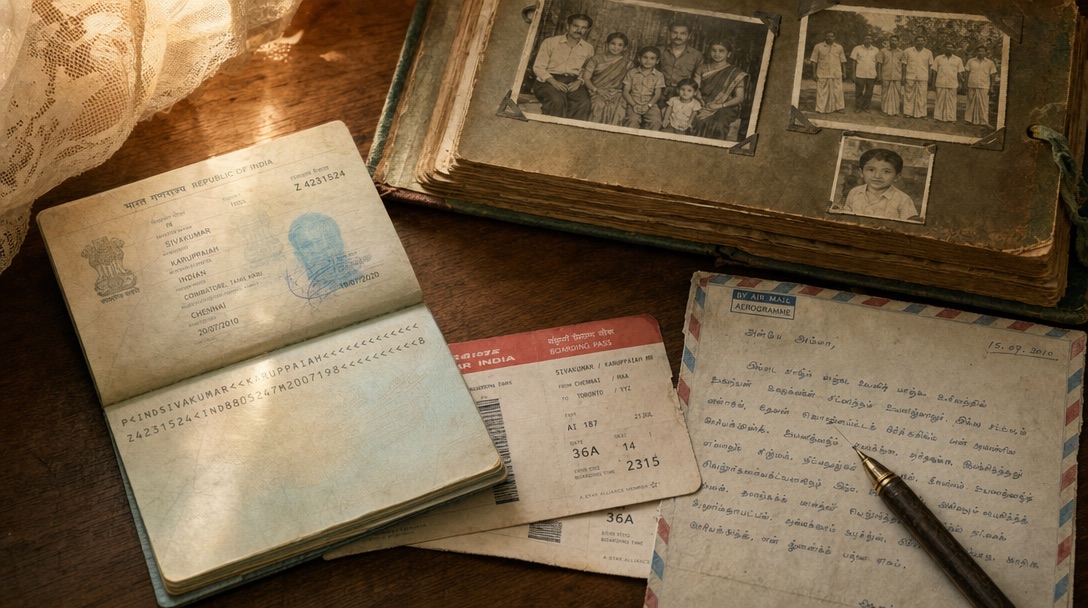
In North India, I was too South Indian. In Tamil Nadu, I was too North Indian, too Telugu. I was always the residue left over after everyone else had been correctly filed.
What America flattened
I left India at twenty-one. Settled in Texas. And for the first time in my life, no one asked me to subcategorize.
In America, I was Indian. Just Indian. The Malayali colleague, the Punjabi neighbor, and I — we are all the same thing. At the office potluck, at the school PTA, at the doctor's office, at the DMV, the checkbox said "Asian Indian" and that was that. No one asked which state, which language, which caste, which side of which river. The entire baroque architecture of Indian identity — the one that had sorted and mis-sorted me for twenty-one years — collapsed into a single word.
That flattening should have felt like erasure. Sometimes it did. But more often, it felt like relief. For the first time, I was not being measured against a regional standard I could not meet. I was not too Tamil or not Tamil enough. I was not too North Indian or too Telugu. I was just a guy from India, building a life, and the sorting was over.
Except it was not over. It had just moved indoors.
The woman who married all my contradictions
My wife is Tamil. That is the simple version. The real version is more interesting.
Her father was from the Saurashtra community — a people with Gujarati roots who settled in Tamil Nadu centuries ago. They speak Saurashtra at home, a migration language that has carried old western roots through centuries of Tamil Nadu air. They are Tamil by geography, by citizenship, by daily life — and yet they carry an internal compass that points elsewhere. Her father moved through Tamil Nadu as someone who belonged and did not belong at the same time. Like me, in a different key.
Her mother was Tamil. But she was born in Burma — part of the Indian community that had lived there for generations, until after Ne Win's 1962 coup, when Indian families like hers were pushed out by the new military order and its nationalization policies. Her mother arrived in Chennai not as someone returning home but as someone arriving for the first time at a place her language said was hers but her memory did not recognize. A Tamil woman who had never lived in Tamil Nadu. A refugee in her own mother tongue's homeland.
When these two married — the Saurashtra man whose roots were Gujarati and whose life was Tamil, and the Tamil woman whose childhood was Burmese and whose displacement was political — they created a home that was, by any definition, a crossroads. The language at dinner depended on who was visiting. The food carried traces of places no one in the house had been born in. Identity was not a flag on a pole. It was a river delta — splitting, merging, spreading, refusing to be one stream.
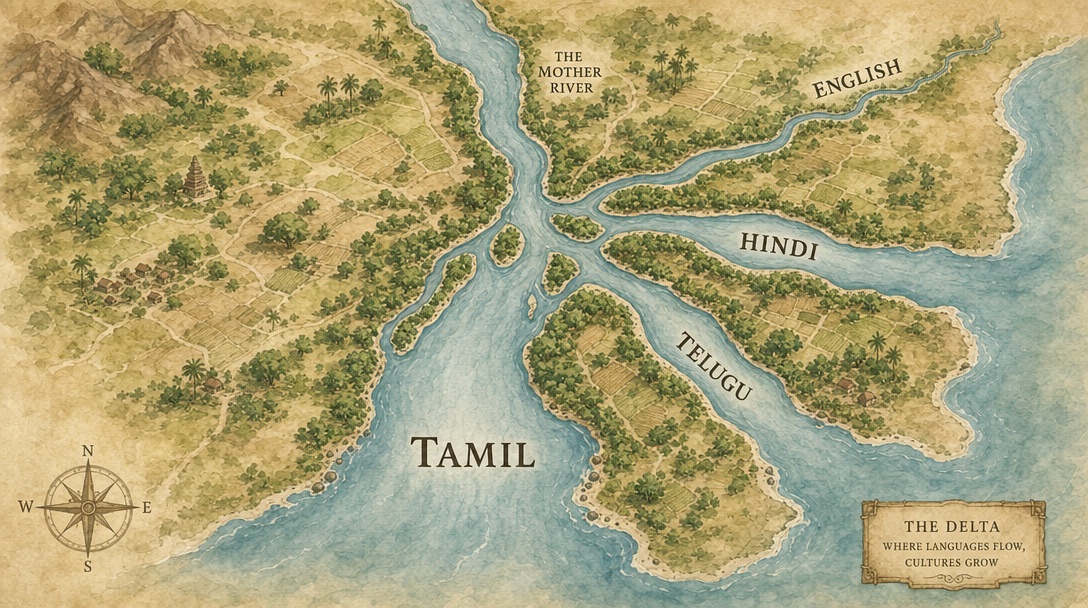
And then she married me — the Telugu-speaking, Tamil-born, North India-raised, America-bound walking contradiction. If identity is a filing system, our marriage broke the cabinet.
Two children, two origin stamps
Our first child was born in Texas. American by birth certificate, Indian by every meal, every phone call to grandparents, every Deepavali celebrated slightly out of season because the school calendar does not know Amavasya from Columbus Day.
Our second was born in Chennai. Indian by birth certificate, but arriving into a household that already ran on English defaults, American school rhythms, and the particular hybrid grammar of a diaspora family that is always performing translation without noticing.
Same parents. Same love. Different origin stamps. And already, in the smallest ways, they carry different relationships to the word "home." When we visit India, one is visiting. The other is returning — to a place they left too young to remember leaving. Last year, one of them was on a video call with their grandmother and said, "When are we going there again?" Not home. Not India. There. My wife looked at me across the room. Neither of us said anything. We both heard it.
What language do they think in? English, mostly. What language do they hear love in? A mix — Tamil from their mother in unguarded moments, Telugu words from my parents that arrive like inherited furniture they cannot name but recognize. Hindi from old Bollywood songs I play in the car. And the ambient English of Texas, which is nobody's mother tongue and everybody's operating system.
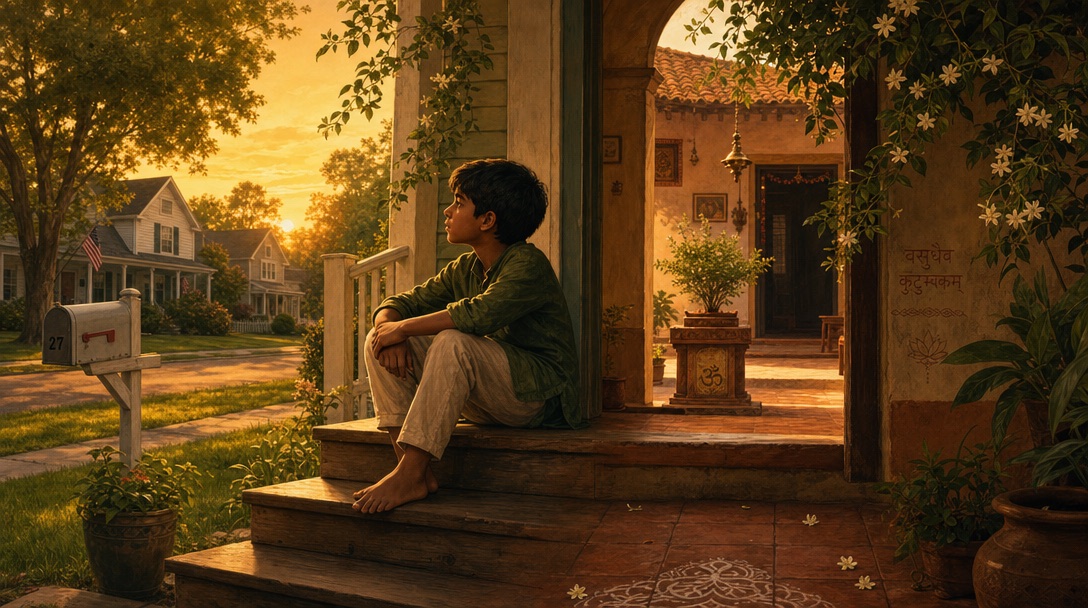
I watch them and I see the question this essay cannot answer: What survives the crossing? Not all of it. You cannot carry every room of the house across an ocean. Some rooms you lock, and when you return years later, the furniture has aged differently than you have.
What gets lost
I will name what I have lost, because pretending otherwise would make this essay dishonest.
I have lost fluency. Not in any one language — I can still speak Telugu, still follow Tamil, still dream in Hindi, still work in English. But I have lost the depth that comes from living inside a language daily, from arguing in it, from telling jokes whose punchlines depend on a shared neighborhood, from reading the newspaper in it every morning until the syntax becomes invisible. I read English that way now. I read nothing else that way. That is a loss, and I chose it, and I would probably choose it again, and it is still a loss.
I have lost context. When a friend in Chennai references a Tamil movie scene as shorthand for an emotion, I sometimes miss the reference. When my mother uses a Telugu proverb, I understand the words but not always the weight behind them — the weight that comes from hearing it used a hundred times in the right situations, not just twice across a phone line. Language is not vocabulary. It is frequency of exposure. And I have been exposed to other frequencies for twenty-three years.
I have lost the uncomplicated right to claim. This is the most uncomfortable one. When I write about Tamil identity, about Telugu roots, about Indian belonging — I do it from Texas. I do it from a house with central air and a two-car garage and a school district that has never heard of Sangam poetry. I have not stood in a Chennai bus queue in July. I have not negotiated with a landlord in Hyderabad. I have not attended a funeral in my village in years. My opinions about Indian identity are formed at a distance, and distance changes the focal length of everything.
The diaspora does not lose its roots. It loses the soil around them. The roots remain — suspended, reaching, alive — but the ground they grew in is somewhere else now.
What remains
And yet.
I let my thoughts linger in the present, most days. The present comes in whatever package it comes packed — a Texas sunset, a work meeting, a school pickup, an evening walk where the only language is English and the only culture is suburban American default. I taste it. It is mine. It is real. I do not need it to be anything else.
But sometimes, without warning, the mind drifts. Not dramatically. Not with nostalgia music playing. Just a quiet drift — to the taste of a food my mother made that I have never been able to replicate, to a street in North India where I played cricket with friends whose last names I have forgotten but whose laughter I have not, to the sound of Tamil film songs that I absorbed through walls and auto-rickshaws and never chose to love but love anyway, to a Telugu word my grandmother used that has no English equivalent and that I will carry untranslated until I die.
These are not memories I summon. They arrive. And when they arrive, all four maps are open at once — Tamil roots, Telugu language, North Indian friendships, American life — and none of them is asking to be ranked. They coexist the way ingredients coexist in a dish that should not work but does, because someone's hands knew what they were doing even if they could not explain the recipe.
The question my children will answer
I used to think the identity question was mine to solve. Pick a flag. Pick a language. Pick a home. File yourself correctly so the world can process you.
I no longer believe that. I believe the question was never mine. It belonged to the systems — the school admissions, the neighborhood labels, the "where are you really from?" at parties, the nation-states that need you to be one thing on a form. Those systems need you filed. You do not need to be filed. You need to be whole.
My children will face their own version. They will be asked, in America, where they are "really" from. They will be asked, in India, why their Tamil is imperfect. They will carry passports that say one thing and kitchens that say another and memories that say a third. They will not fit neatly. No one in our family ever has.
What I hope to give them is not a category. It is a permission: you do not have to choose. You do not have to rank your inheritances. You do not have to amputate a part of yourself to make the rest legible to strangers. Carry it all. Carry it imperfectly. The mess is the identity.
If someone asks, "Where are you from?" — the honest answer is: from a Telugu-speaking family shaped by Tamil, raised in North India, married to a Tamil woman whose mother was born in Burma and whose father's roots are Gujarati, living in Texas with two children who will answer this question differently than I do. We are from everywhere we have been loved.
But what happens when the world keeps asking for only one address?
— VJ
A note on how I write
I am not a writer. I am a person with strong opinions and scattered notes. Every essay on this site started as a messy brain-dump — half-formed arguments, bullet points, and “you know what I mean” — that I hand to an LLM. Another LLM handles the background research needed to find the facts that support an argument. And then it all gets translated into writing far too good for me to pretend is mine. The ideas are mine. The craft is not. They say blogs are dead — but I am falling in love with this. It gives me an outlet for expression that would otherwise have stayed buried in my head. I believe you deserve to know all of that.