
You have probably used ChatGPT. Maybe you have asked it to rewrite an email, explain a concept, or summarize a long document. If so, congratulations — you are already ahead of most people. But there is a next level, and it is not as far away as you think.
That next level is AI agents. And the gap between understanding them and ignoring them is widening every week.
This essay is for the person who has heard the term “AI agent” thrown around and felt a quiet anxiety. The person who wonders if the train has already left the station. It has not. But it is boarding.
The difference, in one sentence
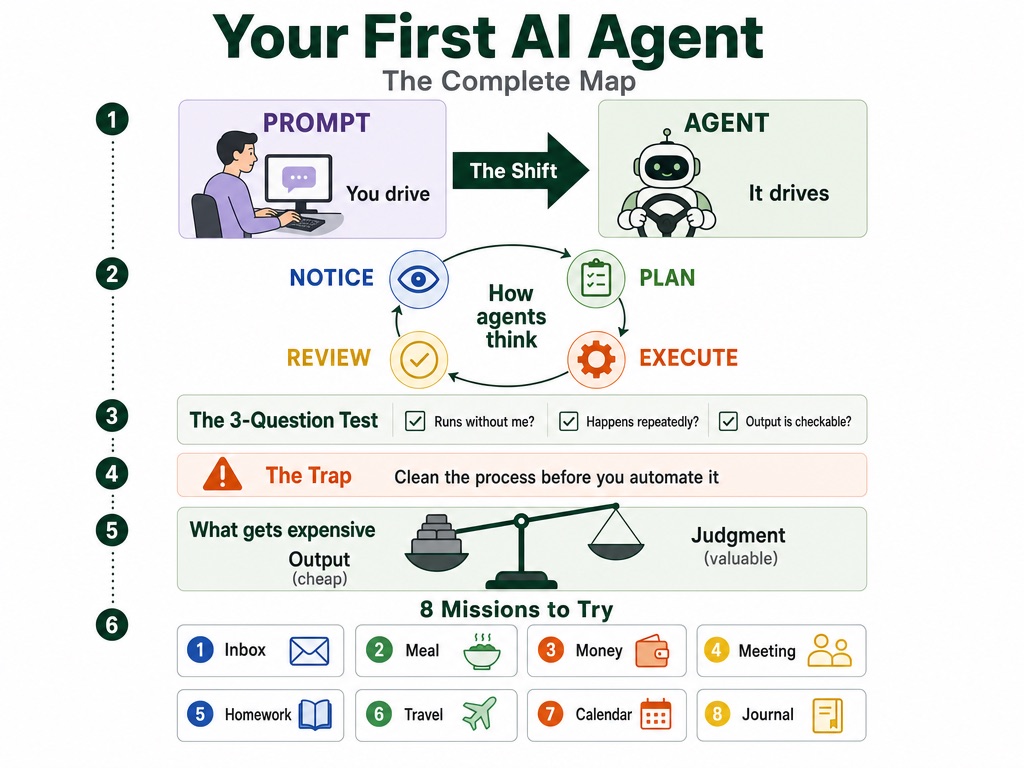
When you use ChatGPT, you are driving the car. You type a question, you get an answer, you decide what to do next, and you type again. Every step requires you to steer.
An AI agent is different. You tell it where you want to go, and it drives itself. It figures out the route, handles the turns, adjusts when there is traffic, and tells you when it arrives.
Prompt (you drive)
“What are three good restaurants near me for a team dinner?”
You get a list. You research each one. You check availability. You make the reservation yourself.
Agent (it drives)
“Find a restaurant for eight people next Thursday, within 20 minutes of the office, with a private room and good vegetarian options. Book it and send the invite.”
Done.
That is the shift. A prompt gives you information. An agent gives you outcomes.
How an agent actually thinks
Under the hood, an agent is not one magic brain. It is a team of four instincts working together in a loop.
Think of it like a really good executive assistant on their first week. They do not just do what you say — they notice what needs doing, plan the best sequence, execute the steps, and then review whether the result is actually good before handing it to you.
Here is a real example. Say you run a small business and every month you spend two hours pulling numbers from your accounting tool, comparing them to last month, writing a summary, and emailing it to your partner.
An agent handles that in four moves:
- Notice — It is the first of the month. Time to pull the numbers.
- Plan — Pull revenue and expenses. Compare to last month. Flag anything that changed by more than 10 percent.
- Execute — Generate the summary. Format it cleanly. Draft the email.
- Review — Does the math add up? Are the comparisons fair? Is the tone right for my partner? Adjust and send.
You did not touch a spreadsheet. You did not write a sentence. The agent ran the whole loop. And if next month your accounting tool changes its export format, the agent adapts. It does not just crash — it figures out a new route, like a GPS recalculating after a wrong turn.
That ability to recover and reroute is what separates a true agent from a simple automation. An automation follows a script. An agent follows a goal.
When to use an agent (and when not to)
Not everything needs an agent. In fact, most things do not. The trick is knowing which tasks are worth handing off.
Here is a simple test. Ask three questions about the task:
Can it run without me watching? If the task requires your live judgment at every step — like negotiating a deal or consoling an upset customer — an agent is the wrong tool.
Does it happen more than once? A one-off creative project is a prompt job. A weekly report, a daily triage, a monthly reconciliation — those are agent jobs.
Can I tell if it did a good job? If the output is measurable or checkable — the numbers match, the email went to the right person, the summary is accurate — an agent can own it. If “good” is purely subjective and changes every time, keep it human.
If all three answers are yes, you are looking at an agent candidate. If even one is no, stick with a prompt or do it yourself.
Here are a few everyday examples that pass the test:
- Scanning your inbox every morning, sorting messages by urgency, drafting replies to routine ones, and flagging the rest
- Monitoring your competitor’s website and alerting you when they change pricing or launch a new product
- Reconciling your daily sales against your POS system and flagging discrepancies before your bookkeeper sees them
- Pulling the top five news stories in your industry every morning and summarizing them in your voice for your team Slack
None of these require genius. All of them eat hours every week. That is the sweet spot.
The trap: automating a mess
Here is where most people fail, and it has nothing to do with technology.
An agent does not fix a bad process. It scales it. If your monthly reporting is a mess of inconsistent spreadsheets, half-remembered formulas, and “I think we usually do it this way,” then an agent will produce that mess faster and with more confidence than you ever could.
Before you hand a task to an agent, you need to be able to answer three things clearly:
1. What is the goal? Not vaguely. In one sentence. “Produce a weekly P&L summary comparing this week to last, emailed to my partner by Monday 8 a.m.”
2. What does good look like? How will you know the agent got it right? “The numbers match our accounting tool. The email is under 200 words. Anything over a 10 percent change is highlighted.”
3. What are the actual steps? Not hand-wavy. Concrete. “Log into the tool. Export this specific report. Compare column D to last month’s column D. Calculate the delta. Write the summary. Send to this address.”
If you cannot describe those three things to a smart new hire on their first day, you cannot describe them to an agent. The agent is not the bottleneck. Your clarity is.
That sounds like a limitation. It is actually a gift. The process of preparing a task for an agent forces you to understand your own work better than you ever have. Most people discover, when they try to write out the steps, that they have been running on habit and improvisation for years. The agent makes you confront that. And the confrontation alone is worth it — even if you never build the agent.
Start narrow, embarrassingly narrow
The biggest mistake beginners make is trying to build an agent that does everything. Do not build an AI chief of staff on day one. Build an AI that does one annoying thing you hate.
Think about your last week. What task made you groan? What did you put off until the last minute because it was tedious but necessary? What took thirty minutes but felt like it should take three?
That is your first agent.
Maybe it is expense categorization. Maybe it is pulling your kids’ school calendar updates into your family calendar every Sunday. Maybe it is scanning job boards for a specific kind of role and sending you a digest. Maybe it is reviewing your daily sales and texting you a one-line summary before you even get out of bed.
It does not have to be impressive. It has to be specific, repeated, and checkable. Narrow wins. Every time.
The companies and individuals winning with AI agents right now are not the ones building the broadest systems. They are the ones solving one specific, tedious, high-frequency problem better than anyone else.
What changes when output is cheap
Here is the part that matters most, and the part most people miss.
When agents can do the work — write the report, draft the email, reconcile the data, monitor the feed — the work itself gets cheap. Not worthless, but cheap. The same way the internet made information cheap. The same way spreadsheets made arithmetic cheap.
When output is cheap, something else gets expensive: judgment.
The ability to look at what the agent produced and know whether it is good. The ability to define what “good” means in the first place. The ability to ask the right question, set the right standard, and know when the agent is confidently wrong.
That is where your value moves. Not to doing more work. To knowing what good work looks like. The person who can define quality, spot errors, and set standards will be more valuable in the age of agents than the person who can grind through tasks. The grinder gets replaced. The quality-setter becomes essential.
This is actually good news for people who know their craft deeply. A chef who understands flavors will use an agent to handle inventory and scheduling and spend more time on the food. An accountant who understands tax strategy will use an agent to handle data entry and spend more time advising clients. A teacher who understands how kids learn will use an agent to handle grading and spend more time teaching.
The agent does not replace your expertise. It removes the busywork that was burying it.
Choose your first agent mission
Pick one tiny, repeated task. Your goal is not to build something impressive. Your goal is to finish one useful loop.
Before you start, check the task
Ask AI to sort 10 unread emails into urgent, reply later, and ignore.
You can open your inbox and know what deserves attention first.
Turn pantry items into 5 dinners and one grocery list.
You have a week of meals planned without opening a recipe app.
Categorize last month’s transactions and flag subscriptions.
You know your top 3 spending categories and found at least one forgotten subscription.
Generate 3 things to know and 2 questions to ask before your next meeting.
You walk into the meeting feeling prepared instead of winging it.
Explain one problem at the child’s grade level — teach the thinking, not the answer.
Your kid says “oh, I get it” and solves the next one themselves.
Build one day of the itinerary first, not the whole trip.
You have a day plan you would actually follow — with restaurants, timing, and a backup option.
Find conflicts across one upcoming week.
You spotted a scheduling conflict before it became a Sunday-night scramble.
Summarize this week into wins, drains, and patterns.
After 3 Fridays, you can name the one thing that consistently drains your energy.
Where to start — pick any one
All four have free tiers generous enough for every mission above. Do not comparison-shop. Pick the one you have heard of, sign up, and start. You can switch later. The tool matters far less than the habit.
You will know it is working when…
- You catch yourself saying “let me ask the AI” before opening a spreadsheet.
- A task that used to take thirty minutes finishes while you are making coffee.
- You start noticing tasks that could be handed off — everywhere, all the time.
- Someone asks how you got something done so fast and you are not sure whether to explain or just smile.
- You stop thinking about AI as a tool and start thinking of it as a teammate with a very specific skill set.
Your first agent does not need to be impressive. It needs to be finished.
Pick one mission, run it badly once, then improve it next week.
You are not late
If you are reading this and feeling behind, here is the truth: most people have not started. The ones who have are mostly experimenting, not mastering. The gap between you and them is a few weekends of curiosity, not years of study.
The train is boarding. The seat is open. You do not need an engineering degree or a subscription to every AI tool on the market. You need one specific task, a clear definition of done, and the willingness to start small.
The rest you will figure out on the way. That is how everyone who got here early did it too.
— VJ
A note on how I write
I am not a writer. I am a person with strong opinions and scattered notes. Every essay on this site started as a messy brain-dump — half-formed arguments, bullet points, and “you know what I mean” — that I hand to an LLM. Another LLM handles the background research needed to find the facts that support an argument. And then it all gets translated into writing far too good for me to pretend is mine. The ideas are mine. The craft is not. They say blogs are dead — but I am falling in love with this. It gives me an outlet for expression that would otherwise have stayed buried in my head. I believe you deserve to know all of that.