On May 10, 2026, Tamil Nadu did something it hadn't done since 1967. It elected a Chief Minister who belongs to neither the DMK nor the AIADMK. C. Joseph Vijay was sworn in as the state's ninth Chief Minister, ending nearly six decades of alternating Dravidian rule.
The shock of the result has already faded into the usual coverage — cabinet lists, oath-ceremony attendees, which fan club leader got which portfolio. The deeper story, the one worth telling now while the moment is still warm, is what voters actually rejected.
It wasn't DMK's specific promises. It wasn't AIADMK's legacy. It was the manifesto cycle itself.
The sixty-year auction
Every Tamil Nadu election since Kamaraj's mid-day meals has been, structurally, the same event. Two parties stand on a stage. Each holds up a list of free things. Whichever list is longer, more emotionally targeted, and better marketed usually wins. The winner spends five years partially delivering. The loser spends five years preparing a longer list. The cycle restarts.

In 2026, the lists looked like this. DMK promised ₹8,000 coupons for homemakers to buy appliances, free laptops for government college students, a ₹2,000 monthly entitlement for women, and an enhanced old-age pension. TVK responded with ₹2,500 monthly for women heads of households, 8 grams of gold for brides from poorer families, six free LPG cylinders a year, 200 units of free electricity, ₹25 lakh family health insurance, and five lakh government jobs.
Voters didn't pick TVK because TVK's list was longer. They picked TVK because — and this is the part that should keep both old parties up at night — they no longer trust the format. The auction has lost its bidders' confidence. A new auctioneer can buy you a cycle or two. A new auction can buy you a generation.
What a manifesto actually is
Step back from the politics and look at a manifesto as a document. What is it?
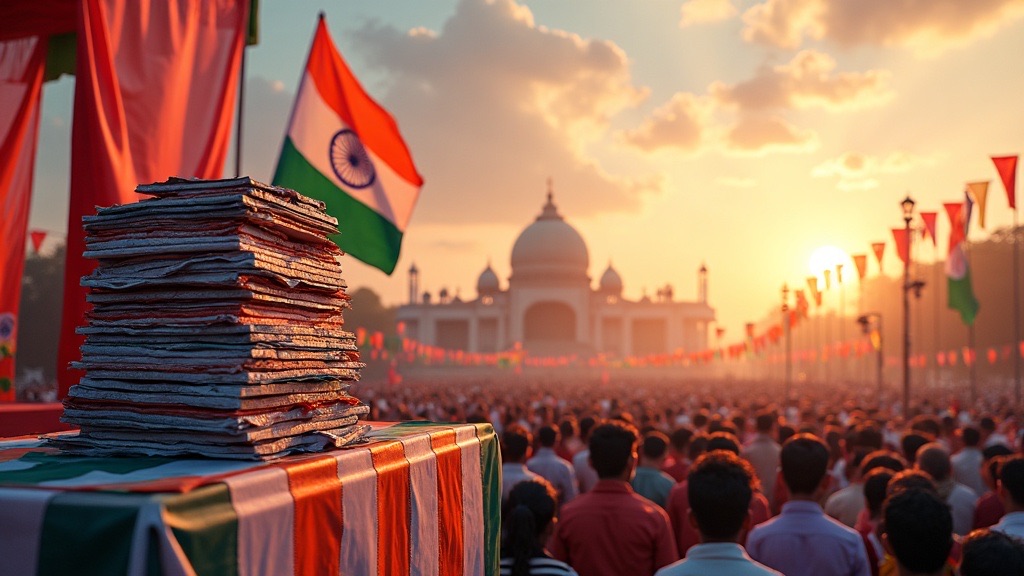
It is a fixed list of promises, written twelve to eighteen months before delivery begins, by a small team that does not know what the state will look like in year three or year five. It is locked the day it is printed. It cannot respond to a flood in Velachery in 2027, a chip-factory layoff in Hosur in 2028, or a fertilizer crisis in the Cauvery delta in 2029. It is a five-year plan in the worst sense — a static answer to a moving question.
Think of a manifesto as a printed train timetable from 1985. It told you the train would leave Egmore at 6:40 a.m. and arrive in Coimbatore at 1:15 p.m. If the train was late, you waited. If the route flooded, you waited. If a faster route opened, you didn't know. The timetable was the truth even when it wasn't.
Now think of how we actually navigate the world today. Google Maps doesn't hand you a timetable. It senses the road in real time, reroutes around accidents, learns which streets flood in monsoon, and gives you an ETA that updates every thirty seconds. The destination is yours. The route is the system's job.
That is the difference between manifesto-democracy and what comes next.
The half-step TVK already took
To TVK's credit, their manifesto recognized this — at least partially. Among the welfare promises sits a quieter line item: the Vetri TN Super App, an AI-monitored citizen services platform promising certificates within twenty-one days and real-time complaint redressal.

This is good. It is also not nearly enough.
The Super App as described is a faster checkout counter for a fixed menu. A citizen wants a land title. The app routes them. The AI tracks the SLA. The certificate arrives in twenty-one days. Excellent. But the menu — what the government is actually working on — is still the manifesto. Static. Five years old. Written before the problem you're living through this month existed.
What Tamil Nadu needs is not a Swiggy for government services. It needs something closer to a nervous system. A state that continuously senses where citizens are hurting, prioritizes by severity, assigns ownership, and lets every citizen watch the response in real time.
That is the system the next three posts in this series will describe.
What we're proposing
Across the next three essays, this series sketches a blueprint for what we'll call a Mandate Engine — a governance operating system, AI-native at its core, that does four things the manifesto cycle structurally cannot.
It listens. Not just to focus groups and party cadres, but to social media in Tamil and English, local news, citizen portals, sensor data, and the field reports of village-level workers who have always known where the pain is.
It prioritizes. AI clustering turns the noise of complaints into a finite, ranked list of real problems, each with a severity score and an affected-population estimate attached.
It assigns. Every problem gets a public ticket, a named owner, a deadline, and a status page. The Velachery flood becomes case TN-CHN-2026-1142, assigned to a specific officer in the corporation, visible to every citizen who searches for it.
It accounts. Citizens with valid state ID can follow any case, subscribe to updates, see who is responsible, and read the audit trail. Departments and ministers carry public scorecards. Missed deadlines escalate automatically. Disinformation is filtered — but moderation itself is published. The system makes truth cheap and lies expensive.
Part 2 will detail how this works across Tamil Nadu's urban-rural divide — AI sensing where bandwidth is abundant, human-mediated sensing through Village Administrative Officers, ASHA workers, and Anganwadi staff where it isn't. Part 3 will get into the trust stack: accountability mechanics, fact-checking, and the hard problem of designing the system so it cannot be captured by whoever is in power. Part 4 will lay out a 100-day, one-year, and five-year implementation plan with budget, owners, and a risk register.
The window
Vijay's government has roughly six months of honeymoon. Maybe a year. In that window, the cost of doing something genuinely new is the lowest it will be for a decade. Every government before this one inherited the manifesto cycle and ran it. This government won by — without quite saying so — running against it. That gives it permission no party has had in sixty years to build something the manifesto cycle couldn't.
If Vetri means only that a new party is in power, history will record it as a regime change. If it means a state that learns, accounts, and responds in real time, history will record it as a system change.
The first happens every few decades. The second is rarer. It also lasts longer.
A note on how I write
I am not a writer. I am a person with strong opinions and scattered notes. Every essay on this site started as a messy brain-dump — half-formed arguments, bullet points, and “you know what I mean” — that I hand to an LLM. Another LLM handles the background research needed to find the facts that support an argument. And then it all gets translated into writing far too good for me to pretend is mine. The ideas are mine. The craft is not. They say blogs are dead — but I am falling in love with this. It gives me an outlet for expression that would otherwise have stayed buried in my head. I believe you deserve to know all of that.