
Something extraordinary happened in the last three years, and most people missed it because it happened gradually, tool by tool, update by update, until one morning the world was simply different.
The gap closed.
Not the wealth gap. Not the education gap. Something more fundamental: the capability gap. The distance between what a well-funded expert could do and what a motivated individual with a laptop could do — in almost every field — collapsed to nearly zero.
A 22-year-old in Lagos with a $300 laptop now has access to the same AI research tools, design software, legal databases, medical knowledge, and financial modeling that a partner at McKinsey had exclusive access to five years ago.
That sentence would have been aspirational in 2023. In 2026, it is a fact. And its implications are staggering.
What actually changed
It was not one thing. It was everything, all at once:
AI became a universal skill amplifier. Not a replacement for thinking — an amplifier of it. A first-year law student can now research case law with the speed and pattern recognition of a senior associate. A solo founder can produce marketing materials that compete with agencies. A nurse practitioner in a rural clinic can access diagnostic reasoning that used to require a specialist in a teaching hospital.
Tools became free or nearly free. The cost of professional-grade software collapsed. Design tools, video production, code editors, data analysis platforms, AI assistants — the free tier of 2026 is more powerful than the enterprise tier of 2020. The paywall around professional capability is gone.
Knowledge became conversational. You no longer need to know where to find information. You need to know what to ask. And the tools are getting better at helping you ask the right questions. The advantage of having attended the right school, read the right textbook, or worked at the right company — that advantage has shrunk dramatically.
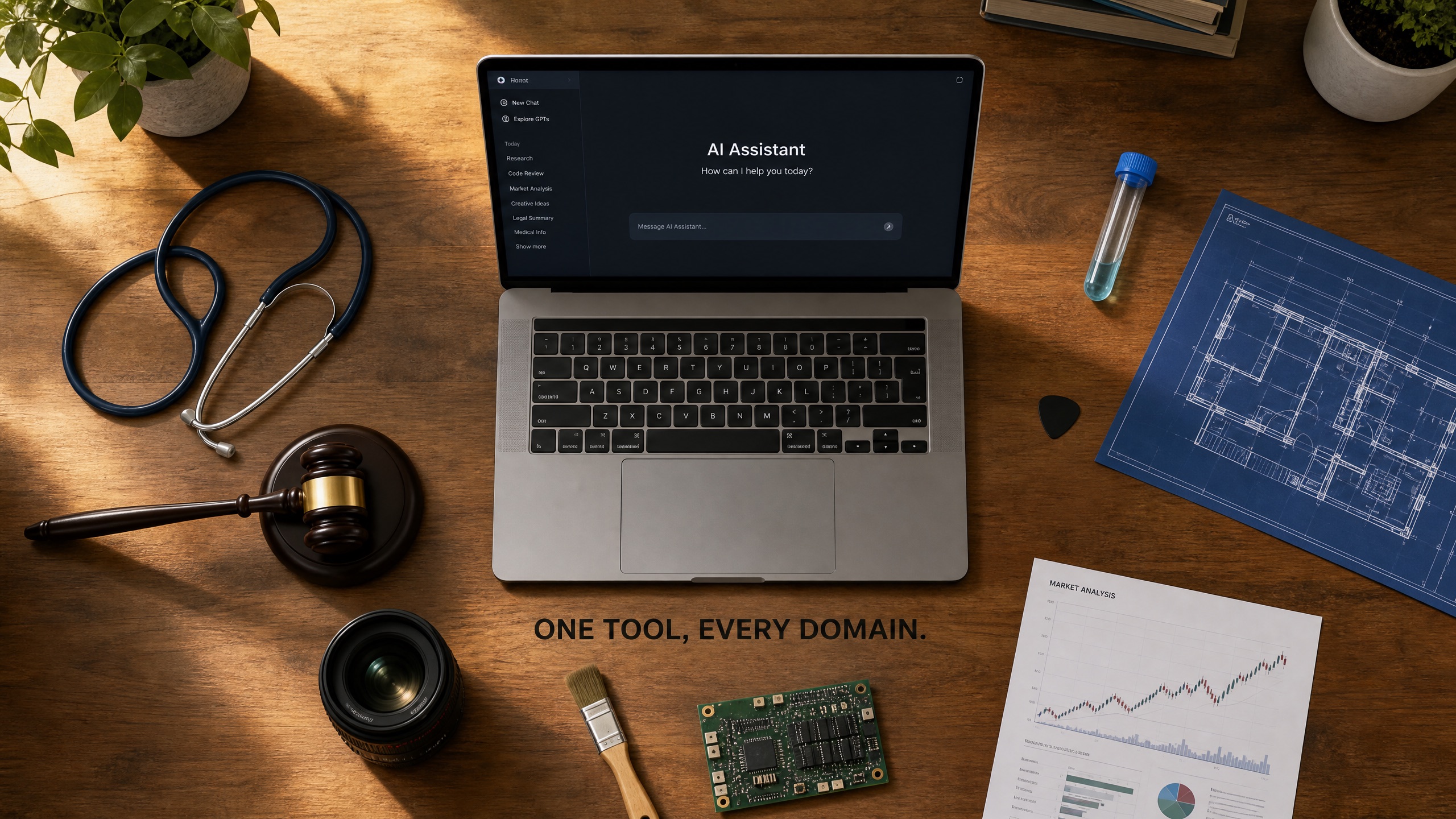
The great equalizer, domain by domain
This is not theoretical. Here is what the leveling looks like in practice, right now, across industries that used to have towering barriers to entry:
Law
AI legal research tools can review contracts, find precedent, and draft documents. A solo practitioner now competes with a team of paralegals.
Medicine
AI diagnostic assistants give rural clinicians access to specialist-level pattern recognition. Medical knowledge is no longer locked behind residency programs.
Design & Creative
Professional-quality design, video, and music production tools are free. A teenager with taste can produce work that rivals a studio.
Finance
AI-powered analysis tools democratized financial modeling. Retail investors access the same data and reasoning frameworks as institutional analysts.
Software Engineering
AI coding assistants turned every programmer into a 10x engineer. Non-programmers build functional software through conversation.
Education
AI tutors provide personalized, adaptive instruction in any subject. A student in a village gets the same quality of explanation as one in a private academy.
Architecture & Engineering
AI-powered CAD and simulation tools collapsed the learning curve. Parametric design that took years to master is now assistable in weeks.
Journalism & Writing
Research, fact-checking, and data analysis that took newsrooms weeks now takes hours. A single writer has the investigative reach of a team.
The pattern is the same in every domain: the knowledge advantage is gone. The tools advantage is gone. The access advantage is gone. What remains is something technology cannot give you.
So what is the new advantage?
When everyone has the same tools, the differentiator is not skill. It is direction.
This is the part most people have not caught up to yet. They are still operating on the old model — acquire skills, acquire credentials, acquire access — when the new model is fundamentally different.
The new model is: pick what matters to you, go deep, and the tools will meet you there.
Think about what that means. For the first time in human history, the question is not "What can I get access to?" but "What do I actually care about enough to commit to?" The constraint is no longer external. It is internal.

This is simultaneously liberating and terrifying. Liberating because the doors are open. Terrifying because you can no longer blame the locked door for not walking through it.
The meaning filter
Here is the practical implication: if you can now succeed in any domain, the rational move is to pick the one that has the most meaning for you. Not the most prestige. Not the highest salary. The most meaning.
Why? Because in a world where tools are equal, the differentiator is persistence. And persistence comes from caring. The person who works on something because it matters to them will always outlast the person who chose a field because it looked lucrative.
Passion used to be a luxury. In 2026, it is a strategy. The person who cares the most about the problem will outwork, outlearn, and outlast everyone who is just chasing the market.
A teacher who is obsessed with how children learn will build better AI tutoring tools than any ed-tech startup staffed by people who picked education because it was a growing market. A nurse who has watched patients fall through the cracks of the healthcare system will design a better patient tracking system than a consulting firm that has never been inside a clinic at 3 AM.
Domain knowledge still matters — but it is no longer the kind you buy. It is the kind you live. And that kind cannot be faked, outsourced, or acquired through a two-year MBA.
What this means for you, right now
If you are reading this and feeling the pull of a domain you have always been curious about — but dismissed because you did not have the credentials, the connections, or the capital — the excuse is gone.
- The cost of starting is zero. Every major AI tool has a free tier. Open-source alternatives exist for everything else. You can start learning, building, and producing today — not after you save enough, not after you finish a degree, today.
- The learning curve is compressed. What used to take five years of apprenticeship now takes months of focused, AI-assisted practice. You are not starting from zero. You are starting from AI.
- The market rewards authenticity. In a world flooded with AI-generated content, the human who brings genuine domain experience, real stories, and lived understanding stands out more than ever. Your unique perspective is your moat.
- Geography is irrelevant. You can serve clients, build audiences, sell products, and collaborate with teams anywhere on earth. The zip code you were born in no longer determines the ceiling of what you can achieve.

The only question that matters
The old question was: "What can I realistically do given my circumstances?"
The new question is: "What would I do if the tools were not the bottleneck?"
Because they are not. Not anymore.
The field is level. The tools are free. The knowledge is accessible. The barriers are down. For the first time in history, billions of people have access to capability that was reserved for a privileged few.
The only variable left is you. What you choose. What you care about. What you are willing to commit to when no one is watching and no credential is forcing your hand.
The world did not just get flatter. It got fairer. Not perfect. Not equal in every way. But fairer in the ways that matter most for someone who wants to build something, learn something, or become something they were not yesterday.
The field is level.
Now pick your game. And play it like it matters.
Because it does.
For everyone who was told they could not.
The answer changed. You just have to look up.
A note on how I write
I am not a writer. I am a person with strong opinions and scattered notes. Every essay on this site started as a messy brain-dump — half-formed arguments, bullet points, and “you know what I mean” — that I hand to an LLM. Another LLM handles the background research needed to find the facts that support an argument. And then it all gets translated into writing far too good for me to pretend is mine. The ideas are mine. The craft is not. They say blogs are dead — but I am falling in love with this. It gives me an outlet for expression that would otherwise have stayed buried in my head. I believe you deserve to know all of that.