Dear Mayor and Council Members,
Cedar Park is one of the fastest-growing cities in Texas. That growth is a vote of confidence from tens of thousands of families who chose this city. They moved here for good schools, safe neighborhoods, reasonable taxes, and a local government that works.
But here is what most of them cannot answer today:
That is not a failure of intent. It is a failure of infrastructure. The information exists inside city systems. It just does not reach citizens in a way they can actually use.
This letter is about fixing that — not with more staff, not with a bigger budget, but with tools that already exist and that cities smaller than Cedar Park are already using.
The transparency gap is a trust gap
Trust in local government across America is declining, even in well-run cities. The reason is not corruption. It is opacity. When residents cannot see how decisions are made, what tradeoffs were considered, or whether promises were kept, they fill the void with suspicion.
The opposite of transparency is not secrecy. It is friction — information that technically exists but is practically invisible.
Cedar Park publishes agendas, minutes, and budgets. That is the legal minimum. But a 400-page budget PDF is not transparency — it is a wall. A resident who wants to know whether the Brushy Creek Road expansion is on schedule should not need to file an open records request or attend a Tuesday night meeting to find out.
The technology to close this gap is not futuristic. It is off-the-shelf. And the cities that adopt it first will set the standard that residents everywhere come to expect.
Five moves that would make Cedar Park the most transparent city in Texas
1. A real-time budget dashboard
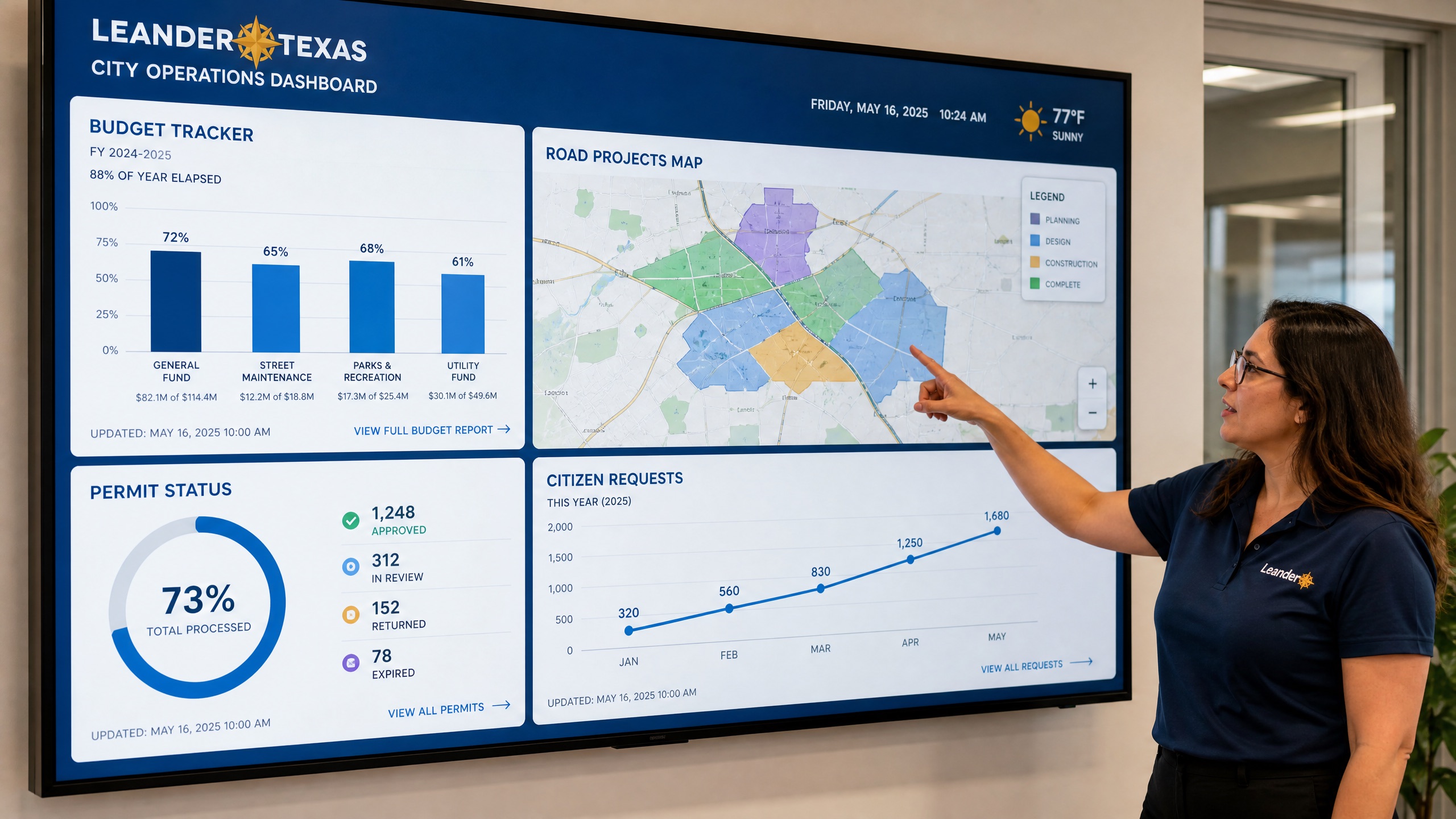
Replace the annual budget PDF with a live, interactive dashboard that every resident can access from their phone. Show exactly where money is allocated, how much has been spent, and what remains — updated monthly, broken down by department.
What this costs
Open-source budget visualization tools exist. Cities like Waco and Round Rock have deployed them for under $15,000. An AI chatbot layer on top of existing budget data adds another $5,000-10,000/year. Total: less than one FTE.
2. A project tracker residents can actually follow
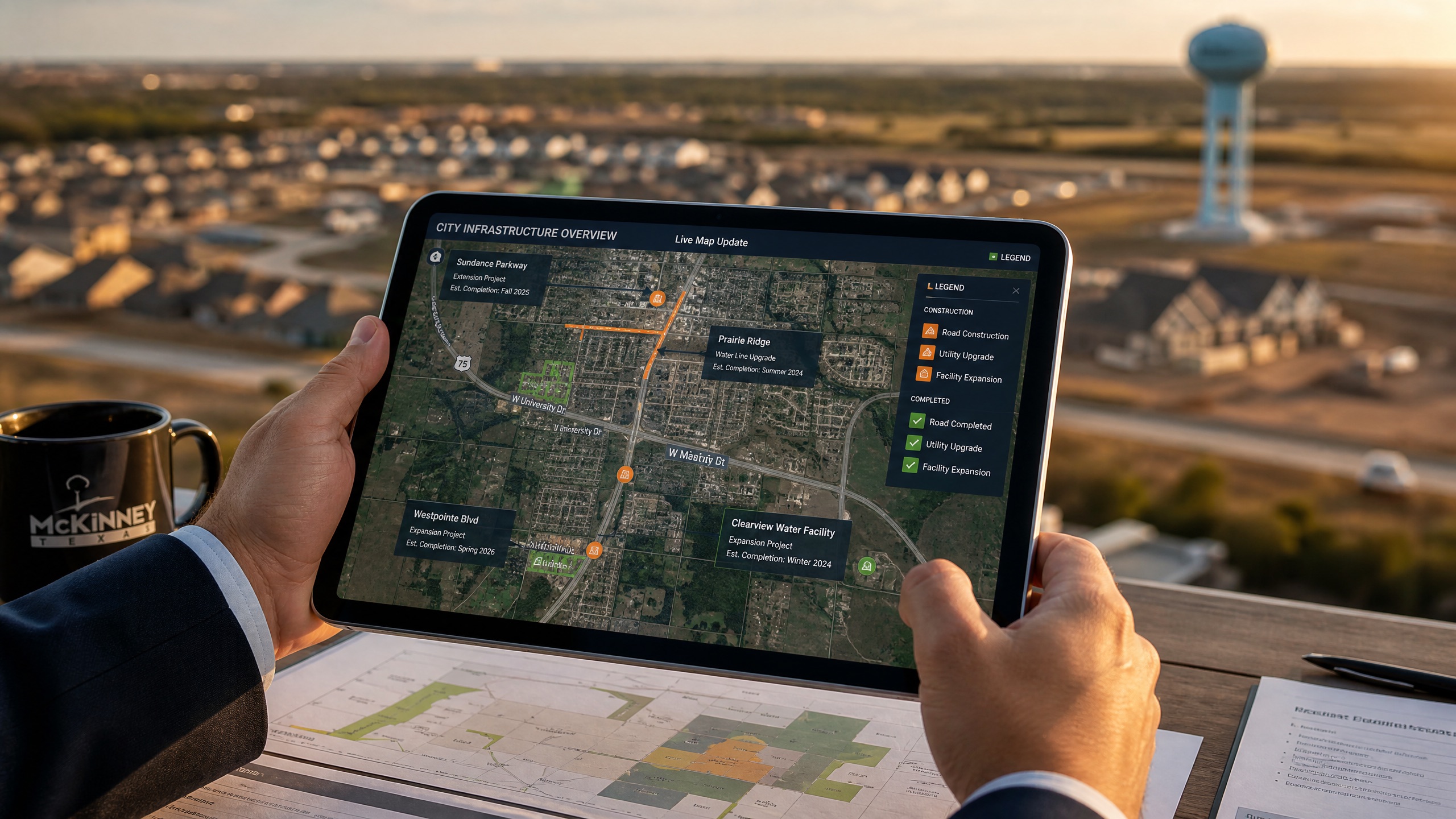
Every capital improvement project — road, park, utility, facility — should have a public status page. Not buried in council minutes. A dedicated, visual tracker showing: what was approved, when it started, current progress, expected completion, and actual spend versus budget.
When a project runs late or over budget, residents see it in real time. When it finishes early or under budget, the city gets credit. Either way, the information is not a surprise at the next bond election.
Who is doing this already
McKinney, TX runs a public capital projects dashboard. Georgetown publishes project status updates with map integration. Cedar Park has the data — it just needs the front end.
3. AI-powered citizen response
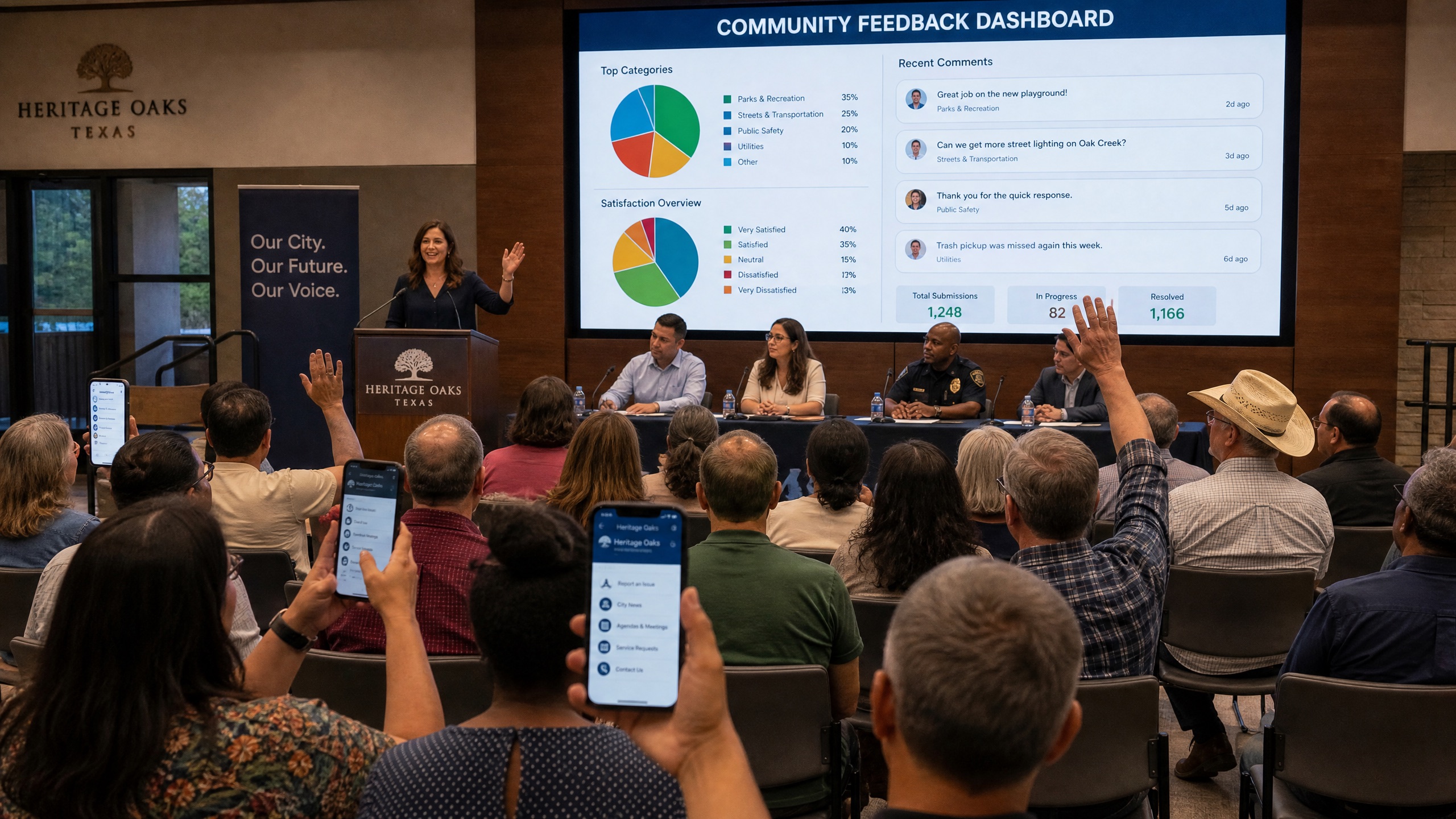
The average Cedar Park resident who emails city hall about a pothole, a permit question, or a park maintenance issue waits days for a response — if they get one at all. Not because staff does not care, but because the volume exceeds capacity.
An AI-powered system can do three things immediately:
- Acknowledge every request instantly — with a ticket number, expected timeline, and the responsible department
- Answer routine questions automatically — "What are the brush pickup dates?" should not require a human to respond to
- Route complex issues to the right person — with full context, so the resident does not have to repeat themselves
A resident who gets an instant, accurate response feels heard. A resident who emails into silence feels ignored. The technology difference is trivial. The trust difference is enormous.
4. Open meetings, truly open
Council meetings are public. But "public" currently means: show up in person on a Tuesday night, or scrub through hours of video later. That is not access — it is a filter that selects for retirees and activists.
Modern tools can change this:
- AI-generated meeting summaries — published within hours, not weeks. Plain English, not minutes-speak. "Council voted 5-2 to approve the Cypress Creek rezoning. Key concerns raised: traffic impact, school capacity."
- Searchable meeting archive — a resident types "water rates" and gets every moment from the last two years where water rates were discussed, with timestamps and context
- Vote tracking — a simple public record of how each council member voted on every issue, with links to the discussion. Not hidden in minutes. Visible.
The technology exists today
AI transcription and summarization tools like Otter.ai, Fireflies, or open-source Whisper can produce accurate meeting summaries at near-zero cost. The City of Leander piloted AI meeting summaries in 2025. Cedar Park can do this tomorrow.
5. A promise tracker
Every campaign season, candidates make promises. Every council session, commitments are made. And then — silence. Not because promises are broken, but because there is no system for tracking them publicly.
A simple promise tracker would:
- Log every public commitment made by the council
- Track its status: not started, in progress, completed, modified, or abandoned
- Link to evidence: the budget line item, the project status, the vote record
- Be publicly accessible and updated quarterly
This is not adversarial. This is the council's own accountability tool. When a promise is kept, the tracker proves it. When circumstances change and a commitment must be modified, the tracker explains why. Either way, residents see a government that keeps score on itself.
What this looks like in practice
CedarPark.gov/budget
Interactive budget explorer. Search by department, project, or keyword. Compare year-over-year. See spending in real time.
CedarPark.gov/projects
Every capital project on a map. Click for status, timeline, photos, budget vs. actual. Updated weekly.
CedarPark.gov/ask
AI-powered Q&A. Ask anything about city services, get an instant answer or a ticket number. No phone tree. No hold music.
CedarPark.gov/meetings
Every council meeting summarized in plain English within 24 hours. Searchable archive. Vote tracker for every member.
CedarPark.gov/promises
Every public commitment tracked from announcement to completion. Quarterly updates. Linked to evidence.
Why Cedar Park, why now
Cedar Park is not Austin. It is not Dallas. It is a city of 90,000 people where the council members still live in the neighborhoods they represent, where the city manager answers to real voters, and where "how my taxes are spent" is not an abstract question — it is a conversation at Little Caesars after a kids' soccer game.
That proximity is an advantage. A city this size can move fast. It can pilot an AI budget chatbot in 90 days. It can launch a project tracker before the next bond election. It can publish AI meeting summaries before the next council session.
The cities that do this first will attract residents, businesses, and talent who value transparency. In a state where dozens of suburbs compete for the same growth, being the city that shows its work is a genuine competitive advantage.
Transparency is not a cost. It is a recruiting tool. The most accountable city in Texas will also be the most desirable one.
The ask
This letter asks the Cedar Park City Council to do three things:
- Commit to a transparency pilot. Pick one of the five proposals above. Fund it for six months. Measure resident engagement before and after.
- Appoint a transparency champion. One council member or staff lead who owns this initiative and reports progress publicly.
- Set a deadline. "We will launch [specific tool] by [specific date]." Public commitment. Public accountability.
That is it. Not a five-year strategic plan. Not a consultant-led study. One pilot, one champion, one deadline.
The technology is ready. The cost is minimal. The only thing missing is the decision to start.
Cedar Park's residents chose this city. They deserve to see their city working for them — not once a year in a budget document, not once a quarter at a council meeting, but every day, in real time, from their phone.
The tools exist. The question is whether Cedar Park will use them.
We think you will.
With respect and expectation,
Your neighbors
A note on how I write
I am not a writer. I am a person with strong opinions and scattered notes. Every essay on this site started as a messy brain-dump — half-formed arguments, bullet points, and “you know what I mean” — that I hand to an LLM. Another LLM handles the background research needed to find the facts that support an argument. And then it all gets translated into writing far too good for me to pretend is mine. The ideas are mine. The craft is not. They say blogs are dead — but I am falling in love with this. It gives me an outlet for expression that would otherwise have stayed buried in my head. I believe you deserve to know all of that.