Every summer, I clear my calendar for a few weeks and run leadership workshops for middle and high school students. People who know my schedule — the engineering day job, the business ventures, the family commitments — ask me why. Of all the things I could spend time on, why this?
The answer is simple: because nobody else is doing it well enough. And because the window to build this skill is closing faster than most parents realize.
You can learn to code at 30. You can pick up finance at 40. You can start a business at 50. Thousands of people do, every year, and they do it well. But leadership — the real thing, not the word on a college application — is built through years of practice, failure, group dynamics, and community-based problem-solving. And the foundation for all of that is laid between the ages of 11 and 16.
Every other skill has a second chance. Leadership has a window. And for most students, that window is right now.
I have watched too many talented young people reach college and then the workforce with brilliant technical skills and zero capacity to lead a room, resolve a conflict, build a coalition, or stand up for something when it was not popular. That gap does not start in college. It starts in middle school, when the curriculum is focused on everything except the skills that will matter most in their lives.
The gap that schools are not closing
Let me be clear: I am not blaming teachers. Most teachers are doing extraordinary work with limited resources and rigid curricula. The gap I am talking about is structural. It is baked into how the education system is designed.
Schools teach subjects. They do not teach students how to lead. They teach students how to perform individually. They do not teach them how to build and navigate a team. They test knowledge. They do not test judgment, empathy, decision-making under ambiguity, or the ability to stand in front of a group and move them toward a shared goal.
Public speaking
What students need: the ability to command a room, adapt to an audience, handle pushback, and communicate ideas that move people to action.
Team dynamics
What students need: how to delegate, how to resolve conflict within a team, how to motivate peers, how to lead without authority.
Decision-making
What students need: how to make decisions with incomplete information, weigh tradeoffs, take ownership of outcomes, and learn from failure.
Civic engagement
What students need: real interaction with local government, understanding how community decisions are made, and the confidence to participate.
Entrepreneurial thinking
What students need: how to identify problems, propose solutions, build prototypes, pitch ideas, and learn that failure is data, not shame.
Emotional intelligence
What students need: self-awareness, empathy, the ability to read a room, manage their own reactions, and support others under pressure.
This is not an indictment of the education system. It is a description of reality. Schools were designed to produce knowledgeable individuals. The world needs capable leaders. Those are two different outcomes, and the gap between them is where programs like ours live.

Why leadership, specifically, cannot wait
I hear this from well-meaning parents all the time: “We will focus on leadership later. Right now, grades and test scores matter.”
I understand the logic. I disagree with it completely.
Here is what the research and my own experience running these programs tells me: leadership is not a module you bolt on later. It is a foundation you build early. And the building materials — group dynamics, community projects, real-world problem-solving, standing up in front of peers — are only available in abundance during the middle and high school years.
The reason is developmental. Between 11 and 16, young people are forming their identity — their sense of agency, their relationship with authority, their understanding of how groups work. If you introduce leadership concepts during this window, they become part of who the person is. If you wait until college or the workplace, they become something the person has to perform. There is a world of difference.
A 13-year-old who learns to facilitate a group discussion will become a 23-year-old who naturally takes charge of a team. A 13-year-old who never gets that practice becomes a 23-year-old who reads a book about leadership and tries to apply frameworks that feel unnatural.
You do not build leaders by teaching leadership. You build leaders by putting young people in rooms where they have to lead — and letting them figure it out.
What we are building this summer
This summer, we are running three programs. Each one is designed to address a different dimension of the leadership gap, and each one is built around the same core principle: students learn by doing, not by listening.
Young Leaders
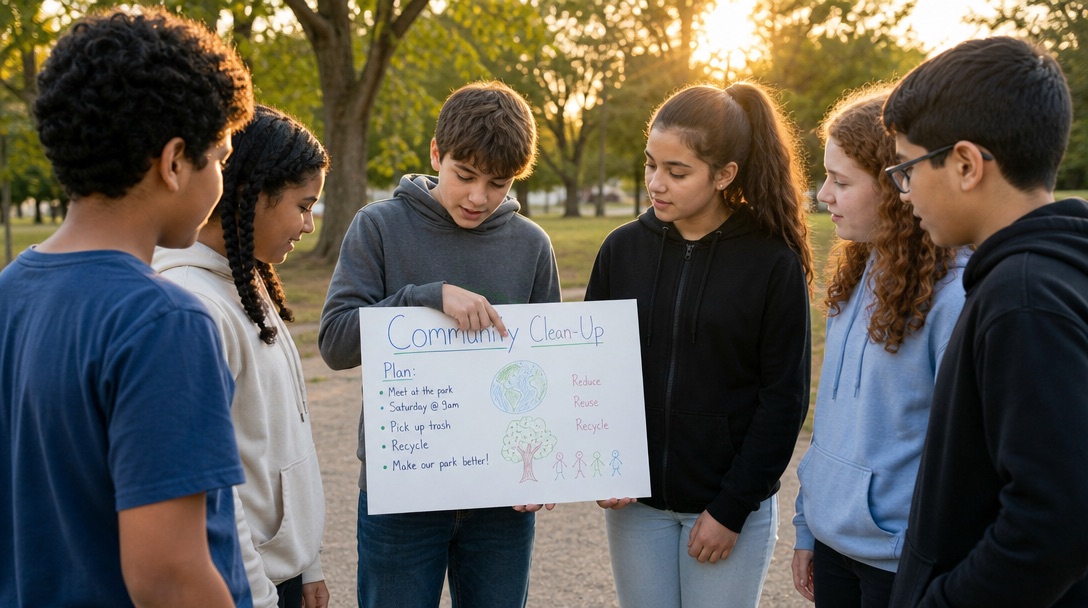
The foundation. Public speaking, team dynamics, project management, and community problem-solving. Students identify a local issue, form teams, and build a real proposal — then present it.
Civic Leadership
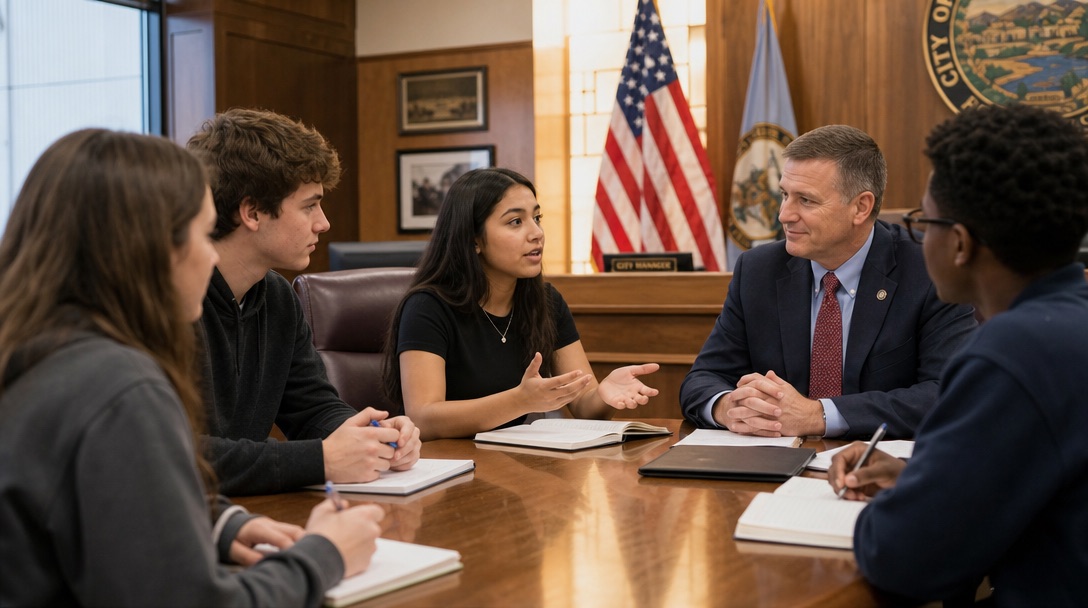
How local government works — and how to engage with it. Students meet real officials, attend public meetings, analyze community budgets, and draft civic proposals that address real needs.
Social Entrepreneurship
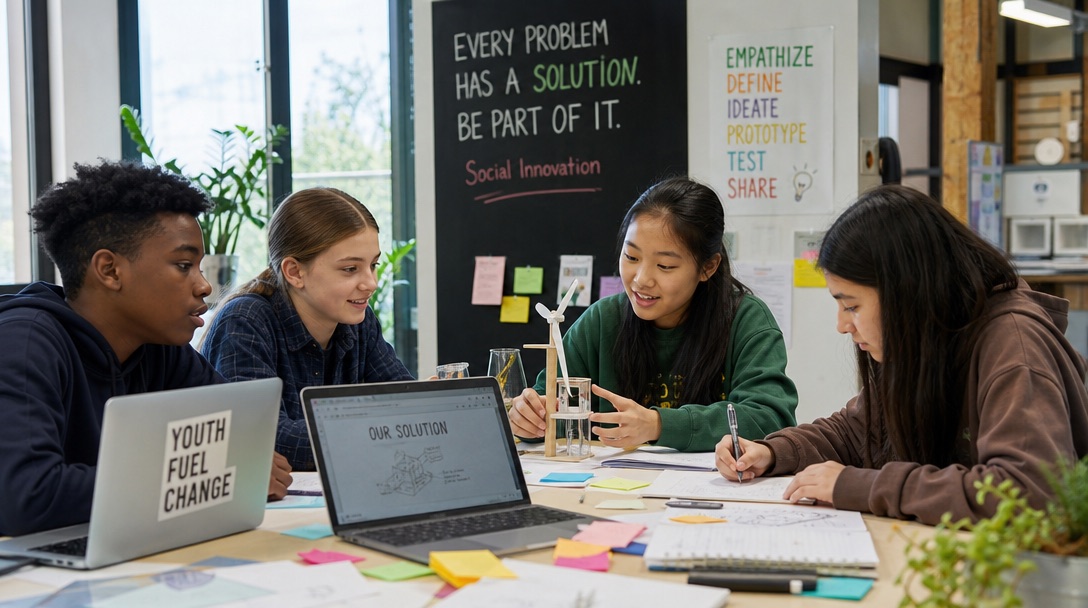
From problem to prototype. Students identify social challenges in their community, design solutions, build pitches, and present to a panel. The goal is not a business plan — it is the mindset.
Notice what these three programs have in common: none of them are lectures. None of them are individual assignments. Every single one requires students to work in groups, navigate disagreements, divide responsibilities, present to an audience, and take ownership of an outcome they cannot fully control.
That is leadership. Not the word. The practice.
What happens in the room
I want to tell you what I see every summer, because it is the reason I keep coming back.
On day one, most students walk in quiet. Some are nervous. A few are overconfident. Most have never been asked to lead anything beyond a school project where one person does all the work and everyone else gets the grade.
By day three, something shifts. The quiet ones start speaking up — not because we force them to, but because the group dynamic creates space for it. The overconfident ones learn to listen, because the team will not move forward until they do. Students who have never disagreed with a peer in a productive way learn to say, “I see it differently, and here is why.”
By the final presentation, I see students standing in front of an audience — sometimes their parents, sometimes community members, sometimes local officials — presenting ideas they built as a team. Their voices are steady. Their posture is different. They make eye contact. They handle questions.
And here is the part that gets me: they did not know they could do this. Nobody told them they were leaders. Nobody gave them a title. They discovered it through practice, in a room where it was safe to fail and necessary to try.
The most rewarding moment in every workshop is not the final presentation. It is the look on a student's face when they realize they just led a room — and it worked.
A message to parents
I say this as a parent myself: we are over-indexing on academics and under-investing in the skills that will actually determine our children's trajectory.
Grades get them into college. Leadership gets them through life.
I am not asking you to deprioritize academics. I am asking you to recognize that the leadership gap is real, it is widening, and the summer months — when the academic pressure eases — are the perfect window to address it.
What to look for in a summer leadership program
- Group-based, not individual. If your child is working alone, they are learning a skill, not leadership. Look for programs that require teamwork, delegation, and conflict resolution.
- Community-connected. The best leadership programs are rooted in real community problems, not hypotheticals. Students should be engaging with their actual neighborhood, city, or region.
- Presentation and public speaking. If the program does not end with students presenting to an audience, it is missing the capstone that makes everything else stick.
- Failure is built in. Programs that are too polished, where every student “succeeds,” are teaching compliance, not leadership. Look for programs where students struggle, adapt, and learn from setbacks.
- Small cohorts. Leadership does not develop in a lecture hall. It develops in groups of 10 to 20, where every student has to contribute and no one can hide.
And if your child resists? Good. That is the point. The discomfort of being asked to lead before you feel ready is exactly how leadership capacity is built. Every adult leader you admire went through a version of this. The question is whether your child gets that experience at 13 or at 33.
Where city councils and communities can help
Programs like ours should not be rare. They should be everywhere. And local government has a significant role to play in making that happen.
1. Provide free or subsidized community spaces
The single biggest barrier to running youth leadership programs is space. Community centers, library meeting rooms, and municipal facilities sit empty during summer weekdays. Cities should create a simple application process for youth program organizers to use these spaces for free or at nominal cost. Remove the friction and programs will multiply.
2. Create a youth leadership program grant fund
Even a modest grant fund — $5,000 to $10,000 per program — can cover materials, transportation for field trips, and guest speaker fees. City councils can allocate a small portion of community development budgets specifically for summer youth leadership initiatives. The return on investment, measured in civic engagement and reduced youth disengagement, is enormous.
3. Open doors to civic participation
Let students attend real council meetings. Create a youth advisory panel. Invite program cohorts to present their community proposals to the council. When a 14-year-old presents a well-researched proposal to their city council, two things happen: the student discovers civic agency, and the council sees the future of their community. Both are transformative.
4. Partner with local businesses for mentorship
City councils can broker connections between youth leadership programs and local business leaders. A 30-minute mentorship session from a local entrepreneur, a nonprofit director, or a city manager costs nothing and gives students a model for what leadership looks like in the real world.
5. Recognize and celebrate student leaders publicly
A certificate of recognition from the city, a spotlight in the community newsletter, a moment at a council meeting — these signals tell students that their community values what they are doing. Public recognition also tells parents that leadership development is not “extracurricular.” It is essential.
6. Reduce bureaucratic barriers for program organizers
Too many potential program leaders — teachers, coaches, community organizers, professionals like me — are deterred by the permitting, insurance, and administrative overhead required to run a youth program. Cities can create streamlined pathways for summer youth programs: a single application, blanket insurance options, and clear guidelines that make it easier to launch a program than to give up on the idea.
A broader call
This is not just about my programs. This is about a systemic need.
Every community has people who could run a youth leadership workshop — former teachers, retired executives, active professionals, college students, parents with relevant experience. What most communities lack is the infrastructure that makes it easy for those people to step up.
We need more summer programs. We need more after-school programs. We need more community organizations that say: “Your child's grades are someone else's job. Our job is to make sure your child can lead.”
We need parents who look at the summer and see not a gap to fill with entertainment, but an opportunity to build the one skill that will compound for the rest of their child's life.
And we need city councils and local governments that recognize youth leadership development as infrastructure — not as a nice-to-have community event, but as a foundational investment in the kind of citizens who will run this community in 15 years.
I keep coming back to this every summer because I have seen what happens when you give a young person the experience of leading. Not a lecture about leadership. Not a chapter in a book. The actual experience of standing in a room, making a decision, navigating disagreement, and presenting something they built with others.
It changes them. Not dramatically. Not overnight. But permanently.
And once you have seen that change happen in a 13-year-old's eyes — the moment they realize they are capable of more than anyone, including themselves, ever told them — you do not stop. You clear your calendar next summer, and the summer after that.
Because that is the investment that matters most.
For every young person who has not been told they are a leader yet.
You are. You just need the room.
— VJ
A note on how I write
I am not a writer. I am a person with strong opinions and scattered notes. Every essay on this site started as a messy brain-dump — half-formed arguments, bullet points, and “you know what I mean” — that I hand to an LLM. Another LLM handles the background research needed to find the facts that support an argument. And then it all gets translated into writing far too good for me to pretend is mine. The ideas are mine. The craft is not. They say blogs are dead — but I am falling in love with this. It gives me an outlet for expression that would otherwise have stayed buried in my head. I believe you deserve to know all of that.