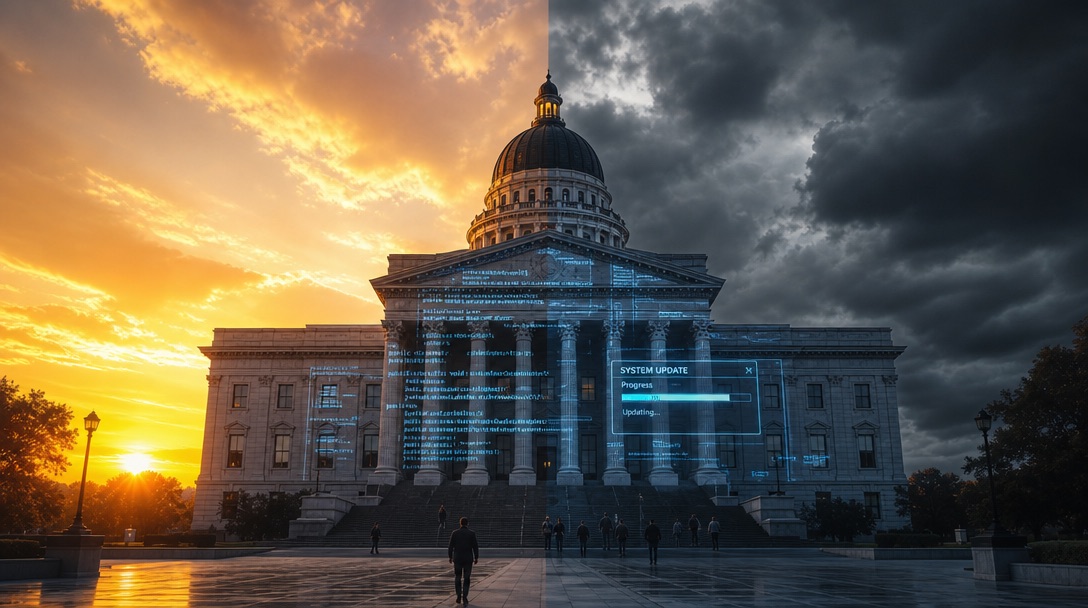
Every state government runs on an ideology. It may not call it that. It may dress it up as "common sense" or "tradition" or "progress." But underneath every budget allocation, every policy decision, every infrastructure choice, there is a set of beliefs about how the world should work.
That ideology is the operating system of the state.
And like any operating system, it determines what the machine can do. What it prioritizes. What it ignores. What it actively prevents. A state government running on an ideology of inclusive growth will build different roads, fund different schools, and measure different outcomes than one running on an ideology of extractive consolidation — even if both use the same words in their campaign speeches.
The difference between a state that thrives and a state that stagnates is rarely about resources. It is almost always about the operating system running underneath.
This is not about left versus right. It is not about any single political party. It is about something more fundamental: when the ideology running a state prioritizes the wrong things, how does a democratic system catch it? And what can both the government and the people do to prevent bad ideology from swaying the trajectory of an entire state?
Why ideology matters more than policy
People focus on individual policies. Tax rates. Education budgets. Healthcare programs. But policies are outputs. Ideology is the input. The same data set — rising unemployment, failing schools, crumbling infrastructure — will produce completely different policy responses depending on the ideological lens applied to it.
Consider two states with the same economic challenge — declining manufacturing jobs. One state, running an ideology of investment and adaptation, retrains workers, attracts new industries, and builds infrastructure for the future economy. Another state, running an ideology of nostalgia and blame, spends its energy on protectionism, resentment narratives, and short-term subsidies that evaporate within an election cycle.
Same problem. Same resources. Radically different futures. The ideology was the variable.
The signs that an ideology is failing a state
Bad ideology does not announce itself. It accumulates. Like technical debt in software, the effects are invisible at first and catastrophic later. But there are patterns:
The dangerous part is this: a state can appear to function normally while running bad ideology for years. Roads still get built. Schools still open. The GDP number may even look fine. But underneath, the foundation is eroding — institutional trust corrodes, talent leaves, civil society weakens, and by the time the cracks show on the surface, recovery takes a generation.
The two-to-three cycle trap
Bad ideology typically takes two to three electoral cycles before the damage becomes visible to average citizens. By then, the institutions needed to course-correct have often been weakened by the same ideology. This is the most dangerous pattern in democratic governance — the delay between cause and consequence.
The democratic checkpoints that should catch it
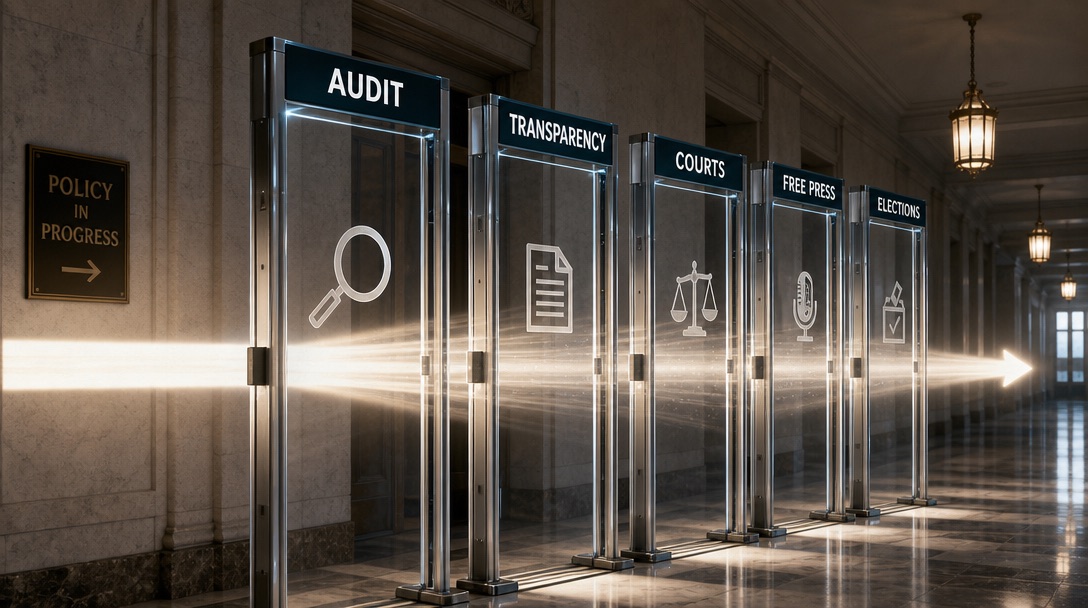
Democracy was designed with checkpoints — structural friction points that slow down bad ideas before they become permanent policy. But these checkpoints only work when they are maintained, strengthened, and actually used. Think of them as the firewall of a democratic system:
Independent judiciary
Courts that can strike down unconstitutional actions without fear of political retaliation. The first and most critical checkpoint against ideological overreach.
Free and adversarial press
Media that investigates power rather than amplifying it. Journalism that counts promises, tracks budgets, and publishes findings regardless of which party is in charge.
Independent audit institutions
State auditors, comptrollers, and ombudsmen with real authority and protected tenure. Numbers that cannot be massaged to fit a political narrative.
Empowered local governance
Strong municipalities and district bodies that can push back on state overreach. Power distributed, not concentrated. Local leaders who can say no.
Active civil society
Non-governmental organizations, citizen watchdog groups, academic institutions, and professional bodies that operate independently and speak truth to power.
Meaningful elections
Elections with real choices, fair access, transparent counting, and informed voters. Not just the act of voting — the entire ecosystem that makes voting meaningful.
Constitutional guardrails
Written protections for fundamental rights that no majority — however large — can override. The floor below which no ideology can push a state.
Transparent data infrastructure
Open budgets, public dashboards, real-time spending trackers. When citizens can see the data, ideology has nowhere to hide.

Democracy does not fail when bad leaders get elected. It fails when the checkpoints that were supposed to catch bad leadership stop working.
What the state can do: building ideology-resistant governance
Good governance is not about finding the perfect ideology. It is about building a system that works regardless of which ideology is temporarily in charge. Here is what state governments themselves can do — if they have the courage:
1. Institutionalize transparency by default
Every budget, every contract, every spending decision should be published in real time on a public dashboard. Not as a PDF buried on a government website — as a living, searchable, interactive system that any citizen can access. Make opacity structurally impossible, not just politically inconvenient. When the next government takes over, they inherit the same dashboard.
2. Create bipartisan sunset commissions
Every major policy should have a built-in expiration date and an independent review commission. If a policy cannot demonstrate measurable outcomes after a defined period, it expires automatically. This prevents ideology from calcifying into permanent programs that serve political constituencies rather than citizens.
3. Protect institutional independence with structural barriers
Audit institutions, election commissions, judiciary appointments, and public university governance should be insulated from direct political control through staggered terms, bipartisan approval requirements, and transparent appointment processes. The goal is to make it structurally difficult for any single ideology to capture the institutions that are supposed to check it.
4. Mandate outcome-based reporting
Every government department should report not on activities (meetings held, programs launched, money spent) but on outcomes (literacy rates, health metrics, employment numbers, infrastructure condition scores). Activities are theater. Outcomes are truth. No ideology survives sustained contact with honest outcome data.
5. Build cross-party infrastructure commitments
Critical infrastructure projects — water, power, transportation, digital connectivity — should be placed in multi-decade plans that survive electoral transitions. Singapore, South Korea, and several Northern European states have demonstrated that infrastructure commitments that transcend election cycles produce dramatically better outcomes than those that restart with every new government.
What the people can do: the citizen firewall
Governments will not check themselves. The most robust checkpoints in any democracy are the ones powered by its citizens. Here is the citizen playbook:
1. Vote on outcomes, not on identity
The single most powerful thing a citizen can do is shift their voting criteria from identity (caste, religion, language, party loyalty) to outcomes (did my roads improve, did the school get better, did the hospital wait time go down). When a critical mass of voters becomes outcome-driven, ideology is forced to produce results or be replaced.
2. Demand and use public data
Right to Information laws exist in most democracies. Use them. File requests. Publish findings. Create citizen dashboards. Share data on social media. Technology in 2026 makes it possible for a single motivated citizen with a laptop to build a more comprehensive government accountability tracker than entire newsrooms could a decade ago.
3. Build cross-ideological civic coalitions
The most effective citizen movements are not partisan. They are issue-specific. A coalition of parents who care about school quality — regardless of political affiliation — is more powerful than any party-aligned group. When citizens organize around outcomes rather than ideology, they become impossible for any government to dismiss.
4. Support independent media and institutions
Subscribe to independent journalism. Fund local news. Support non-governmental research organizations. Attend public hearings. Join citizen audit groups. Every institution in the democratic checkpoint system runs on one fuel: public engagement. When citizens disengage, checkpoints atrophy.
5. Track promises systematically
Every election produces promises. Almost no one tracks them. Build or support promise-tracking dashboards. Compare manifesto commitments against actual delivery. Score every elected official not on their speeches, but on their delivery rate. AI tools in 2026 make this trivially easy to automate.
6. Engage between elections, not just during them
The democratic checkpoint system only works when citizens are paying attention between elections — attending local council meetings, reading budget documents, responding to public comment periods, and organizing around specific issues. Democracy is not a once-in-five-years activity. It is a daily practice.

Technology as the great equalizer of accountability
Here is the part that makes 2026 different from every previous era of democratic governance: technology has made it radically cheaper and faster to build the accountability infrastructure that used to require entire institutions.
AI-powered budget analysis can flag anomalies in government spending in real time — something that used to take auditors months now takes minutes.
Satellite imagery and geospatial data can independently verify infrastructure claims — did the road actually get built? Is the hospital actually staffed? No government can lie about physical reality when citizens can check from space.
Natural language processing can scan thousands of legislative documents and flag changes that affect specific communities — no more hiding policy changes in 500-page bills that no one reads.
Promise-tracking dashboards with AI classification can automatically match government actions to campaign commitments and generate a real-time scorecard for every elected official.
In 2026, the tools to hold any government accountable exist, are affordable, and are accessible to any citizen who wants to use them. The only remaining variable is whether citizens choose to.
This is the most hopeful and the most sobering fact about modern democracy. The technology to make accountability effortless exists. The question is whether the will to use it does.
The real test of a democracy
The real test of a democratic system is not whether it elects good leaders. It is whether it can survive bad ones. Whether the checkpoints hold. Whether the institutions resist capture. Whether citizens stay engaged even when it is inconvenient.
Every state — every democratic body from a city council to a national government — will periodically be run by people whose ideology does not serve the majority. That is not a failure of democracy. It is a feature. The failure is when the system lacks the structural integrity to course-correct.
Ideology is inevitable. Every leader has one. The question is not how to eliminate ideology from governance — that is impossible. The question is how to build a system where no single ideology can do lasting damage before the next checkpoint catches it.
A state is not its current leader. It is not its current party. It is the quality of the systems that outlast any individual administration. The operating system matters, yes. But the firewall matters more.
Build the firewall. Maintain the checkpoints. Demand the data. Engage between elections. And teach the next generation that democracy is not something you receive — it is something you practice, every day, whether or not anyone is watching.
Because the states that get this right do not just survive bad ideology. They make bad ideology irrelevant.
For every citizen who believes that paying attention is itself a form of patriotism.
The checkpoints only hold if you are standing at them.
A note on how I write
I am not a writer. I am a person with strong opinions and scattered notes. Every essay on this site started as a messy brain-dump — half-formed arguments, bullet points, and “you know what I mean” — that I hand to an LLM. Another LLM handles the background research needed to find the facts that support an argument. And then it all gets translated into writing far too good for me to pretend is mine. The ideas are mine. The craft is not. They say blogs are dead — but I am falling in love with this. It gives me an outlet for expression that would otherwise have stayed buried in my head. I believe you deserve to know all of that.