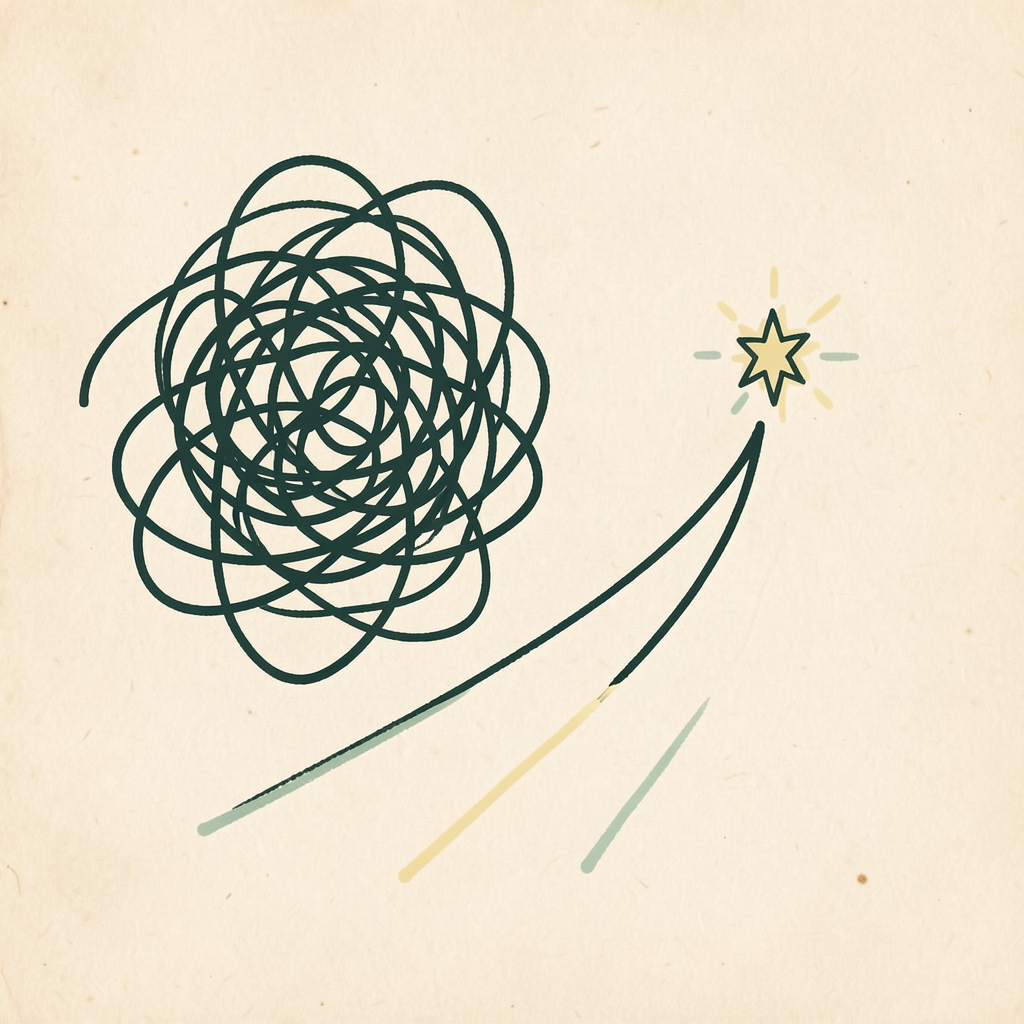
There is a particular kind of overwhelm that has nothing to do with having too much to do. It is the overwhelm of having too much to think about — too many open loops, half-formed plans, vague anxieties, and good intentions living rent-free in your head. You are not busy. You are scattered. And scattered feels worse than busy, because at least busy has a direction.
This essay is about the path from scattered to clear. Not perfectly organized — that is a fantasy. Just clear enough to know what matters today, what can wait, and what you can let go of entirely.
Why your brain makes a terrible inbox
The human brain is extraordinary at making connections, generating ideas, and reading social cues. It is terrible at holding lists. Every open loop — the email you need to send, the appointment you need to schedule, the conversation you have been avoiding — takes up cognitive space. Psychologists call this the Zeigarnik effect: unfinished tasks occupy more mental bandwidth than finished ones.

Most people walk around with dozens of these open loops buzzing in the background. They are not forgotten, but they are not organized either. They surface at random — in the shower, at 3 a.m., in the middle of a conversation with your child. And every time one surfaces, it brings a small wave of anxiety with it, because you are reminded that it exists without being any closer to resolving it.
Clarity does not come from thinking harder. It comes from thinking less — by moving the inventory out of your head and into a system you trust.
The brain dump
The first step is the simplest and the most underrated: get everything out. Every thought, every to-do, every worry, every half-idea. Do not organize. Do not prioritize. Just dump. Paper is good for this. A blank document works. The point is speed and completeness — not neatness.
Most people, when they do this for the first time, are surprised by how much they are carrying. The list is long, and that is the point. You were carrying all of that in your head. Now it is on paper, and your head is lighter.
Do this regularly — weekly is a good rhythm. Sunday evening, fifteen minutes, everything out. Not because the list changes dramatically week to week, but because the act of externalizing it resets the mental cache. You see what is actually there, instead of what anxiety tells you is there.
The three bins
Once everything is out, you need a simple way to sort it. Not twelve categories. Not a color-coded matrix. Three bins.
The first bin is Do. These are things that need action from you, this week. Not someday. This week. If the list has more than seven items, you are being ambitious — trim it. The constraint is not laziness. It is honesty about how much you can actually accomplish in a week alongside everything else life asks of you.
The second bin is Decide. These are things that are stuck not because you lack time, but because you lack clarity. You have not decided whether to accept the invitation, change the plan, have the conversation. Decision debt is the most expensive kind — it blocks everything downstream. Pick one decision this week and make it. Imperfectly is fine. Decided is better than optimized.
The third bin is Drop. These are things that have been on your list for weeks or months, and they are not getting done. Not because they are hard, but because they are not actually important enough. Dropping them is not failure. It is editing. And editing is how you make space for the things that matter.
Rituals over willpower
The difference between people who seem organized and people who feel overwhelmed is rarely talent or discipline. It is rituals. The organized person has built small, repeatable habits that handle coordination automatically, so they do not have to use willpower for logistics.

A morning ritual that takes ten minutes — check the day's commitments, identify the one thing that matters most, clear anything urgent — replaces an hour of scattered anxiety. An evening ritual that takes five minutes — review what happened, capture what is still open, set tomorrow's intention — replaces the 3 a.m. worry spiral.
These rituals do not need to be sophisticated. They need to be consistent. A ritual you do every day at the same time, in the same way, for six weeks becomes automatic. You do not have to decide to do it. It just happens, the way brushing your teeth happens.
Where AI actually helps
AI is genuinely useful in this process — not as a replacement for your own thinking, but as a processing partner. It excels at turning messy brain dumps into organized lists, identifying patterns in your recurring worries, and suggesting what to prioritize based on deadlines and dependencies.

The key is to use AI for processing, not for deciding. Let it organize your thoughts, but make the decisions yourself. Let it draft your weekly plan, but edit it with your own judgment. The clarity has to be yours — informed by the tool, but not outsourced to it.
A useful prompt for this: take your brain dump and ask the AI to group it into the three bins. Then look at what it put in each bin and adjust. The AI's first pass is usually 80% right. The 20% you change is where your own priorities and values come in. That adjustment is the thinking that matters.
Calmer days, not perfect days
The goal of all of this is not productivity. Productivity is a side effect. The goal is calm — the particular kind of calm that comes from knowing where things stand. Not everything is handled, but you know what is handled and what is not. You are not surprised by your own life.
Calm does not mean empty. A calm day might still be full — full of work, full of children, full of unexpected problems. But the fullness has a container. You know what you chose to take on and what you chose to set down. The chaos is outside, where it belongs. Not inside your head.
Clarity is not a destination. It is a practice — something you do weekly, daily, sometimes hourly. The brain fills back up. The loops reopen. The anxiety creeps back in. And then you sit down, dump it out, sort it into three bins, and start again.
The path from chaos to clarity is not a one-time journey. It is a loop. And the more you walk it, the shorter it gets.
A note on how I write
I am not a writer. I am a person with strong opinions and scattered notes. Every essay on this site started as a messy brain-dump — half-formed arguments, bullet points, and “you know what I mean” — that I hand to an LLM. Another LLM handles the background research needed to find the facts that support an argument. And then it all gets translated into writing far too good for me to pretend is mine. The ideas are mine. The craft is not. They say blogs are dead — but I am falling in love with this. It gives me an outlet for expression that would otherwise have stayed buried in my head. I believe you deserve to know all of that.