Dear editors, reporters, and journalists covering Tamil Nadu,
Tamil Nadu has a new government. New promises. New faces. The usual honeymoon coverage is underway — cabinet formation, portfolio assignments, first hundred days projections. This letter is about what happens after the honeymoon ends, and who is responsible for making sure the promises don't end with it.
That someone is you.
A government press release without independent verification is just marketing. Democracy needs an external nervous system — journalists who check the numbers, challenge the narratives, and tell the stories that no government will tell about itself.
This essay is about what that looks like in 2026, when the tools available to a newsroom have changed more in three years than in the previous thirty.
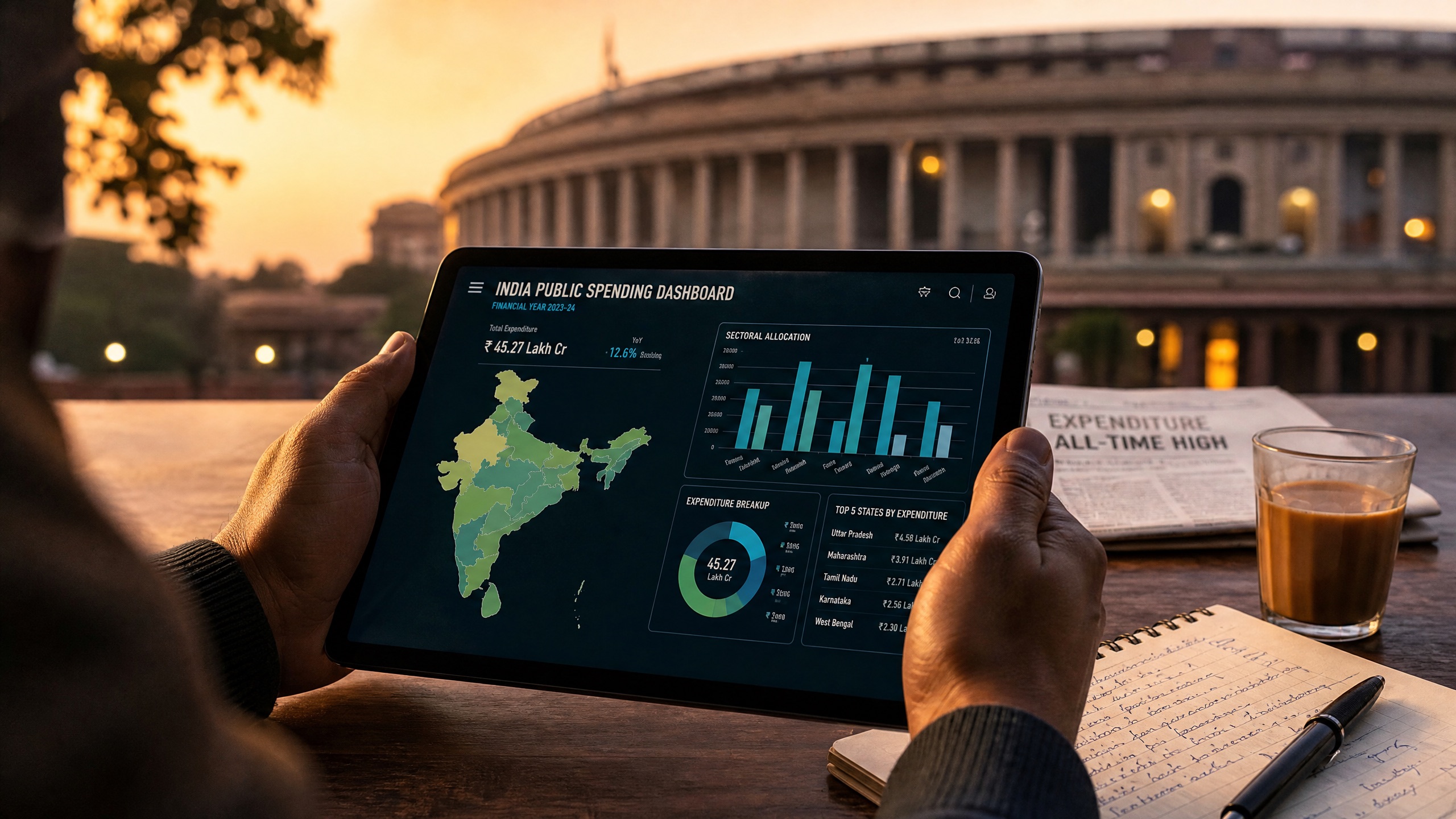
The accountability gap you already know about
You do not need this essay to tell you that covering Tamil Nadu governance is hard. You already know:
- Government press releases announce schemes but rarely report outcomes
- RTI responses arrive late, incomplete, or not at all
- District-level data is scattered across dozens of portals with different formats
- Budget documents are released in formats designed to be difficult to analyze
- Official statistics and ground reality often tell different stories
- Sources inside the bureaucracy speak off the record or not at all
The result is that most governance journalism in Tamil Nadu — and most of India — is event-driven. A scheme is announced: you cover the announcement. A scandal breaks: you cover the scandal. Between announcement and scandal, there is a vast, quiet space where governance actually happens. That space is where accountability lives, and it is where most newsrooms have the least presence.
This is not a criticism of effort. It is a description of structural constraints. Newsrooms are shrinking. Beat reporters are stretched across too many districts. The economics of digital media reward speed over depth. You are doing more with less, and the "less" keeps getting smaller.
AI and open-source technology can change those structural constraints — not by replacing journalists, but by giving a team of five the investigative reach that previously required fifty.
Six tools that change the game
1. AI-powered RTI tracking and analysis
The problem
Right to Information requests are the backbone of accountability journalism in India. But the process is slow, responses are inconsistent, and tracking dozens of active RTI requests across multiple departments is a full-time job that most newsrooms cannot afford.
What technology enables now
Automated RTI filing systems. Tools exist to batch-file RTI requests across multiple departments simultaneously, using templates that maximize the chance of a substantive response. A single journalist can file 50 targeted RTIs in the time it previously took to file 5.
Response tracking dashboards. Build a simple database — even a well-structured Google Sheet with automation — that tracks every RTI filed, its status, response deadline, and whether the response was complete. When a department consistently misses deadlines, that pattern itself becomes a story.
AI analysis of responses. When responses arrive — often as scanned PDFs in Tamil or English — AI tools can extract, translate, summarize, and compare them. Feed in 30 RTI responses about road construction spending across 30 districts. Ask the AI: "Which districts show the largest gap between allocated budget and reported spending?" You will have a lead in minutes that would have taken weeks of manual analysis.
How to start
Pick one government scheme — say, the 21-day certificate guarantee. File identical RTI requests to every district collector. Track the responses. Let AI find the patterns. Publish what you find. The scheme's own data will tell the story.
2. Satellite and geospatial verification
The problem
Governments announce infrastructure projects — roads, bridges, buildings, water bodies, housing. Whether they are actually built, on time, and to specification requires physical verification that newsrooms cannot afford to do at scale.
What technology enables now
Free satellite imagery. Google Earth, Sentinel-2 (European Space Agency), and ISRO's Bhuvan provide free, regularly updated satellite imagery of every square meter of Tamil Nadu. You can literally see whether a road was built.
Before-and-after comparisons. AI-powered change detection tools can compare satellite images from different dates and highlight what changed. A housing project announced in 2024 should show construction activity by 2026. If the satellite shows an empty field, that is your story.
Flood and disaster verification. When the government claims flood relief reached a district, satellite imagery of the affected area, combined with social media reports from the ground, provides independent verification.
Agricultural verification. NDVI analysis of satellite images can verify agricultural claims — whether fallow land was actually brought under cultivation, whether deforestation occurred in protected areas, whether water body restoration actually happened.
How to start
Pick 10 infrastructure projects announced in the 2024 budget with specific location details. Pull satellite imagery from before the announcement and today. Compare. Publish what you find. This requires no sources, no access, no permission — just publicly available data and a laptop.
3. Budget tracking and expenditure analysis
The problem
Tamil Nadu's state budget runs to hundreds of pages. Tracking what was promised versus what was spent versus what actually reached citizens is an enormous analytical task that few newsrooms attempt beyond top-line numbers.
What technology enables now
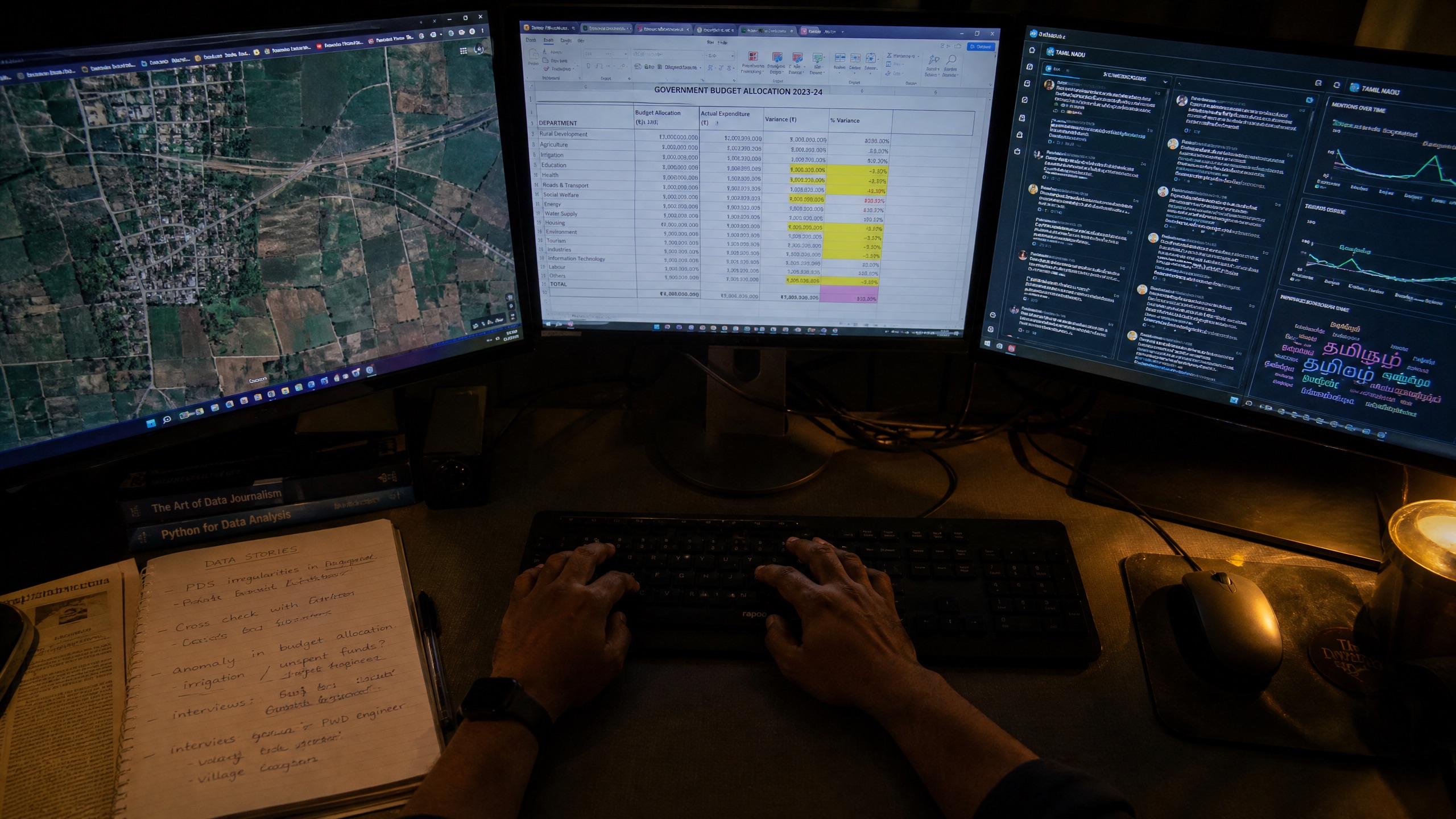
AI budget parsing. Feed the entire state budget PDF into an AI tool. Ask it to extract every line item related to a specific sector — health, education, rural development. Ask it to compare this year's allocation with last year's. Ask it to flag items where allocation decreased despite a government promise to increase spending. What used to take an analyst a week now takes an afternoon.
Expenditure tracking via open data. The Tamil Nadu Open Data Portal, the CAG reports, and the Finance Department's monthly expenditure statements are public. AI can monitor these sources continuously and flag anomalies — a district that has spent only 12% of its health budget by month nine, a scheme where administrative costs exceed 40% of total spending.
Cross-referencing with outcomes. The real power comes from connecting spending to outcomes. The government spent ₹500 crore on rural roads. The National Rural Roads database shows which roads were approved, sanctioned, and completed. Satellite imagery confirms which ones physically exist. AI connects these datasets and flags the gaps.
How to start
Download the last three CAG reports on Tamil Nadu. Feed them to an AI tool. Ask: "What are the top 10 findings about financial irregularities or underperformance?" You will have a story framework in an hour.
4. Social media and citizen complaint monitoring
The problem
Citizens complain about government services constantly — on X, Facebook, WhatsApp groups, local news comment sections, the CM Helpline, and district grievance portals. This is a real-time signal about where governance is failing. But the volume is overwhelming and separating genuine systemic issues from noise is difficult.
What technology enables now
AI-powered topic clustering. Tools can monitor Tamil-language social media in real time, cluster complaints by topic and geography, and surface emerging patterns. If 200 people in Thanjavur are complaining about water quality in the same week, that is a signal worth investigating — even if no single complaint went viral.
Complaint pattern analysis. The CM Helpline receives thousands of complaints daily. If the data is available through RTI or open data, AI can analyze which types of complaints are resolved fastest, which districts have the worst resolution rates, and which categories are systematically ignored.
Bot and fake account detection. AI tools can identify coordinated inauthentic behavior — networks of accounts amplifying government messaging or attacking critics. This is itself a story about the health of public discourse.
How to start
Set up a free social media monitoring dashboard using Google Alerts for Tamil keywords and open-source tools. Monitor for three months. The patterns will emerge on their own.
5. Fact-checking at scale
The problem
Government claims — about employment generated, schemes delivered, infrastructure completed — often go unchallenged because verification is slow and resource-intensive. By the time a fact-check is published, the news cycle has moved on.
What technology enables now
Real-time claim extraction. AI can watch government press conferences, legislative sessions, and official social media in real time and extract every factual claim. "50,000 jobs created under Scheme X" — logged, timestamped, ready for verification.
Automated cross-referencing. Each extracted claim can be checked against available data sources. The government says 50,000 jobs were created. The EPFO data shows 12,000 new registrations in that sector. The gap between claim and data is the starting point for investigation.
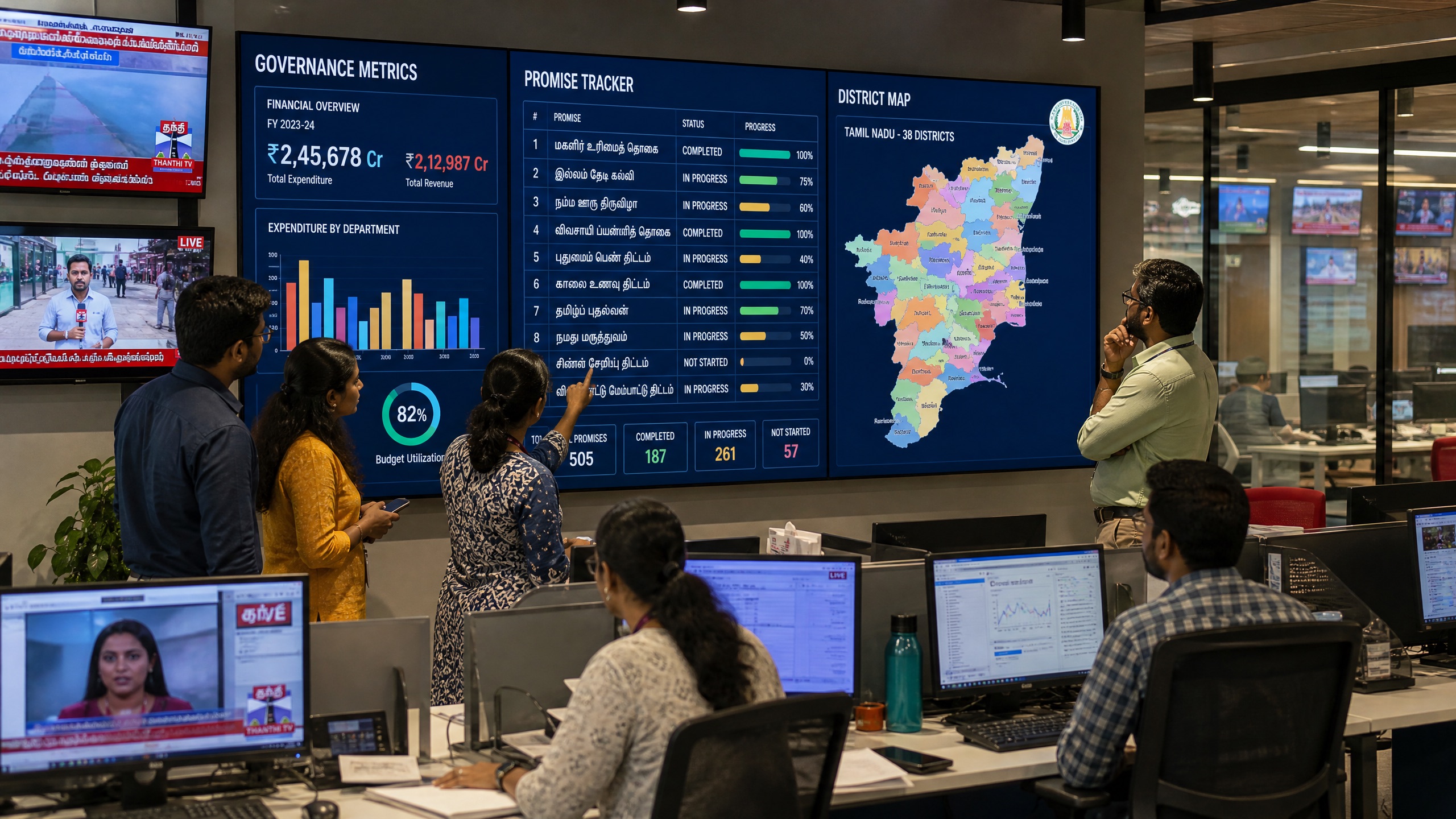
Historical claim tracking. Build a database of every major claim made by the government since taking office. Track which were verified, partially true, or misleading. Publish a monthly "Promise Tracker" — a simple scorecard that citizens can understand.
Deepfake and manipulated media detection. AI tools can identify manipulated images, doctored documents, and synthetic audio/video. As political communication increasingly uses AI-generated content, detecting manipulation becomes a critical journalistic skill.
How to start
Start a "Claim of the Week" column. Pick one major government claim each week. Use every tool available — RTI, open data, satellite imagery, AI analysis — to verify or challenge it. Be transparent about your methodology. Over time, this builds both capacity and credibility.
6. Collaborative investigation networks
The problem
No single newsroom in Tamil Nadu has the resources to cover governance across all 38 districts with the depth that accountability requires. Important stories go uncovered because the reporter who knows the issue is at a different publication, or in a different district.
What technology enables now
Shared investigation platforms. Secure, encrypted platforms allow journalists from different publications to collaborate on investigations without compromising source protection. A reporter in Madurai with a tip about a health scheme can connect with a data journalist in Chennai who can verify the numbers.
AI-assisted translation. Tamil Nadu's governance documents exist in both Tamil and English, often with important differences between versions. AI translation tools can flag discrepancies between versions of the same government order — discrepancies that sometimes reveal what the government intended versus what it announced.
Crowdsourced verification networks. Train citizen contributors to submit structured reports — photographs of government project sites with GPS coordinates, copies of RTI responses, documentation of service delivery failures. With proper verification protocols, this creates a distributed reporting network that no newsroom could afford to build with staff alone.
How to start
Identify five journalists at different publications covering different districts who share a commitment to accountability journalism. Create a secure Signal group. Start sharing leads, data, and methods. The network effect is immediate.
Separating fact from fiction: a practical framework
In the age of AI-generated content, political deepfakes, and coordinated disinformation, the press needs a systematic approach. Here is a four-level verification stack:
Level 1 — Source verification. Before engaging with any claim, verify the source. AI tools can check whether a social media account is genuine, whether a document's metadata is consistent with its claimed origin, whether an image has been manipulated. This takes seconds, not hours.
Level 2 — Data verification. Cross-reference every quantitative claim against at least two independent data sources. If the government says maternal mortality decreased by 30%, check the National Health Mission data, the Sample Registration System, and hospital records. If only one source confirms the claim, flag it as unverified.
Level 3 — Ground verification. Some claims can only be verified on the ground. But AI can help prioritize which claims to verify in person. If satellite imagery confirms a bridge was built, you do not need to drive there. If it shows an empty field, that is where you send the reporter.
Level 4 — Pattern verification. Individual data points can be misleading. Patterns are harder to fake. If a district consistently reports better outcomes than its neighbors despite similar budgets and demographics, either it has genuinely better governance — a positive story — or it has better data manipulation — an investigative story. Either way, the pattern points you to the truth.
Red flags AI can detect
- Statistics that are too round (exactly 100% coverage, exactly 50,000 beneficiaries)
- Numbers that do not add up (district totals that exceed the state total)
- Claims that contradict the government's own data from a different department
- Timelines that are physically impossible (a project completed before it was sanctioned)
- Photographs that appear in multiple contexts (the same inauguration photo used for different projects)
The elephant in the room: press freedom
No amount of technology helps if journalists face threats, legal harassment, or economic pressure for doing accountability journalism. This essay would be incomplete without acknowledging that the tools described here are only useful if the press has the freedom to use them.
Legal preparedness. Every newsroom covering governance should have a lawyer familiar with press freedom cases. AI-assisted legal research can help identify precedents and prepare defenses before they are needed. Document everything — every threat, every pressure, every attempt to influence coverage. Encrypted, redundant, timestamped.
Economic independence. The advertising model makes media vulnerable to government pressure, since state government advertising is a significant revenue source for many Tamil Nadu publications. Subscription models, reader-funded investigations, and grant-funded accountability projects reduce this vulnerability. Technology makes reader-funded journalism more viable than ever.
Solidarity. When one publication is pressured for accountability journalism, the response of other publications matters. Shared investigation networks create mutual defense — if five publications hold the same data, suppressing one does not suppress the story.

A specific proposal: The Tamil Nadu Governance Monitor
This essay proposes that Tamil Nadu's media organizations — individually or collectively — build a permanent, technology-enabled governance monitoring operation.
1. Promise Tracker — Track every major government promise from manifesto to delivery. Monthly public scorecard. AI-assisted, journalist-verified.
2. Budget Watch — Continuous monitoring of government spending against allocation. Automated alerts when spending patterns deviate significantly from budget. Quarterly deep-dive analysis.
3. Citizen Signal Dashboard — AI-monitored aggregation of citizen complaints, social media signals, and ground reports. Weekly summary of emerging issues by district and category.
4. Fact-Check Wire — Real-time verification of government claims. Shared across participating publications. Speed measured in hours, not days.
5. Investigation Commons — Shared datasets, tools, and verified information available to any Tamil Nadu journalist doing accountability work. Open-source, encrypted, sustainable.
The technology for all five components exists today. The cost is modest — a small team of data journalists, a few AI tool subscriptions, and cloud infrastructure. The impact would be disproportionate.
The window is now
Tamil Nadu has a new government. The press has a brief window — the same window the government has — to establish new norms. If the media builds its accountability infrastructure now, during the honeymoon period when the government is most receptive to transparency, those structures become harder to dismantle later.
If the press waits, the government will fill the information vacuum with its own narratives, its own dashboards, its own version of accountability. By the time the press catches up, the frame will already be set.
The technology is ready. The data is increasingly available. The question is whether Tamil Nadu's media will use these tools to build systematic accountability, or continue to cover governance the way it always has — event by event, scandal by scandal, election by election.
Democracy does not die in darkness. It dies in noise — when there is so much information that no one can tell what is true, when every claim has a counter-claim, when citizens give up trying to keep score.
The press exists to keep score. The tools to do it well have never been better. Use them.
With respect and urgency,
A citizen who reads your work
A note on how I write
I am not a writer. I am a person with strong opinions and scattered notes. Every essay on this site started as a messy brain-dump — half-formed arguments, bullet points, and “you know what I mean” — that I hand to an LLM. Another LLM handles the background research needed to find the facts that support an argument. And then it all gets translated into writing far too good for me to pretend is mine. The ideas are mine. The craft is not. They say blogs are dead — but I am falling in love with this. It gives me an outlet for expression that would otherwise have stayed buried in my head. I believe you deserve to know all of that.