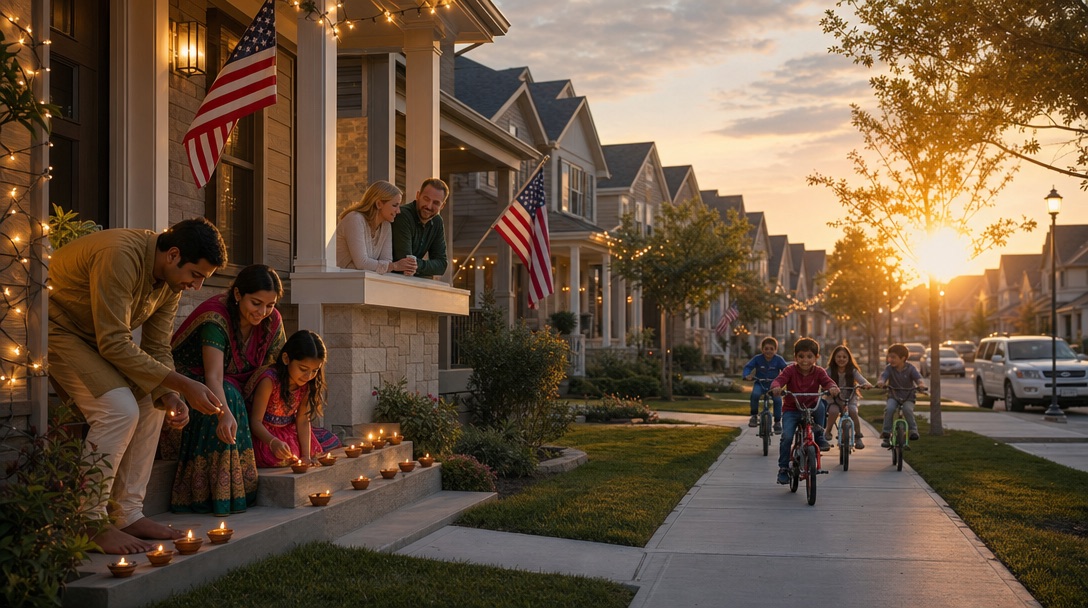
On February 3, 2026, the George A. Purefoy Municipal Center in Frisco, Texas, filled beyond capacity. About a dozen speakers took the podium to address the city council. Most wore America First hats. They spoke about an Indian takeover, about H-1B visa fraud, about a city being stolen from the people who built it.
Here is the detail that matters: the majority of speakers were not from Frisco. They were activists from Richardson, Garland, and across the DFW metroplex, drawn by social media influencers who framed a fast-growing suburb as ground zero for a demographic invasion. One viral video urging attendance gathered over 370,000 views.[1] A documentary released weeks later pulled two million more.[2]
Meanwhile, the actual residents of Frisco — including the Indian-American families who make up roughly 19% of the city — watched from the gallery, some nervous, some angry, most just trying to figure out how a place they had moved to for good schools and safe streets had become a national flashpoint.
Frisco Councilman Burt Thakur, the city's first council member of Indian origin, a Navy veteran and U.S. citizen who came to America in the late 1980s, was shown a viral video of Indian Boy Scouts leading the Pledge of Allegiance that had drawn hateful comments. His response cut through the noise: if you go after Boy Scouts — ten-year-old kids doing the most American thing imaginable — how can you also claim the issue is assimilation?
That question is the spine of this essay. Because underneath the political theater and the rage-bait algorithms, there is a real conversation that Frisco, and every fast-growing American suburb, needs to have. It is not about whether immigrants belong. It is about how belonging actually works — and what both sides owe the process.
To be clear: this essay is not only about racism, and it is not only about immigrant behavior. It is about the civic habits that let diverse suburbs function — the unglamorous infrastructure of shared life that breaks down when a community changes faster than its norms can adapt. Both sides have work to do. Pretending otherwise helps no one.
What civic awareness means in this essay. Civic awareness is not assimilation into whiteness. It is not giving up your language, your food, your festivals, or your identity. It is learning the shared rules of public life: noise ordinances, parking norms, trash and recycling schedules, school expectations, HOA agreements, tipping customs, public meeting participation, volunteering, and basic neighborliness. Every society has these rules. When you move to a new one, learning them is not submission — it is respect for the people you now share space with.
The honest list
Before we can talk about solutions, we have to talk about friction. And the friction has to be named honestly, without weaponizing it and without dismissing it.
Here is what surfaces repeatedly in community forums, HOA meetings, and — importantly — in self-reflective conversations within the Indian-American community itself:
HOA rules that nobody explained. Parking on lawns. Too many vehicles in driveways. Unapproved structures. Lawn maintenance standards that seem arbitrary until you realize they are legally binding. Most countries do not have Homeowners' Associations. The CC&Rs are handed over at closing in a stack of papers that nobody reads in any language.
Noise and gathering norms. Large family celebrations, religious festivals, late-night socializing that runs past noise ordinance cutoffs. In a culture where hospitality means fifty people in a three-bedroom house, the idea that your neighbor might call 311 at 10 PM feels hostile. To the neighbor, forty cars on the street at midnight feels inconsiderate. Both reactions are understandable. But shared life requires the family hosting the event to account for the impact on the street — because the noise ordinance is not a suggestion, and the neighbor's sleep is not optional.
Tipping. In India, a tip is a gesture for exceptional service. In America, it is how servers, barbers, and delivery drivers pay rent. Sixty-three percent of Americans already hold negative views about tipping culture, according to Pew Research[6] — so this is not purely an immigrant issue. But the cultural gap is wider for people coming from non-tipping economies, and the resentment it creates among service workers is real and immediate.
Public space behavior. Queue etiquette, volume of conversation, picking up after pets. These sound trivial until you are the person standing behind someone who cuts a line, or the neighbor who steps in dog waste on a shared trail every morning. Small violations compound into general resentment, and resentment does not stay specific for long.
Insularity. This is the critique that comes most often from within the community. The Carnegie Endowment's 2026 Indian American Attitudes Survey found that nearly one-third of Indian Americans reported not engaging in any civic or political activities.[3] Non-citizens and foreign-born citizens reported nonparticipation at roughly twice the rate of U.S.-born citizens. You can live in Frisco for a decade, earn well, send your children to excellent schools, and never attend a single city council meeting, PTA gathering, or neighborhood cleanup. Economic integration without civic integration is not integration. It is coexistence with a good credit score.
An important caveat. Homeowners of color are disproportionately targeted for HOA violations — lawn maintenance, noise complaints, minor architectural choices — while identical violations by white neighbors are ignored. HOAs have a well-documented discriminatory history. Not every complaint about an immigrant family is legitimate civic concern. Some of it is surveillance dressed as neighborliness. Both realities exist simultaneously, and the inability to hold both is what makes this conversation so difficult.
How Frisco became a symbol
Frisco's population grew from 33,000 in 2000 to over 245,000 today — a 539% increase.[4] Its Asian population went from 2% to over 33%. Roughly one in five residents is of Indian origin, the highest concentration of any city in Texas and about ten times the national average. The draw: corporate campuses, T-Mobile's regional footprint, and Frisco ISD's reputation.
The demographic shift happened faster than most suburban civic structures are designed to absorb. HOA boards, school PTAs, neighborhood associations, and city services were built for a different population mix. When a city changes this quickly, the infrastructure of belonging — the informal agreements about how we share space — has to be renegotiated. That renegotiation is messy even in the best circumstances.
Frisco did not get the best circumstances. It got outside agitators, social media amplification, and a national political climate that turned a suburban growing pain into a culture war set piece.
The Center for the Study of Organized Hate documented over 24,000 anti-Indian posts on X in 2025 alone, generating more than 300 million views.[5] Between July and September 2025, 680 high-engagement posts amassed 281 million views. Nearly 70% framed Indians as invaders and job thieves. In Irving, three masked men staged a roadside protest with signs reading "Don't India My Texas."
In this climate, a legitimate conversation about noise ordinances and parking rules becomes impossible. The people who have real concerns get drowned out by the people who have an agenda. And the immigrant families who were willing to listen, to learn, to adjust, start to feel that no amount of adjustment will ever be enough — because the goalposts are not about civic behavior. They are about skin color.
When outside agitators hijack a local conversation, the first casualty is the conversation itself. The second casualty is the neighbor who was about to knock on the door with a plate of food.
What the research says about integration
The Migration Policy Institute frames integration as a two-way process: newcomers adjusting to the norms of their new country, and the receiving society adjusting to accommodate new communities. This is not a euphemism for letting immigrants off the hook. It is a recognition that integration requires infrastructure, not just willingness.
Stanford research on historical immigrant assimilation found that full integration generally occurs within three to four generations.[8] By the second generation, there is strong convergence in language, intermarriage, income, and civic participation. By the third, the distinction between immigrant-origin and native-born populations largely disappears — at least for European immigrants in the early twentieth century.
Indian Americans are, by most economic measures, the most successful immigrant group in the country. Over 82% hold college degrees, compared to 42% of white Americans. Median family income substantially exceeds the white median. They are the second-largest immigrant group in the U.S. by country of origin, numbering over 5.2 million.[7]
But economic success is not civic integration. A 2025 study in Frontiers in Sociology found that immigrants assimilate values over time, approximating the norms of their host society — but that value assimilation only weakly predicts broader integration in employment, social life, and political participation. Learning the rules intellectually is not the same as being woven into the social fabric. You can ace the citizenship test and still not know that your neighbor expects you to wave when you pull into the driveway.
What immigrants can do
This is not a list of ways to apologize for existing. It is a set of specific, practical actions that close the civic gap — drawn from what has actually worked in communities that got this right.
Read your HOA documents before you need to. The CC&Rs, the architectural guidelines, the parking rules — they are in the stack of papers from closing day. Most friction starts here. If your HOA does not provide multilingual orientation materials, request them. If they do not exist, help create them. That is civic participation, not compliance.
Attend one city council meeting and one HOA meeting in your first six months. Carnegie's data shows only 8% of Indian Americans attend public meetings. This is where norms get established, budgets get allocated, and neighborhoods get shaped. If you never show up, the decisions get made without you — and then you are surprised by the outcome. Councilman Thakur exists because someone showed up.
Join the PTA. The school system is the single best integration vehicle in American suburbs. Frisco ISD has over 18,000 active parent volunteers. Showing up at a bake sale, chaperoning a field trip, sitting on a curriculum committee — these are not trivial acts. They are how you become a neighbor instead of a resident.
Learn and practice tipping norms. Fifteen to twenty percent at restaurants. Tip your barber, your delivery driver, your movers. This is not optional in American service culture — it is how workers are compensated. If you disagree with the system, advocate to change it politically. But do not penalize the server who is earning $2.13 an hour plus tips while you wait for structural reform.
Volunteer for something that is not an ethnic organization. Sewa International does extraordinary work — 387 volunteers logged 3,000 hours during the Kerrville floods alone. But also volunteer for the food bank, Habitat for Humanity, the local fire department auxiliary. This is where cross-cultural relationships form — not at cultural festivals where everyone already agrees, but at a Habitat build site where you are handing drywall to someone whose last name you cannot pronounce and who cannot pronounce yours.
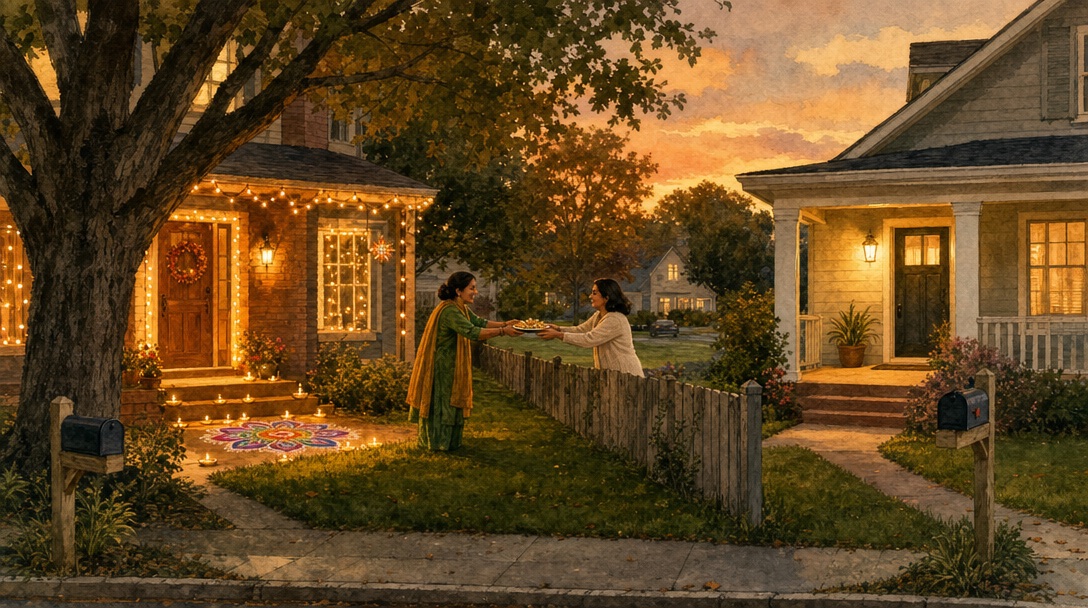
Be the neighbor who explains before the noise starts. A thirty-second conversation before Diwali — we are celebrating tonight, there will be some fireworks, it should be done by ten — prevents a 311 call. It also opens a door. Your neighbor may show up with a bottle of wine. Or they may not. But you gave them the choice, and that matters more than the outcome.
Acknowledge the gap without shame. Some newcomers come from civic systems where public rules are enforced inconsistently, where the line between private and shared space is drawn differently, and where the American expectation that your private behavior affects shared space can take time to learn. Recognizing this is not self-hatred. It is the first step toward bridging two civic cultures. The within-community conversation matters as much as the cross-community one.
What established residents can do
Integration is not a one-sided obligation. If you have lived in a community for twenty years and your response to demographic change is a NextDoor post, you are part of the problem. Here is how to be part of the solution.
Show up at city council when outside agitators show up. The February 3 meeting in Frisco was dominated by people who do not live there. When actual residents stay silent, silence becomes the story. Mayor Jeff Cheney pushed back. Councilman Thakur pushed back. They need residents behind them — of all backgrounds.
Distinguish between civic friction and racial animus. A legitimate noise complaint is not racist. But "Don't India My Texas" signs are. The inability to separate these two things is what allows influencers and agitators to hijack a local conversation and turn it into content. If you cannot tell the difference between a neighbor who parks on the lawn because nobody told them the rule and a protester with a mask and a slogan, the problem is your framework, not theirs.
Be the HOA board member who educates instead of fines. The Welcoming America framework emphasizes that newcomer orientation transforms the document-heavy HOA process into something accessible. A fifteen-minute conversation with a new homeowner about trash day, parking rules, and noise ordinances prevents months of escalating violations and mutual resentment. Fines are compliance. Conversations are community.
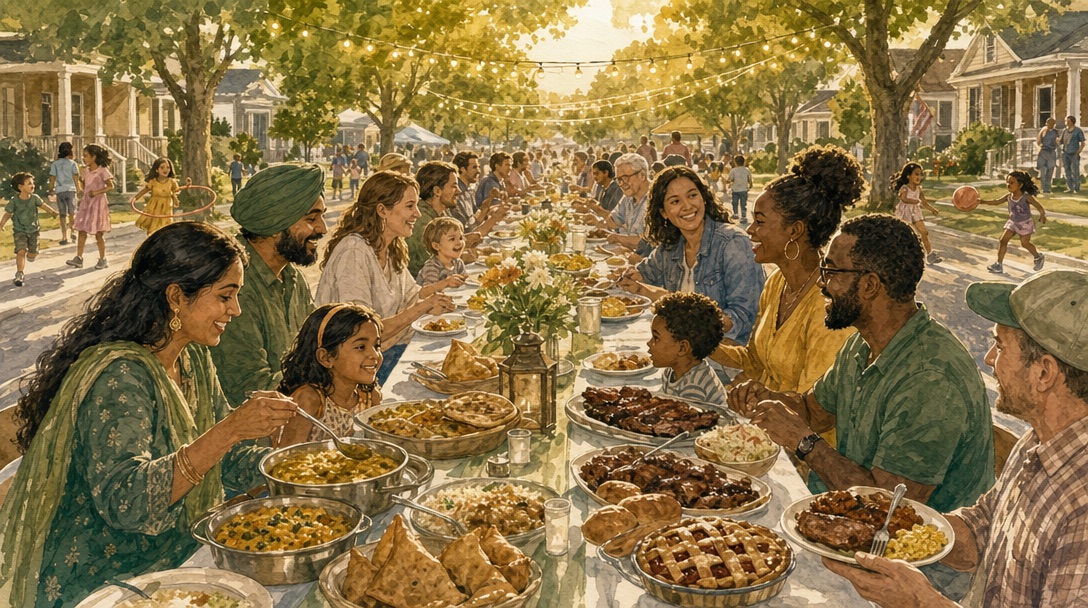
Attend a cultural event. Go to a Diwali celebration. Visit a Navratri garba. Accept the plate of biryani. You will learn more in one evening than in a year of NextDoor arguments. And the family that invited you will remember that you came.
Call out the outside agitators by name. Forty-four cities and counties have achieved Certified Welcoming status through the Welcoming America framework. Frisco is not one of them. If your city's civic fabric is being torn by people who do not live there, name that publicly. Community defense is not a political act. It is a civic one.
Cities that got this right — and what it took
Edison, New Jersey is the cautionary success story. Indians set up businesses on Oak Tree Road in the 1980s and faced vandalism, police harassment, and organized resistance. It took decades. But today, Edison's Little India is a cultural landmark. The lesson: integration happened, but it was messy, slow, and required both sides to exhaust their worst impulses before finding their better ones.
Cupertino, California shows what mature integration looks like. Indians now constitute over 22% of the population. Over twenty years, the community integrated into the Chamber of Commerce, the city workforce, and the city council. Indian culture became part of the mainstream Cupertino experience — not a separate track running alongside it.
Sugar Land, Texas offers the quieter model. Nearly four in ten residents are Asian American. The city attracted established professionals and grew with less of the demographic shock Frisco experienced. Integration has been smoother — partly because it was gradual, and partly because the economic floor was higher.
The pattern is consistent: where demographic change is gradual and civic infrastructure adapts, integration works. Where it is sudden and the infrastructure does not adapt, friction becomes a vacuum that bad actors fill.
What Frisco could do next
Frisco does not need to wait for the national temperature to cool down. It can build the civic infrastructure that makes integration work, starting now. Here is a concrete playbook:
A newcomer civic guide. A short, multilingual document — ten pages, not a hundred — covering the essentials: noise ordinances, trash and recycling schedules, parking rules, HOA basics, tipping norms, school enrollment process, how city council works, how to report a problem, and where to volunteer. Distributed at closing, at apartment lease signing, at school enrollment. Available in English, Tamil, Telugu, Hindi, Spanish, and Mandarin. This does not exist today. It should.
HOA orientation sessions. Every HOA should offer a thirty-minute new-resident walkthrough within sixty days of move-in. Not a stack of documents. A conversation, with a real person, covering the five things that generate the most complaints. For HOA boards: this is cheaper than enforcement and more effective than fines.
PTA and city council onboarding for new residents. A specific invitation — not a generic flyer — to new families explaining what the PTA does, when it meets, and how to get involved. The same for city council: a one-page guide explaining what happens at meetings, how public comment works, and why it matters. Remove the mystery and you remove the barrier.
Cultural-event neighbor notification templates. A simple form — printable, shareable — that families can fill out and hand to neighbors before Diwali, Eid, Navratri, a graduation party, or a quinceañera. "We are celebrating [event] on [date]. Expect [music/fireworks/parking]. We will wrap up by [time]. Please come say hello — we would love to share food." Normalize this. Make it easy. Make it expected.
A multicultural civic advisory board. Not a symbolic committee that meets twice a year. An operational body with a real mandate: review civic communication for accessibility, advise on cultural calendar conflicts, recommend policy changes that reduce friction, and mediate before problems escalate to city council theater. Include immigrant community leaders, long-time residents, school representatives, HOA board members, and local business owners. Give it a budget and a reporting line to the city manager.
Pursue Welcoming Certified status. Forty-four cities and counties have done it through the Welcoming America framework. The certification takes about a year and includes standards for language access, civic participation, economic integration, and community cohesion. Frisco has the resources and the civic energy. What it needs is the decision to begin.
What the future can look like
Here is what I believe, as someone who left India at twenty-one, raised a family in Texas, and has watched this conversation unfold from inside both cultures:
Civic awareness is not about performing Americanness for an audience. It is not about proving that you deserve to be here. It is about recognizing that when you move to a place, you inherit its social contract — the set of small, unglamorous agreements that make shared life possible. You mow your lawn not because the HOA can fine you, but because the family next door takes pride in the street you share. You tip your server not because someone is watching, but because the person carrying your plate is working for a living. You introduce yourself to your neighbor not because it is strategic, but because a street where people know each other's names is safer, kinder, and more resilient than one where they do not.
And the social contract runs both ways. When a new family moves in and gets the parking wrong, the civic response is a conversation, not a complaint to the HOA. When Diwali lights go up next to Christmas lights, the civic response is curiosity, not suspicion. When your city council is targeted by people who do not live in your city, the civic response is to stand up and say: these are our neighbors, and you do not speak for us.
The immigrant's job is to learn the rules of the place.
The community's job is to make the rules learnable.
The country's job is to make sure both sides have a reason to try.
Frisco is not broken. It is a city experiencing what every fast-growing American community will experience in the next twenty years. The question is not whether demographic change happens — it is whether the civic infrastructure evolves fast enough to hold it. Frisco has a city council that defended its residents. It has Indian-American veterans on the dais. It has 18,000 parent volunteers in its schools. The raw materials for integration are there.
What is missing is the bridge — the deliberate, unglamorous work of teaching civic norms to newcomers and teaching patience to long-timers. Not through viral videos or city council spectacles, but through the one tool that has always worked: the neighbor who knocks on the door.
Nobody hands you a manual for belonging when you land at DFW. Maybe it is time someone wrote one — and maybe it should have chapters from both sides.
Sources & references
- Kaylee Campbell's viral video urging attendance at the Frisco city council meeting, posted to X; reported in American Kahani and Dallas Observer coverage of the February 3, 2026 meeting. ↑
- Tyler Oliveira, documentary on Indian immigration in Texas, YouTube and X, April 2026; reported in American Bazaar Online. ↑
- Carnegie Endowment for International Peace, Indian American Attitudes Survey (IAAS), 2026 wave (N=1,000, YouGov, Nov 2025–Jan 2026). ↑
- U.S. Census Bureau population estimates; CBS Texas, "Frisco growth, demographic changes spark debate over diversity" (2026). ↑
- Center for the Study of Organized Hate (CSOH), anti-Indian rhetoric analysis on X, July–September 2025; American Bazaar Online, "300 Million Views of Hate" (March 2026). ↑
- Pew Research Center, survey on American attitudes toward tipping, 2023. ↑
- Pew Research Center, "Indian Americans: A Survey Data Snapshot" (August 2024); Carnegie IAAS 2026 demographic data. ↑
- Stanford Institute for Economic Policy Research, research on historical immigrant assimilation patterns (European immigration, early 20th century). ↑
— VJ
A note on how I write
I am not a writer. I am a person with strong opinions and scattered notes. Every essay on this site started as a messy brain-dump — half-formed arguments, bullet points, and “you know what I mean” — that I hand to an LLM. Another LLM handles the background research needed to find the facts that support an argument. And then it all gets translated into writing far too good for me to pretend is mine. The ideas are mine. The craft is not. They say blogs are dead — but I am falling in love with this. It gives me an outlet for expression that would otherwise have stayed buried in my head. I believe you deserve to know all of that.