The companion to “Teach Them to Want.”
If you read the last essay and found yourself nodding, you probably arrived — within about a minute — at the question it deliberately didn’t answer. Fine. But what do I actually do about it?
Here is the part nobody enjoys hearing. That essay was an argument about schools. And you cannot reform your child’s school on any timeline that helps your child. The curriculum committee that would have to agree with me will still be debating it when your ten-year-old is filling out college applications. Institutions move in decades. Your kid is growing up in months.
So the honest answer is the uncomfortable one. You can’t wait for the school. The leverage was never really there anyway — it’s at home. And it begins not with something you give your child, but with something you stop doing.
You are the home’s reward system
Volition, I argued, is caught, not taught. It grows in conditions. Which means the useful question was never “what lesson do I deliver?” It is “what does my home actually reward?”
And here is the hard look in the mirror. Most loving, modern parenting is, structurally, a volition-suppression machine. We are professional removers of friction. We drive them door to door. We solve the problem the second they are stuck. We fill every bored minute with a screen. We praise the A and skip right past the question that earned it.
None of that is bad parenting. It is the definition of good parenting as the last generation understood it: smooth the road, clear the obstacles, optimize for comfort and outcomes. The trouble is that comfort and outcomes are now exactly what the machine supplies for free. Optimize a child’s life for total frictionlessness, hand them an AI, and you have built — with love, with the best intentions in the world — the first student from the last essay: efficient, comfortable, and quietly hollowing.
Your child doesn’t need you to remove the struggle. The machine already does that. Your child needs you to protect it.
The one move everything follows from
So the single shift — the one that makes every practical step below make sense — is small to say and hard to live:
Stop being the remover of friction. Start being the protector of it.
That is the whole reorientation. Everything that follows is just a way of practicing it.
Three things to do this week
1. Hand them a pilgrimage
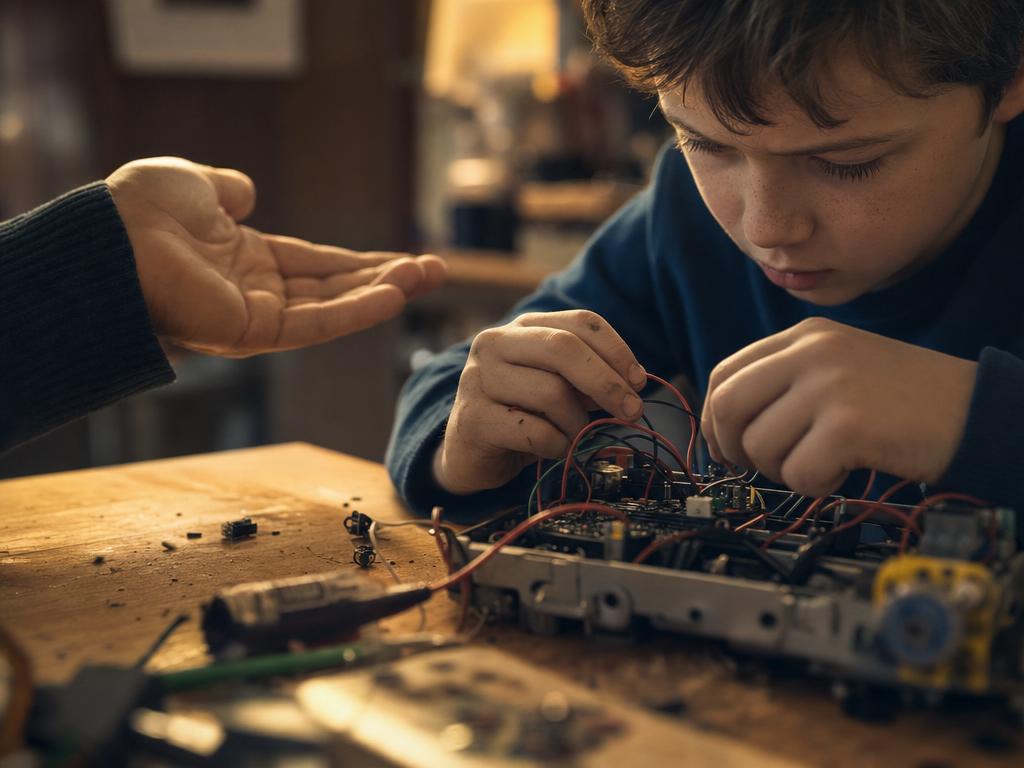
Help your child pick one hard thing they actually want — a real project measured in months, not a worksheet measured in minutes. Then do the difficult parental thing: help them amplify (tools, AI, your time as a tutor) but refuse to rescue. Being stuck and climbing out is the entire point. Remove it and you have removed the lesson.
2. Praise the question, not the answer
Catch yourself before “good job.” Try “what was the hardest part?” or “what would you try next?” Children optimize relentlessly for whatever earns the warmth in your voice. Aim that warmth at persistence and curiosity — not at the grade.
3. Let them see you want something hard
Volition is modeled before it is chosen. A child who never watches an adult struggle toward a self-chosen goal quietly concludes that adulthood is the art of arranging your life to avoid struggle. Learn the instrument. Take the hard class. Let them see the messy middle, not just the finished result.
The catch every agreeing parent gets wrong
The moment a parent buys this argument, they tend to over-correct — and the over-correction can do real harm. So let me be precise about it.
The goal is productive struggle, not maximum struggle. There is a world of difference between the two, and it is the whole ballgame. The research the last essay leaned on — Deci and Ryan on intrinsic motivation — is just as clear that drive needs competence as that it needs autonomy. A child held at a difficulty they cannot meet, with no support, does not grow grit. They learn helplessness, and they learn to hate the thing. Pure frustration is not character-building. It is just frustration.
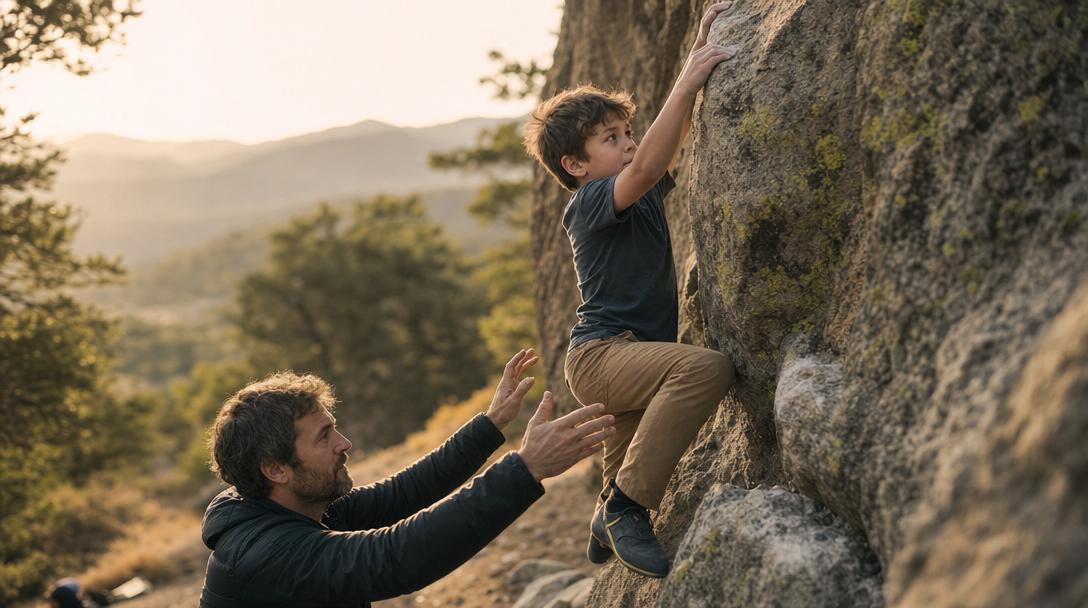
Look back at the photo at the top of this essay. The parent is not carrying the child up the rock. But they are not sitting in the car, either. They are a spotter — hands close, ready to catch, and letting the child do the actual climbing. That is the job. Not absent. Not intervening. Present, and restrained. The skill you are building in yourself is calibration: keep the difficulty in the narrow band where your child can just barely succeed, and hold your hands close enough to catch them — and still enough to let them climb.
Why you can’t do this alone
Now the part I have to be honest about, because it is the part that makes or breaks everything above. Volition is brutally hard to sustain at a single kitchen table. It needs stakes. It needs structure. And more than anything, it needs peers — other kids climbing nearby, which is the oldest engine of human effort there is. A child will run a mental marathon for a teammate, a rival, a club, an audience long after they would have quit running it for a worksheet, or for you.
This is precisely why the job historically belonged to schools, and precisely what a lone child with a chatbot will never have. A parent can protect the struggle at home, and should. But turning a good month into a durable disposition usually takes a structure outside the house.
This is the reason I build what I build
The student workshops. The ongoing AI club. The MillionRoots programs. None of them are a substitute for what you do at your kitchen table — they are the scaffolding that makes it last: a cohort of other curious kids, real projects with real stakes, and adults whose whole job is to keep the fire lit when home life gets busy and the worksheet always wins.
Protect the hunger at home. Let a community help you sustain it.

You can’t wait for the school. But you were never as powerless as that sentence makes you sound. The biggest variable in whether your child meets the AI age as its author or its passenger is not their school, their test scores, or even the tools in their hands. It is whether the people who love them protected their hunger — or fed it, one frictionless afternoon at a time, into a screen.
That work starts at your kitchen table, this week, with one hard thing your child actually wants — and your hands held close, but still.
Teach them to want. You don’t need anyone’s permission — or any committee’s — to begin.
For every parent who refuses to outsource their child’s hunger.
You are the spotter. Stay close. Let them climb.
— VJ
A note on how I write
I am not a writer. I am a person with strong opinions and scattered notes. Every essay on this site started as a messy brain-dump — half-formed arguments, bullet points, and “you know what I mean” — that I hand to an LLM. Another LLM handles the background research needed to find the facts that support an argument. And then it all gets translated into writing far too good for me to pretend is mine. The ideas are mine. The craft is not. They say blogs are dead — but I am falling in love with this. It gives me an outlet for expression that would otherwise have stayed buried in my head. I believe you deserve to know all of that.